At a glance
Schedule H is attached to a Form 5500 filed for a pension or welfare plan that “covered 100 or more participants as of the beginning of the plan year”, and to the Form 5500 filed for an MTIA, CCT, PSA, 103-12 IE, DCG or GIA. If you are not sure the plan is large, start with the 100-participant rule.
Three exceptions keep a plan off Schedule H. Fully insured, unfunded or combination welfare plans and fully insured pension plans that meet 29 CFR 2520.104-44 are exempt. A plan that filed Schedule I or a Form 5500-SF for 2024 and covered fewer than 121 participants at the start of 2025 may file Schedule I instead (the 80-120 rule). And a plan that files the Form 5500-SF for 2025 does not file Schedule H at all.
Check box 10b(1) on the Form 5500 when Schedule H is attached. “Do not attach both a Schedule H and a Schedule I to the same Form 5500.” The schedule is due with the Form 5500, which “must be filed by the last day of the 7th calendar month after the end of the plan, DCG or GIA year”, and it is filed the same way: “Your 2025 Form 5500 must be electronically filed in the ERISA Filing Acceptance System (EFAST2).” You may use the cash, modified cash or accrual basis, as long as you use one method consistently, and every amount is rounded to the nearest dollar.
Schedule H usually comes with an audit. A plan filing Schedule H generally must engage an independent qualified public accountant and attach the IQPA's report, unless line 3d(1) or 3d(2) applies. “If the required IQPA's report is not attached to the Form 5500, the filing is subject to rejection as incomplete and penalties may be assessed.”
The form, page by page
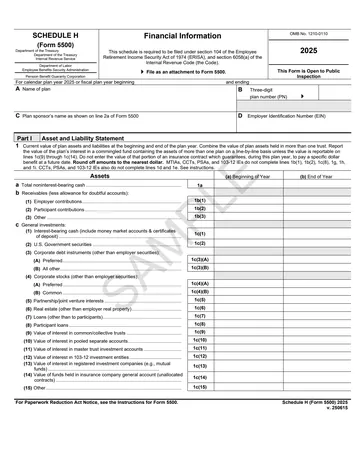
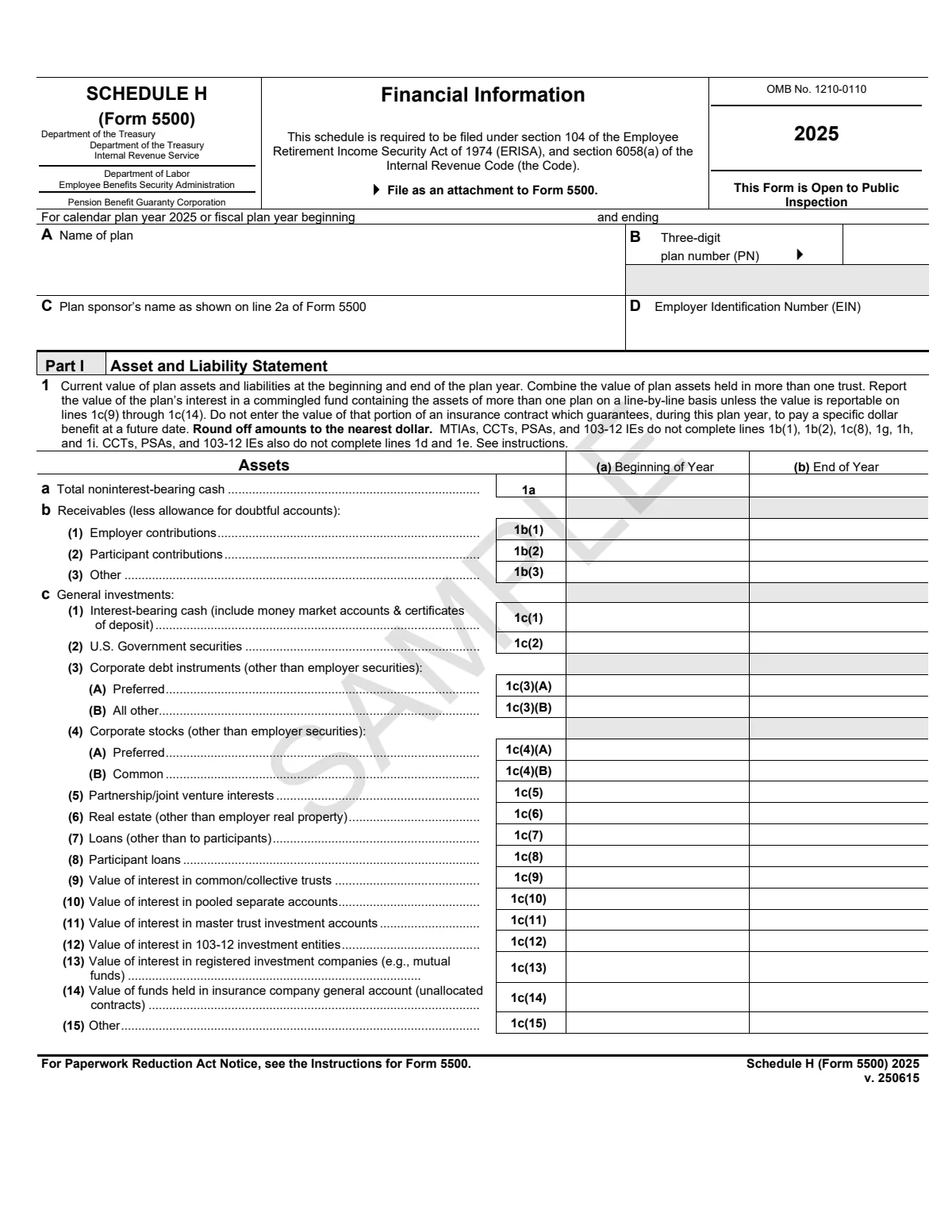
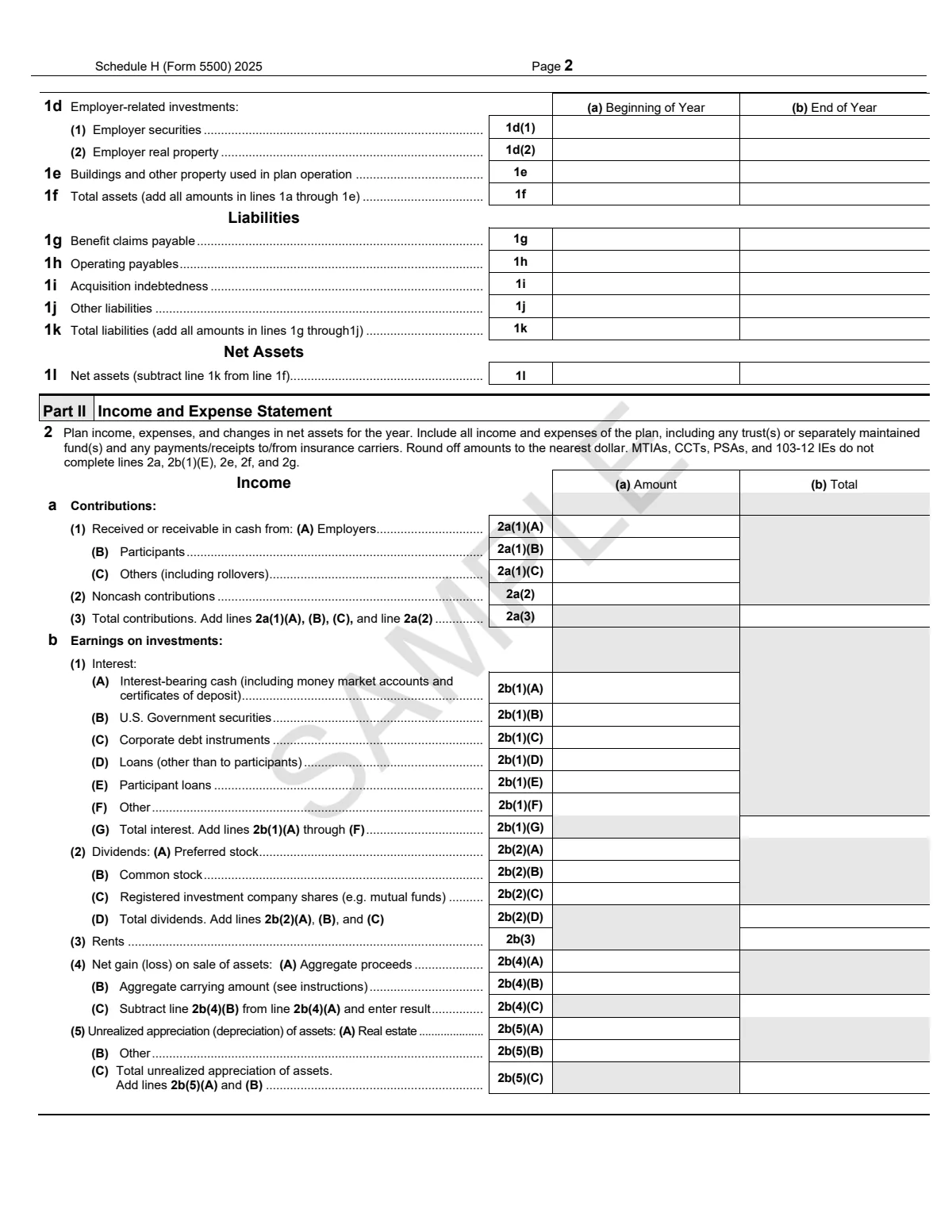
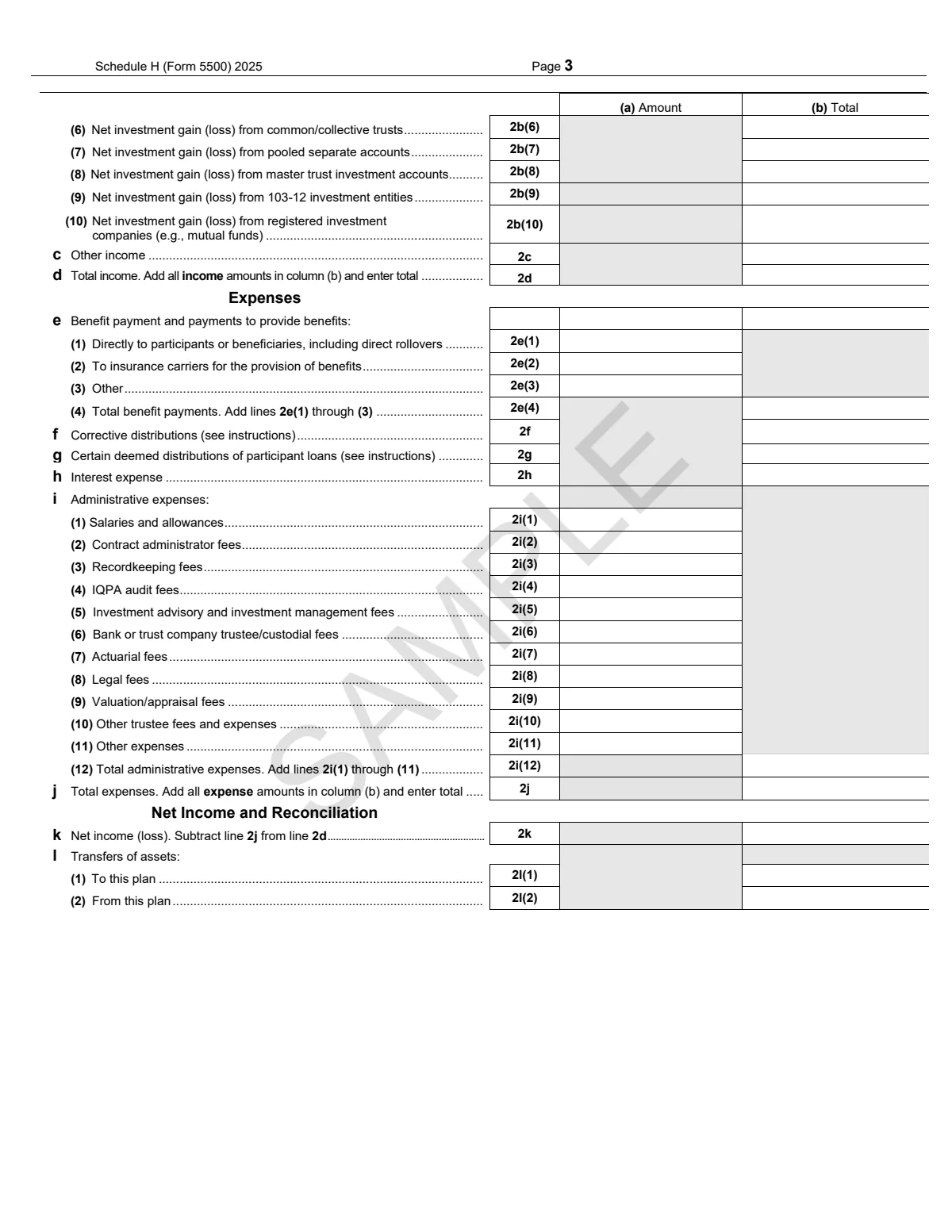
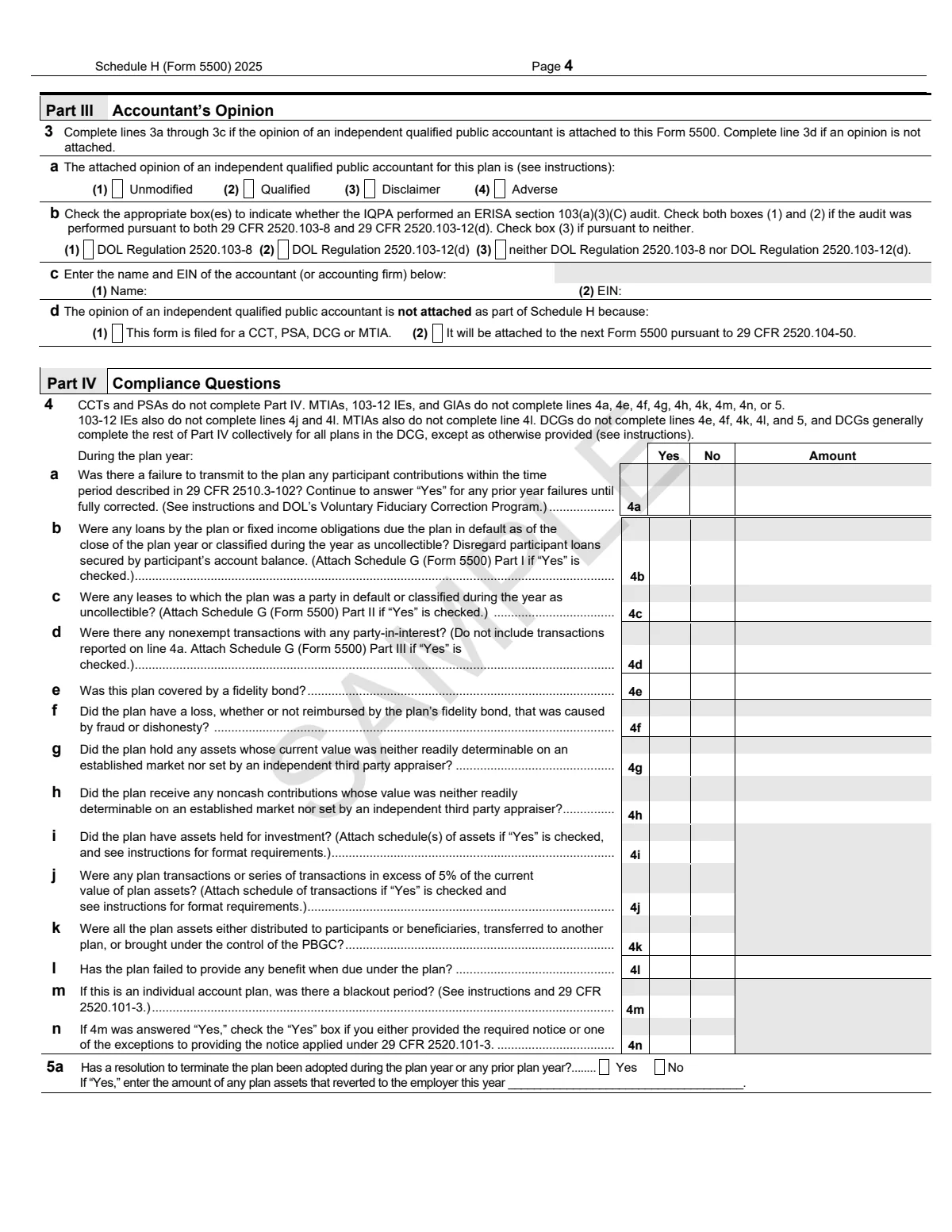
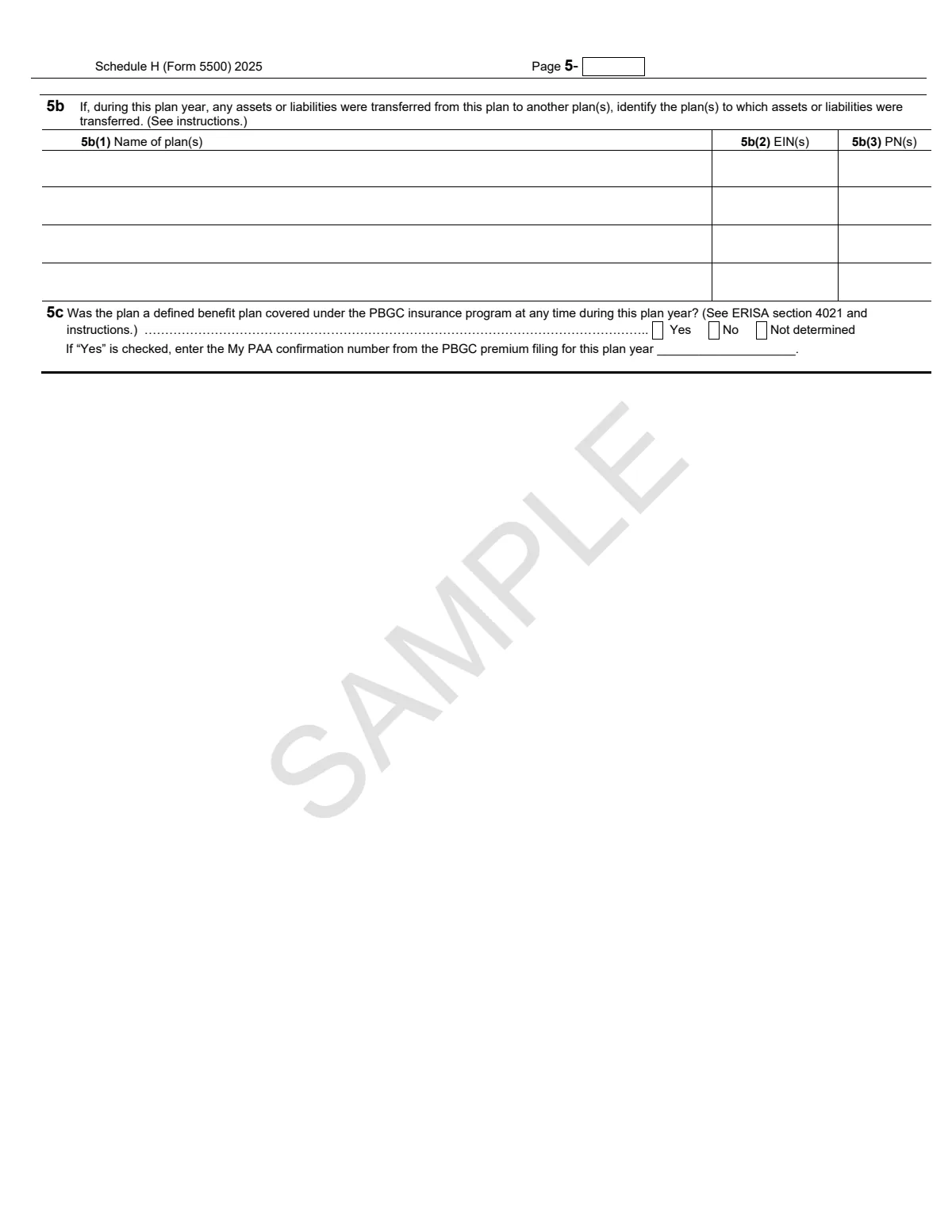
The 2025 Schedule H has five pages: the balance sheet on pages 1 and 2, the income statement on pages 2 and 3, the opinion and compliance questions on page 4, and line 5 on pages 4 and 5. Each box jumps to its row below.
Swipe sideways to see the whole page, or pinch to zoom. Tap a box once for its note, again to jump to the line.
Part I: assets and liabilities
Columns (a) and (b) are current value at the beginning and end of the year: fair market value where available, otherwise fair value set in good faith by a trustee or named fiduciary (ERISA section 3(26)). Combine assets held in more than one trust, and leave contributions designated for 2025 out of column (a).
| Line | Label | What goes there |
|---|---|---|
| A-D | Plan name, plan number, sponsor, EIN | Must match Part II of the Form 5500. Use the sponsor's EIN, never a Social Security number: the schedule is public, and an SSN on it or on an attachment may cause the filing to be rejected. |
| 1a | Total noninterest-bearing cash | Cash on hand and cash in a checking account that pays no interest. |
| 1b | Receivables: (1) employer contributions, (2) participant contributions, (3) other | Noncash basis filers only. 1b(1) is employer contributions due but unpaid, not expense reimbursements or loan repayments the employer owes. 1b(2) is participant contributions withheld or due but not yet received, not participant loan repayments. 1b(3) is everything else due, such as investment income earned but not received. |
| 1c(1) | Interest-bearing cash | Interest-bearing checking, passbook savings and money market accounts. |
| 1c(2) | U.S. Government securities | Securities issued or guaranteed by the U.S. Government or its agencies, such as Treasury bonds and bills, FNMA and GNMA. |
| 1c(3) | Corporate debt instruments: (A) preferred, (B) all other | Corporate bonds, debentures and commercial paper, other than employer securities. Preferred means publicly traded on a recognized exchange and rated A or above; the rest is All other. |
| 1c(4) | Corporate stocks: (A) preferred, (B) common | Stock of corporations other than the employer: preferred (with preferential rights) or common. Warrants go with the class they convert into. |
| 1c(5) | Partnership/joint venture interests | Only if the underlying assets are not plan assets under 29 CFR 2510.3-101. An interest in a 103-12 IE goes on 1c(12). |
| 1c(6) | Real estate (other than employer real property) | Income and non-income producing real property. Employer real property goes on 1d(2), property used in plan operations on 1e. |
| 1c(7) | Loans (other than to participants) | Construction, securities and mortgage loans not subject to Code section 72(p), made or bought by the plan. |
| 1c(8) | Participant loans | Unpaid principal plus accrued unpaid interest. A loan deemed distributed this year leaves column (b) only if it is a directed investment solely of the participant's account and the participant is not repaying at year end; it then goes on line 2g. If either condition fails, the loan stays here. |
| 1c(9)-(12) | Interest in CCTs, PSAs, MTIAs and 103-12 IEs | The plan's interest in each DFE, with the year-end value of each also reported on Schedule D. A CCT or PSA that filed no DFE Form 5500 cannot go here: allocate its underlying assets to the other Part I lines. |
| 1c(13) | Registered investment companies | Mutual funds, closed-end funds and unit investment trusts registered under the Investment Company Act of 1940. |
| 1c(14) | Insurance company general account (unallocated contracts) | Use the valuation method used on Schedule A line 4, or line 7 if line 4 is not required. See the Schedule A guide. |
| 1c(15) | Other | Options, index futures, state and municipal securities, collectibles and other personal property. A plan with pension feature code 2R may report brokerage window assets here in total, except loans, partnership interests, real property, employer securities and investments that could lose more than the account balance. |
| 1d | Employer-related investments: (1) employer securities, (2) employer real property | Securities issued by an employer of covered employees or an affiliate, and real property leased to the employer or an affiliate. |
| 1e | Buildings and other property used in plan operation | Current, not book, value. Property held as an investment goes on 1c(6) or 1d(2). |
| 1f | Total assets | Add lines 1a through 1e. “Amounts reported in column (a) must be the same as reported for the end of the plan year for corresponding line items of the return/report for the preceding plan year.” |
| 1g | Benefit claims payable | Noncash basis plans: claims approved for payment. Welfare plans include incurred but not reported (IBNR) claims. |
| 1h | Operating payables | Noncash basis plans: approved but unpaid obligations from normal operations. |
| 1i | Acquisition indebtedness | Debt incurred to acquire or improve property other than real property (Code section 514(c)). |
| 1j | Other liabilities | Noncash basis plans: any other amount owed. |
| 1k | Total liabilities | Add lines 1g through 1j. Never include the value of future pension payments. |
| 1l | Net assets | Line 1f minus line 1k. “The entry in column (b) must equal the sum of the entry in column (a) plus lines 2k and 2l(1), minus 2l(2).” |
Part II: income and expenses
Part II covers all plan income and expenses, including trusts and insurance carrier payments. MTIAs, CCTs, PSAs and 103-12 IEs skip lines 2a, 2b(1)(E), 2e, 2f and 2g.
| Line | Label | What goes there |
|---|---|---|
| 2a(1) | Cash contributions: (A) employers, (B) participants, (C) others including rollovers | Received and, for accrual basis plans, due, without contributions designated for years before 2025. Participant contributions include 401(k) deferrals and, for welfare plans, cafeteria plan contributions. |
| 2a(2) | Noncash contributions | Current value on the date contributed. |
| 2a(3) | Total contributions | Lines 2a(1)(A) to (C) plus 2a(2). |
| 2b(1) | Interest, (A) to (F), total on (G) | Interest on the matching Part I assets: interest-bearing cash, government securities, corporate debt, other loans, participant loans and other. |
| 2b(2) | Dividends, (A) to (C), total on (D) | Preferred, common and mutual fund dividends. Accrual basis plans include dividends declared but not received by year end. |
| 2b(3) | Rents | Net rents: rent received minus expenses directly tied to the property. |
| 2b(4) | Net gain (loss) on sale of assets | For assets sold during the year: (A) proceeds, (B) beginning-of-year value or, for assets bought during the year, purchase price, (C) the difference. Bond write-offs are realized losses. |
| 2b(5) | Unrealized appreciation (depreciation) | Year-end value minus beginning value plus cost of assets acquired, for assets not reported on 2b(4) or 2b(6) to 2b(10). |
| 2b(6)-(9) | Net investment gain (loss) from CCTs, PSAs, MTIAs and 103-12 IEs | Year-end value of the plan's interest minus beginning value, plus transfers out, minus transfers in. CCT and PSA results go here whether or not the entity filed as a DFE. |
| 2b(10) | Net investment gain (loss) from registered investment companies | Same method, leaving out dividends reported on 2b(2)(C). |
| 2c | Other income | Income not on 2a or 2b. Transfers from other plans go on 2l. |
| 2d | Total income | All income in column (b). |
| 2e | Benefit payments, (1) to (3), total on (4) | Direct payments to participants, including eligible rollover distributions; payments to insurers, Blue Cross Blue Shield and HMOs for benefits; and payments to other providers such as legal or day care services. |
| 2f | Corrective distributions | Excess deferrals, excess contributions and excess aggregate contributions distributed, with income, and elective deferrals or employee contributions returned. |
| 2g | Certain deemed distributions of participant loans | Only loans meeting both conditions on 1c(8). If repayment resumes on a loan reported earlier, reduce 2g by that amount and put the loan back on 1c(8). |
| 2h | Interest expense | Interest on money the plan borrowed. |
| 2i(1) | Salaries and allowances | Pay and benefits of plan employees, including those doing recordkeeping or accounting work. |
| 2i(2) | Contract administrator fees | A firm managing the plan's clerical operations under contract. Not plan staff, banks or insurers. |
| 2i(3) | Recordkeeping fees | Recordkeeping and other accounting fees, such as payroll audits, other than contract administrator and IQPA fees. |
| 2i(4) | IQPA audit fees | The annual audit and related work. |
| 2i(5) | Investment advisory and management fees | Managing the portfolio, investment advice and performance evaluation. |
| 2i(6)-(10) | Trustee/custodial, actuarial, legal, valuation and other trustee fees | Bank or trust company fees; actuarial fees, including Schedule MB or SB; legal fees for the plan, not legal benefits; appraisals; and other trustee fees and expenses such as travel. |
| 2i(11) | Other expenses | Office supplies, telephone, postage, rent and building costs, plus PBGC premiums paid from plan assets. |
| 2i(12) | Total administrative expenses | Lines 2i(1) to 2i(11). |
| 2j | Total expenses | All expenses in column (b). |
| 2k | Net income (loss) | Line 2d minus line 2j. |
| 2l | Transfers of assets: (1) to this plan, (2) from this plan | Assets or liabilities moved between plans, as in mergers. Not a shift between investments and not a distribution reported on Form 1099-R. |
Part III: accountant's opinion
Complete lines 3a to 3c when the IQPA's opinion is attached, and line 3d when it is not. The IQPA requirement comes from ERISA section 103(a)(3)(A) and 29 CFR 2520.103-1(b), and it applies to 103-12 IEs and GIAs too. For a DCG, the opinion is reported plan by plan on each Schedule DCG.
| Line | Label | What goes there |
|---|---|---|
| 3a | Type of opinion: (1) unmodified, (2) qualified, (3) disclaimer, (4) adverse | “The Plan Administrator should confirm with their IQPA whether the opinion was an unmodified, qualified, disclaimer of, or adverse opinion before answering line 3a.” |
| 3b | ERISA section 103(a)(3)(C) audit | Box 1 for an audit under 29 CFR 2520.103-8 (assets held by a regulated bank or insurer that certifies the information), box 2 for 2520.103-12(d) (investments in a 103-12 IE), both if both, box 3 if neither. “Neither of these regulations exempt the plan administrator from engaging an IQPA nor from attaching the IQPA's report to the Form 5500.” |
| 3c | Accountant's name and EIN | The accountant or firm and its EIN, never an SSN. |
| 3d | Opinion not attached: (1) CCT, PSA, DCG or MTIA, (2) deferred under 29 CFR 2520.104-50 | Box 1 only for a CCT, PSA, DCG or MTIA. Box 2 defers the opinion for the first of two plan years when one is a short year of seven months or fewer; the next filing carries audited statements for both years. 103-12 IEs and GIAs cannot defer. |
Part IV: compliance questions
Every plan filing Schedule H answers lines 4a to 4n Yes or No; the instructions say not to leave any answer blank unless directed. For lines 4a to 4h and 4l, a Yes needs an amount. Report investments in CCTs, PSAs, MTIAs and 103-12 IEs, but not the investments those entities make.
| Line | Label | What goes there |
|---|---|---|
| 4a | Failure to transmit participant contributions on time | Participant contributions become plan assets as soon as they can reasonably be segregated from the employer's assets (29 CFR 2510.3-102). If Yes, enter the year's late total and attach the Schedule of Delinquent Participant Contributions. “All delinquent participant contributions must be reported on line 4a even if violations have been corrected.” Corrections under VFCP that meet PTE 2002-51 need not be treated as nonexempt transactions, and the instructions relieve those filers from Form 5330. |
| 4b | Loans or fixed income obligations in default or uncollectible | Amount plus Schedule G, Part I. Leave out participant loans secured by the vested account balance. |
| 4c | Leases in default or uncollectible | Amount plus Schedule G, Part II. |
| 4d | Nonexempt transactions with a party-in-interest | Amount plus Schedule G, Part III, even if the IQPA's report discloses it. Exempt transactions and late contributions already on 4a are left out. |
| 4e | Fidelity bond | Yes “only if the plan itself (as opposed to the plan sponsor or administrator) is a named insured under a fidelity bond”. Enter the coverage. Fiduciary liability insurance does not count. |
| 4f | Loss from fraud or dishonesty | Yes even if reimbursed. Enter the full amount or a good faith estimate. Willful failure to report is a crime under ERISA section 501. |
| 4g | Hard-to-value assets | Assets with no market value that no independent appraiser valued this year. Not mutual funds or insurance contracts valued at least annually, and, in a defined contribution plan, not participant loans that are not in default or 404(c) assets. |
| 4h | Hard-to-value noncash contributions | The same test, for noncash contributions. |
| 4i | Assets held for investment | Attach the Schedule of Assets (Held At End of Year) and, if any, (Acquired and Disposed of Within Year). Mark parties-in-interest with an asterisk. Participant loans may be aggregated. |
| 4j | Transactions over 5% of plan assets | Attach the Schedule of Reportable Transactions. Measure 5% against beginning-of-year assets. Participant-directed transactions are not reportable. |
| 4k | All assets distributed or transferred | Yes if all assets went to participants, another plan or PBGC. A welfare plan with unpaid pre-termination claims checks No. |
| 4l | Benefits not paid when due | Includes late required minimum distributions and earlier unpaid amounts. Unpaid RMDs for participants who cannot be located after reasonable efforts need not be reported. |
| 4m | Blackout period | A suspension of more than three consecutive business days on investment changes, loans or distributions. Disclosed routine suspensions and QDRO holds generally do not count. |
| 4n | Blackout notice | Yes if notice went out 30 to 60 days ahead, or an exception in 29 CFR 2520.101-3 applied. |
Line 5: termination, transfers and PBGC
Line 5 sits at the bottom of page 4 and carries over to page 5. MTIAs, 103-12 IEs, GIAs and DCGs do not complete it.
| Line | Label | What goes there |
|---|---|---|
| 5a | Resolution to terminate the plan | Yes if adopted this year or earlier and not revoked. Enter any reversion to the employer, or 0. A Form 5500 is due each year the plan has assets. |
| 5b | Assets or liabilities transferred to other plans | Name, sponsor EIN and plan number of each transferee plan. Not 1099-R distributions. Form 5310-A may be due at least 30 days before a merger or transfer. |
| 5c | PBGC coverage | ““Yes” must be checked even if coverage has ceased and/or final premiums have been paid before the Form 5500 is due.” Enter the My PAA confirmation number for this year's premium filing. Defined contribution and welfare plans skip this line. |
Who skips which Part IV lines
| Filer | Lines not completed |
|---|---|
| CCTs and PSAs | All of Part IV |
| MTIAs | 4a, 4e, 4f, 4g, 4h, 4k, 4l, 4m, 4n and line 5 |
| 103-12 IEs | 4a, 4e, 4f, 4g, 4h, 4j, 4k, 4l, 4m, 4n and line 5 |
| GIAs | 4a, 4e, 4f, 4g, 4h, 4k, 4m, 4n and line 5 |
| DCGs | 4e, 4f, 4k, 4l and line 5; the rest is answered for all plans in the DCG together |
| Plans with all funds in a master trust | Answer No on 4b, 4c, 4i and 4j |
Required attachments
Several Schedule H answers trigger an attachment. EFAST2 checks for them by attachment type, so label each one as the instructions require.
| Trigger | Attachment |
|---|---|
| Line 3 (unless 3d(1) or 3d(2) is checked) | The IQPA's report: opinion, financial statements, notes and supplemental schedules |
| 4a Yes | Schedule H Line 4a: Schedule of Delinquent Participant Contributions |
| 4b, 4c or 4d Yes | Schedule G, Part I, II or III |
| 4i Yes | Schedule H, line 4i: Schedule of Assets (Held At End of Year), and Schedule of Assets (Acquired and Disposed of Within Year) if any |
| 4j Yes | Schedule H, line 4j: Schedule of Reportable Transactions |
| 3d(2) checked | A statement explaining the short plan year and that next year's report will include the IQPA's report for both years |
A line 4j reportable transaction is a single transaction over 5% of plan assets, a series of non-securities transactions with one person over 5% in total, a series in securities of one issue over 5% in total, or any securities transaction with a person who also had a single securities transaction over 5% that year.
Common mistakes and EFAST2 checks
- No accountant's opinion. EFAST2 error P-204 flags a Schedule H with assets or liabilities and no opinion attached, and P-205 flags a missing opinion with neither 3d(1) nor 3d(2) checked. The DOL's error list says the filing “will be incomplete and may be subject to further review, correspondence, rejection, and civil penalties”.
- Line 4i answered Yes with no schedule of assets. Error P-317 says that even if the schedule is in the accountant's report, “you must still attach a statement”.
- Beginning balances that do not match last year. Warning Z-008 compares the beginning-of-year total assets on line 1f with the end-of-year total from last year's return.
- Blank Part IV answers. The EFAST2 filing tips say plans filing Schedule H “must answer all items in Part IV, Lines 4a through 4n and Line 5”.
- Filing Schedule H and Schedule I together, or leaving box 10b(1) unchecked on the Form 5500.
- Social Security numbers on the schedule or an attachment. The schedule is public and may be rejected for an SSN.
An incomplete filing is exposed to the DOL's civil penalty of up to $2,739 a day under ERISA 502(c)(2) for a plan administrator who fails or refuses to file a complete and accurate report (the 2025 amount, 90 FR 1854; the DOL made no 2026 adjustment, 91 FR 31358). See Form 5500 penalties.
Questions filers ask
Do we file Schedule H or Schedule I?
Schedule H if the plan files as a large plan, generally 100 or more participants at the start of the plan year, and for every DFE. A plan between 80 and 120 participants may file in the same category as last year under the 80-120 rule.
Does a limited-scope audit under 29 CFR 2520.103-8 mean no accountant's report?
No. The instructions say neither 2520.103-8 nor 2520.103-12 exempts the administrator from engaging an IQPA or from attaching the report. Check box 1 or 2 on line 3b and the opinion type on line 3a.
We fixed late deferrals through VFCP. Do they still go on line 4a?
Yes. All delinquent participant contributions are reported on line 4a even if corrected, through the plan year in which the correction is complete. Corrections that meet PTE 2002-51 are not treated as nonexempt transactions.
Our schedule of assets is inside the audit report. Do we attach it again?
Yes. EFAST2 error P-317 says you must still attach a statement, using the Schedule of Assets (Held at End of Year) attachment type.
Can we defer the audit for a short plan year?
Only for the first of two consecutive plan years where one is seven months or fewer, by checking line 3d(2). The next year's Form 5500 then includes audited statements for both years. 103-12 IEs and GIAs cannot defer.