At a glance
Every pension and welfare plan covered by ERISA files an annual return/report unless an exemption applies (see which Form 5500 to file). The full Form 5500 is the default. “If you are a small plan (generally under 100 participants at the beginning of the plan year), you may be eligible to file the Form 5500-SF instead of the Form 5500.” Plans that cannot use the Form 5500-SF (multiemployer plans, pooled employer plans, plans with hard-to-value assets or that need an audit) and every DFE use this form. One-participant plans use the Form 5500-EZ.
| Question | Answer for the 2025 Form 5500 |
|---|---|
| Who files | The plan administrator of each covered plan not eligible for the 5500-SF or 5500-EZ; MTIAs; other DFEs that choose to file |
| Due date | Last day of the 7th calendar month after the plan year ends (July 31 for a calendar year); DFEs other than DCGs and GIAs get 9½ months. See Form 5500 due date |
| Extension | Form 5558 (up to 2½ months) or the automatic extension tied to the employer's tax return |
| How filed | Electronically in EFAST2, using IFILE or EFAST2-approved software. “You cannot file a paper Form 5500 by mail or other delivery service.” |
| Public? | Yes, posted on the internet, so an SSN anywhere in the filing can get it rejected |
| Penalty | DOL civil penalty up to $2,739 a day under ERISA section 502(c)(2) (2025 amount, 90 FR 1854; no 2026 adjustment, 91 FR 31358); IRS penalty under Code section 6652(e) |
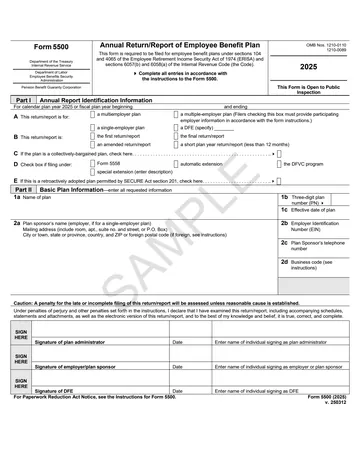
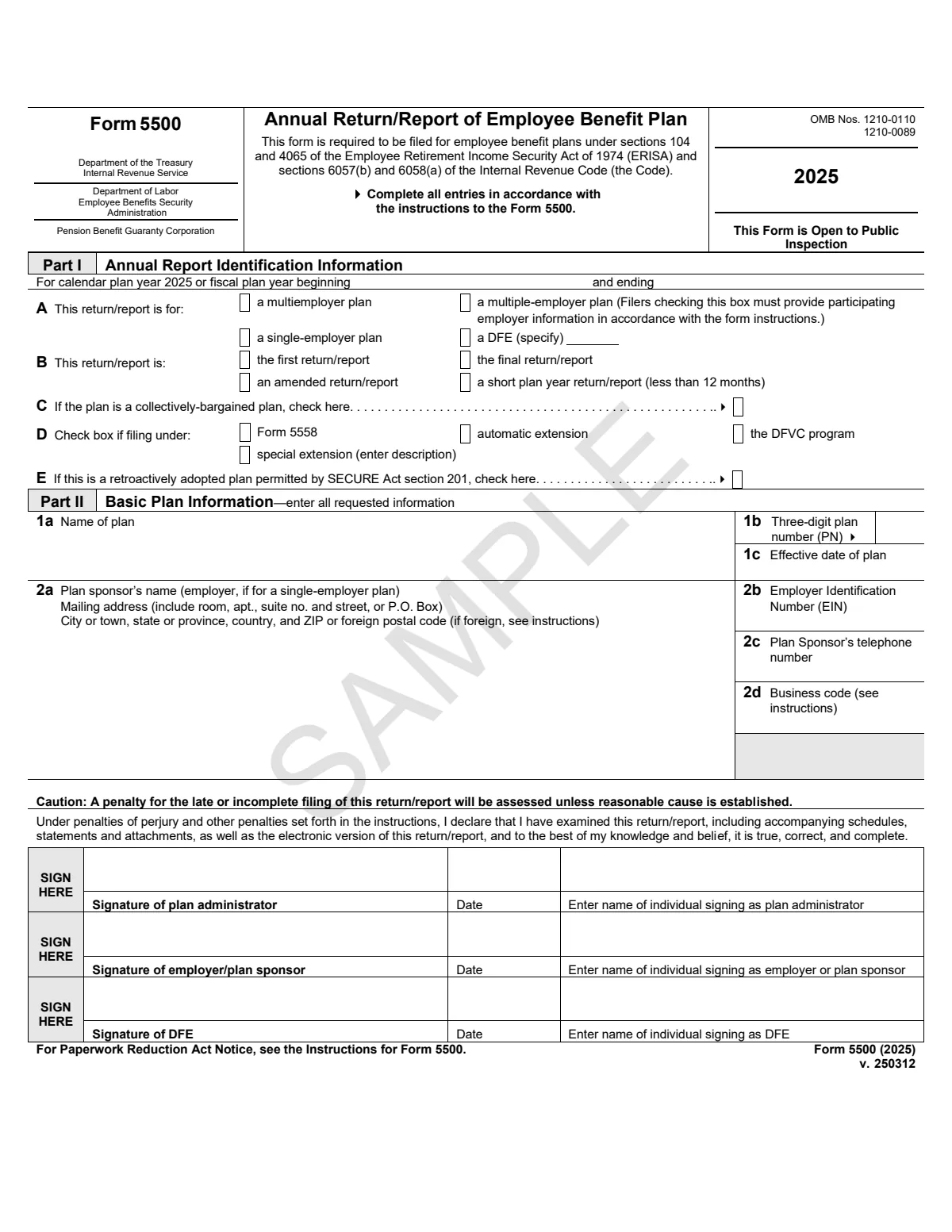
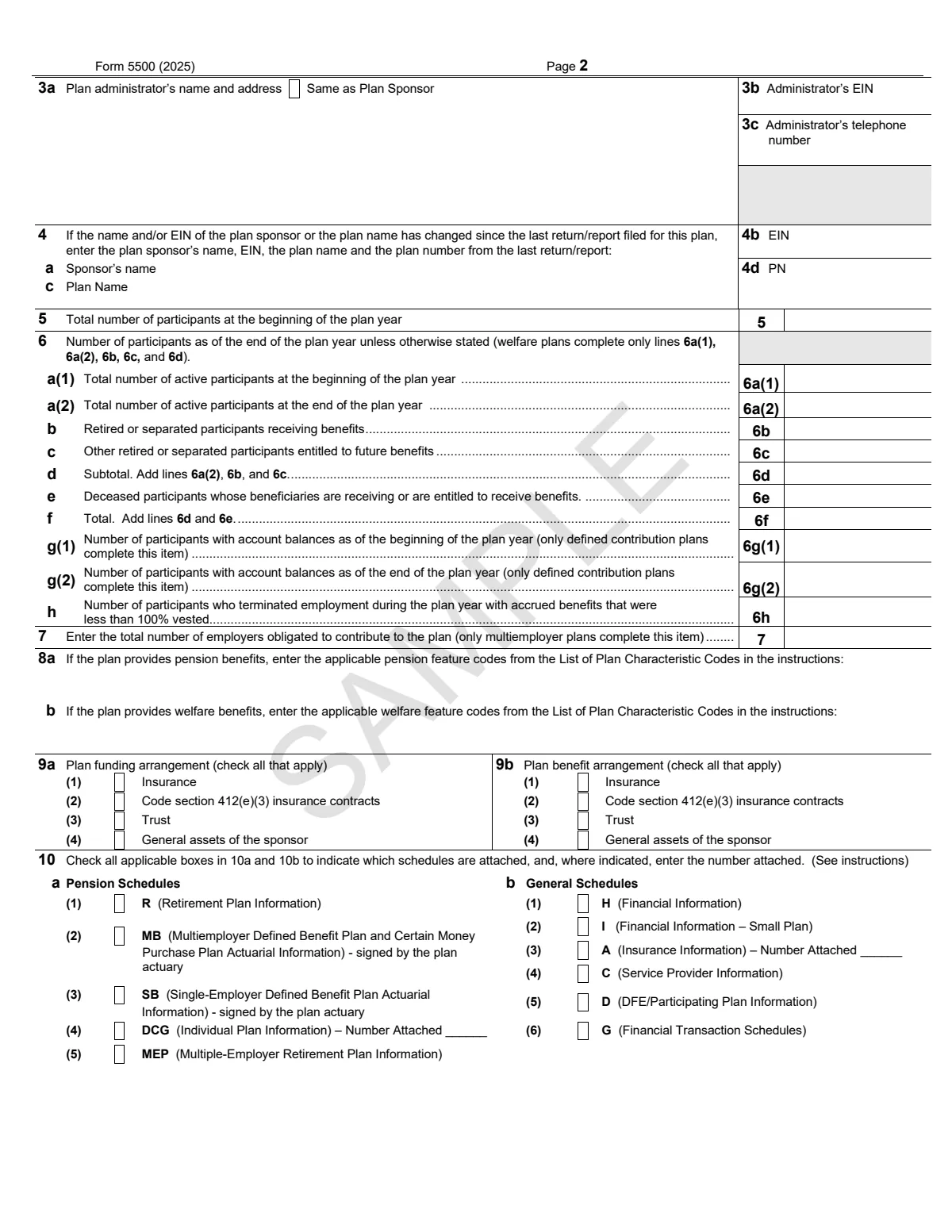
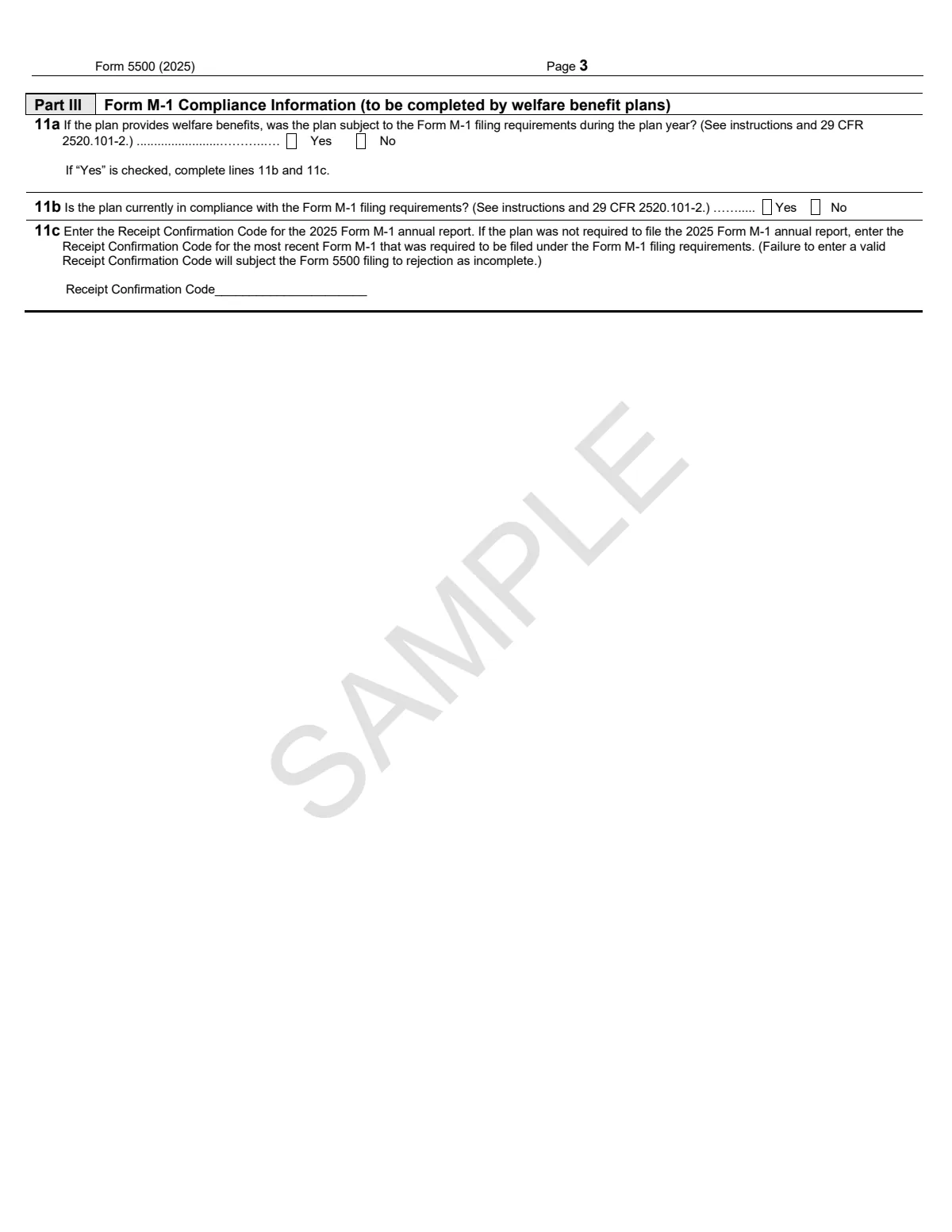
The image below is the DOL's informational copy. The DOL's forms page labels these copies “For Information Purposes Only, Not to be Used for Filing”: you complete the same lines in EFAST2 or your software, which builds the electronic return.
The form, line by line
Hover over or tap any box on the form to see what goes there; click it to jump to that line's full note below. Use the page buttons to move between pages 1 to 3.
Swipe sideways to see the whole page, or pinch to zoom. Tap a box once for its note, again to jump to the line.
Part I: identification
Part I tells EFAST2 what kind of return this is. The answers drive which edit checks run, so get them right before anything else.
| Line | Label | What goes there |
|---|---|---|
| Year | Plan year beginning and ending | The 2025 form is for plan, DCG and GIA years that began in 2025; a plan whose year is not the calendar year fills in its fiscal year beginning and ending dates. A short plan year gets its own dates here plus the short plan year box on line B. If the 2026 form is not out before a filing is due, the instructions say to use the 2025 form and enter the 2026 fiscal year dates. The EFAST2 filing tips add a check: make sure there is no gap between last year's ending date and this year's beginning date. |
| A | This return/report is for | “Do not check more than one box.” A controlled group under Code section 414(b), (c) or (m) is generally one employer. A multiple-employer pension plan (including a pooled employer plan) attaches Schedule MEP; a multiple-employer welfare plan attaches a participating employer list instead. A DFE enters M (MTIA), C (CCT), P (PSA), E (103-12 IE), D (DCG) or G (GIA). |
| B | This return/report is | First return: no annual return/report was ever filed for the plan (an earlier Form 5500-EZ does not count). Amended: a 2025 filing already has a Filing_Received, Filing_Error or Filing_Stopped status; resubmit the entire filing with every schedule. Final: “Do not mark the final return/report box if you are reporting participants and/or assets at the end of the plan year.” A small welfare plan leaving the filing system enters code 4R on line 8b instead. |
| C | Collectively-bargained plan | Check it even if the plan is not run by a joint board of trustees. Contributions and benefits do not have to be identical for all employees. |
| D | Check box if filing under | Form 5558: keep a copy of the request. Automatic extension: the plan year and the employer's tax year match and the employer has an income tax extension; keep a copy of it. Special extension: one announced by the IRS, DOL and PBGC, such as disaster relief; describe it. DFVC: “Checking this box does not enter you in the DFVC Program.” You apply and pay separately; see DFVCP. |
| E | Retroactively adopted plan (SECURE Act section 201) | No 2024 Form 5500 is required for such a plan. A defined benefit plan includes the 2024 Schedule SB as an attachment to the 2025 Schedule SB. |
Part II: basic plan information
Lines 1 to 4 identify the plan, the sponsor and the administrator. Lines 5 to 7 are participant counts, and lines 8 to 10 describe the plan and list the schedules. The participant definitions below apply only to lines 5 and 6.
| Line | Label | What goes there |
|---|---|---|
| 1a | Name of plan | Abbreviate if necessary, then keep the same name or abbreviation on every later filing and never reuse it for another plan. EFAST2 warning Z-003 fires when line 1a does not match last year's plan name. |
| 1b | Three-digit plan number (PN) | The PN plus the EIN on line 2b is the 12-digit number the IRS, DOL and PBGC use to identify the plan. Start at 001 for plans that provide pension benefits (alone or with welfare benefits) and for DFEs, and at 501 for plans that provide only welfare benefits and for GIAs. “Do not use 888 or 999.” A plan already numbered 333 or higher in a 333 sequence may keep that number. |
| 1c | Effective date of plan | Enter the date the plan first became effective. |
| 2a | Plan sponsor's name and address | A multiple-employer plan with no association or other sponsor names one participating employer, and a controlled group names one member; the same name is then used in every later filing. A P.O. box is allowed only if the Post Office does not deliver to the street address. Use IRS Form 8822-B to tell the IRS about a business address change. |
| 2b | Employer Identification Number (EIN) | Enter the sponsor's nine-digit EIN, or the EIN of the CCT, PSA, MTIA, 103-12 IE, DCG or GIA for a DFE. “Do not use a social security number in lieu of an EIN.” The EBSA does not issue EINs; apply to the IRS. A trust EIN is generally not entered here. Report any EIN change on line 4. |
| 2c | Plan sponsor's telephone number | Enter the plan sponsor's telephone number using numbers only, including the area code, with no special characters. |
| 2d | Business code | Use only a code from the 2025 list; last year's code may no longer be valid. Do not use 525100 (insurance and employee benefit funds) or 813930 (labor unions) unless that really is the active participants' industry. |
| 3a | Plan administrator's name and address | The administrator is the person or group named in the plan instrument, the pooled plan provider for a pooled employer plan, the PEO for a PEO plan, the common administrator for a DCG, or else the sponsor. “Employees of the plan sponsor who perform administrative functions for the plan are generally not the plan administrator unless specifically designated in the plan document.” A pooled employer plan's entries must match its Form PR. |
| 3b | Administrator's EIN | A plan administrator must have an EIN for Form 5500 reporting. A group of individuals who together are the administrator uses one EIN. An employee of the sponsor who is designated as administrator must get an EIN. |
| 3c | Administrator's telephone number | Enter the plan administrator's telephone number using numbers only, including the area code, with no special characters. |
| 4 | Change in sponsor name, EIN or plan name (4a to 4d) | Enter the sponsor's name (4a), EIN (4b), plan name (4c) and plan number (4d) as they appeared on the last return/report. Skipping it after a change can lead to DOL or IRS correspondence, and EFAST2 warning Z-009 compares these items with last year's filing. |
| 5 | Total participants at the beginning of the plan year | All filers complete lines 5 and 6 except IRA plans, MTIAs, CCTs, PSAs and 103-12 IEs. In a welfare plan, COBRA continuees count, but “Covered dependents are not counted as participants.” Alternate payees under a QDRO are not counted in pension plans. Plans other than defined contribution pension plans use this line for the small plan (generally under 100) or large plan test; see the 80-120 rule. |
| 6a(1) | Active participants at the beginning of the plan year | Includes anyone eligible to elect 401(k) deferrals and nonvested employees still earning service; excludes nonvested former employees past the break in service period and former employees cashed out of their entire vested benefit. Welfare plans complete this line. |
| 6a(2) | Active participants at the end of the plan year | Same definition as 6a(1), counted at the end of the plan year. Welfare plans complete this line. |
| 6b | Retired or separated participants receiving benefits | Individuals retired or separated from covered employment who are receiving benefits from the plan, excluding anyone to whom an insurance company has made an irrevocable commitment to pay all benefits. Welfare plans complete this line. |
| 6c | Other retired or separated participants entitled to future benefits | Individuals retired or separated from covered employment who are entitled to begin receiving benefits in the future, again excluding anyone covered by an insurer's irrevocable commitment. Welfare plans complete this line. |
| 6d | Subtotal (6a(2) + 6b + 6c) | Add lines 6a(2), 6b and 6c. Welfare plans complete only lines 5, 6a(1), 6a(2), 6b, 6c and 6d. |
| 6e | Deceased participants whose beneficiaries receive or are entitled to benefits | Deceased individuals who had one or more beneficiaries receiving or entitled to receive benefits, excluding those covered by an insurer's irrevocable commitment. |
| 6f | Total (6d + 6e) | Add lines 6d and 6e. A plan that reports participants here at year end should not check the final return box. |
| 6g(1) | Participants with account balances, beginning of year | Enter the participants included on line 5 who had account balances at the beginning of the plan year. Since 2023 this is the count that sets a defined contribution plan's size: “A defined contribution pension plan uses the number required to be entered on line 6g(1), except that a defined contribution pension plan that checks the “first return/report” box on Part I, line B uses the number entered on line 6g(2).” |
| 6g(2) | Participants with account balances, end of year | For a 401(k) plan, that is everyone on 6f who has made a contribution, or had one made for them, for this or any earlier plan year. Defined benefit plans skip line 6g. |
| 6h | Participants who terminated with less than 100% vesting | Include each individual who terminated employment during the plan year with accrued benefits less than 100% vested, whether or not the person incurred a break in service, received an insurer's irrevocable commitment, or received a cash or deemed distribution. “Multiemployer plans and multiple-employer plans that are collectively bargained do not have to complete line 6h.” |
| 7 | Number of employers obligated to contribute | Only multiemployer plans complete line 7. Count each employer that, during 2025, was a party to the plan's collective bargaining agreement(s) or may otherwise owe withdrawal liability under ERISA section 4203. Contributing entities with the same EIN count as one employer. |
| 8a | Pension feature codes | Line 8 cannot be left blank. Codes run 1A to 1L (defined benefit), 2A to 2Y (defined contribution) and 3B to 3J (other). An eligible combined plan under Code section 414(x) enters codes for both parts; an IRA plan enters 2N. EFAST2 warning Z-005 compares these codes with last year's. |
| 8b | Welfare feature codes | Codes run 4A to 4U. Code 4R marks an unfunded, fully insured or combination welfare plan that will not file next year under 29 CFR 2520.104-20 (do not check the final box); code 4S marks such a plan that resumes filing after reaching 100 participants again. |
| 9a | Plan funding arrangement | Insurance means a contract or policy with an insurer, including GICs, but not when the insurer only provides administrative services. Trust covers any other fund or account. General assets of the sponsor means no assets, or assets commingled with the sponsor's. Checking 9a(1) or 9a(2) requires Schedule A, and EFAST2 cross-checks these boxes against Schedules H, I and A. |
| 9b | Plan benefit arrangement | The instructions' example: a plan holding mutual funds until it buys annuities checks 9a(3) and 9b(1). A 403(b)(1) annuity arrangement marks insurance in both; a 403(b)(7) custodial account marks trust in both. Checking 9b(1) or 9b(2) also requires Schedule A. |
| 10a | Pension schedules attached | Schedules MB and SB are signed by the plan's enrolled actuary. The EFAST2 filing tips put it simply: if you check a box for a schedule, that schedule must be in the submission. |
| 10b | General schedules attached | Schedule H is for large plans and DFEs, Schedule I for small plans. Attach as many Schedules A as the plan's insurance contracts need and enter the count on 10b(3). |
Part III: Form M-1 compliance
Part III is for plans that provide welfare benefits. Pension-only plans leave it blank.
| Line | Label | What goes there |
|---|---|---|
| 11a | Was the plan subject to the Form M-1 filing requirements? | It cannot be left blank. A MEWA or ECE subject to the Form M-1 requirements checks Yes and completes 11b and 11c. The 2025 Form M-1 annual report is due by March 1, 2026. |
| 11b | Is the plan currently in compliance with the Form M-1 filing requirements? | Every plan that answered Yes on line 11a must answer line 11b Yes or No. See 29 CFR 2520.101-2 for the Form M-1 rules. |
| 11c | Receipt Confirmation Code for the 2025 Form M-1 | The code appears under completed filings in the Form M-1 filing system. If no 2025 annual report was required, use the code for the most recent required Form M-1, such as a registration filing after an event late in 2025. A missing or invalid code “will subject the Form 5500 filing to rejection as incomplete” and to civil penalties. |
Signatures
The signature block is on page 1, but it is the last thing you complete. For Title I of ERISA the plan administrator is the filer, and a filing it does not sign is subject to further review, correspondence, rejection and civil penalties.
| Line | Label | What goes there |
|---|---|---|
| Sig-PA | Signature of plan administrator | “The plan administrator must electronically sign the Form 5500 or 5500-SF submitted to EFAST2.” The signer registers in EFAST2 through Login.gov as a Filing Signer. An entity administrator signs through an authorized person. An authorized service provider may sign under the e-signature option, attaching a PDF of the completed Form 5500 bearing the administrator's manual signature. A missing signature triggers EFAST2 error P-227. See how to file in EFAST2. |
| Sig-ER | Signature of employer/plan sponsor | “The Code permits either the plan sponsor/employer or the administrator to sign the filing.” Title I of ERISA still requires the plan administrator's signature. Per the EFAST2 error list, a person who is both sponsor and administrator signs only on the administrator line. |
| Sig-DFE | Signature of DFE | Used only when the Form 5500 is filed for a direct filing entity. For DFE filings, a person authorized to sign on behalf of the DFE must sign for the DFE. |
Rules that matter
Small plan or large plan
Size decides Schedule I or Schedule H, and whether an independent qualified public accountant must audit the plan. Fewer than 100 participants at the beginning of the year generally means a small plan. Defined contribution pension plans count only participants with account balances (line 6g(1)), and the 80-120 rule lets a plan with 80 to 120 participants stay in last year's category.
Which schedules go with which plan
| Schedule | Who attaches it |
|---|---|
| H / I | H: large plans and all DFEs, unless exempt (such as insured or unfunded welfare plans). I: small plans filing the Form 5500 |
| A | Benefits or investment contracts provided by an insurer; not for ASO contracts |
| C | Large plans and certain DFEs with a service provider paid $5,000 or more, or a terminated accountant or actuary |
| D / G | D: plans in MTIAs, CCTs, PSAs or 103-12 IEs, and DFE filings. G: Yes on Schedule H lines 4b, 4c or 4d |
| R, MB, SB | R: defined benefit plans and plans subject to Code section 412. MB: multiemployer and certain money purchase plans. SB: single-employer defined benefit plans |
| MEP / DCG | MEP: multiple-employer pension plans. DCG: each plan in a DCG reporting arrangement |
Do not attach Form 8955-SSA: it goes directly to the IRS. Every schedule and attachment carries the plan name, EIN and PN exactly as on lines 1a, 2b and 1b.
What changed for 2025
The instructions list two changes. New multiemployer codes 1J, 1K and 1L (mass withdrawal termination, termination by amendment, insolvency) and code 1G (variable annuity benefit formula) join line 8a, and code 1H now applies only to terminated single-employer PBGC-covered plans. The maximum ERISA section 502(c)(2) penalty was also updated to the inflation-adjusted amount.
Common mistakes and EFAST2 checks
EFAST2 screens each filing on arrival and should return a status within 20 minutes. These are the DOL's most common errors and warnings, matched to the line that causes them.
| Code | Line | What triggers it and the fix |
|---|---|---|
| P-227 | Signatures | No valid plan administrator User ID and PIN. The signer needs an active EFAST2 account with the Filing Signer role. |
| I-101 | D | Filed after the due date. Check the extension box that applies, or attach a reasonable cause statement; check the DFVC box if filing under the program. |
| Z-003 | 1a, 4c | Plan name differs from last year. Use the old name or report it on line 4c. |
| Z-005 | 8a, 8b | Feature codes differ from last year. Confirm no code was dropped by mistake. |
| Z-009 | 1 to 6, 8, 9 | Key identifying information differs from last year. Check line B if this is the first return; otherwise use lines 4b to 4d. |
| I-207 | 5, 6 | Looks like a one-participant plan. Such plans file Form 5500-EZ, not Form 5500. |
Check the participant definitions before you count. Covered dependents, alternate payees and individuals covered by an insurer's irrevocable commitment are not participants for lines 5 and 6, and the wrong count can move a plan into the wrong size category.
Questions filers ask
Can I file Form 5500 on paper?
No. The 2025 instructions say the form must be filed electronically in EFAST2, through IFILE or approved software, and that a paper Form 5500 cannot be filed by mail or delivery service. The DOL's PDF is an informational copy only.
Who has to sign Form 5500?
The plan administrator, electronically, with an EFAST2 User ID and PIN. The employer or plan sponsor may also sign, but its signature does not replace the administrator's. A DFE filing is signed by a person authorized to sign for the DFE.
Which participant count decides whether my 401(k) plan needs Schedule H?
Line 6g(1), the participants with account balances at the beginning of the plan year. A first-year defined contribution plan uses line 6g(2). Other plans use line 5.
What goes on line 4?
Only changes: if the sponsor's name or EIN, or the plan name, changed since the last filing, enter the old sponsor name, EIN, plan name and plan number as they appeared on that last return.
What do I do with the Form 5558 when I file?
Check the Form 5558 box on line D and keep a copy of the completed extension request with the filer's records. See the Form 5558 page for how and when to file the extension itself.