At a glance
The instructions describe the schedule's purpose this way: it “reports certain information on retirement plan distributions, funding, nondiscrimination, coverage, and the adoption of amendments”, plus more on defined benefit plans. “Schedule R must be attached to a Form 5500 filed for both” qualified and nonqualified pension benefit plans, and you check the Schedule R box on Form 5500 Part II, line 10a(1).
| Question | Answer from the 2025 instructions |
|---|---|
| Who files | Pension benefit plans filing Form 5500. The parts you complete depend on plan type and on whether the plan is subject to minimum funding under Code section 412 or ERISA section 302. |
| Who does not | DCG reporting groups (each plan answers the IRS questions on Schedule DCG instead) and plans funded only with IRAs or individual retirement annuities under Code section 408. |
| Small plans on 5500-SF | Not attached. The Quick Reference Chart says not to complete it when filing the Form 5500-SF instead of the Form 5500. |
| Attach to | Form 5500. Check Part II, line 10a(1). |
| Due | With the Form 5500: the last day of the 7th month after the plan year ends, or the extended date. See Form 5500 due date. |
| How filed | Electronically through EFAST2, using IFILE or approved software. See how to file in EFAST2. |
The instructions also exclude DCGs in plain words: Schedule R “should not be completed for a DCG reporting group as each individual plan participating in the DCG reports Part VII IRS Compliance information on Schedule DCG”. For plans that use IRAs as their only funding vehicle, the exception applies where the plan “uses, as the sole funding vehicle for providing benefits, individual retirement accounts or annuities (as described in Code section 408)”.
For Schedule R, a participant has a special meaning: any present or former employee who at any time during the plan year had an accrued benefit in the plan, which for a defined contribution plan means an account balance.
The form, line by line
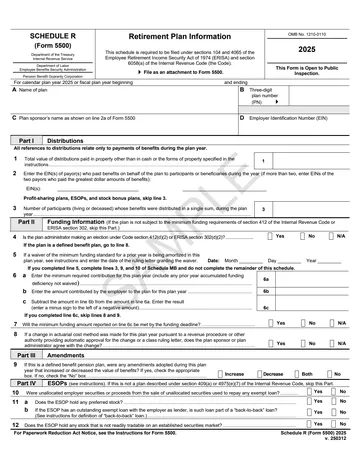
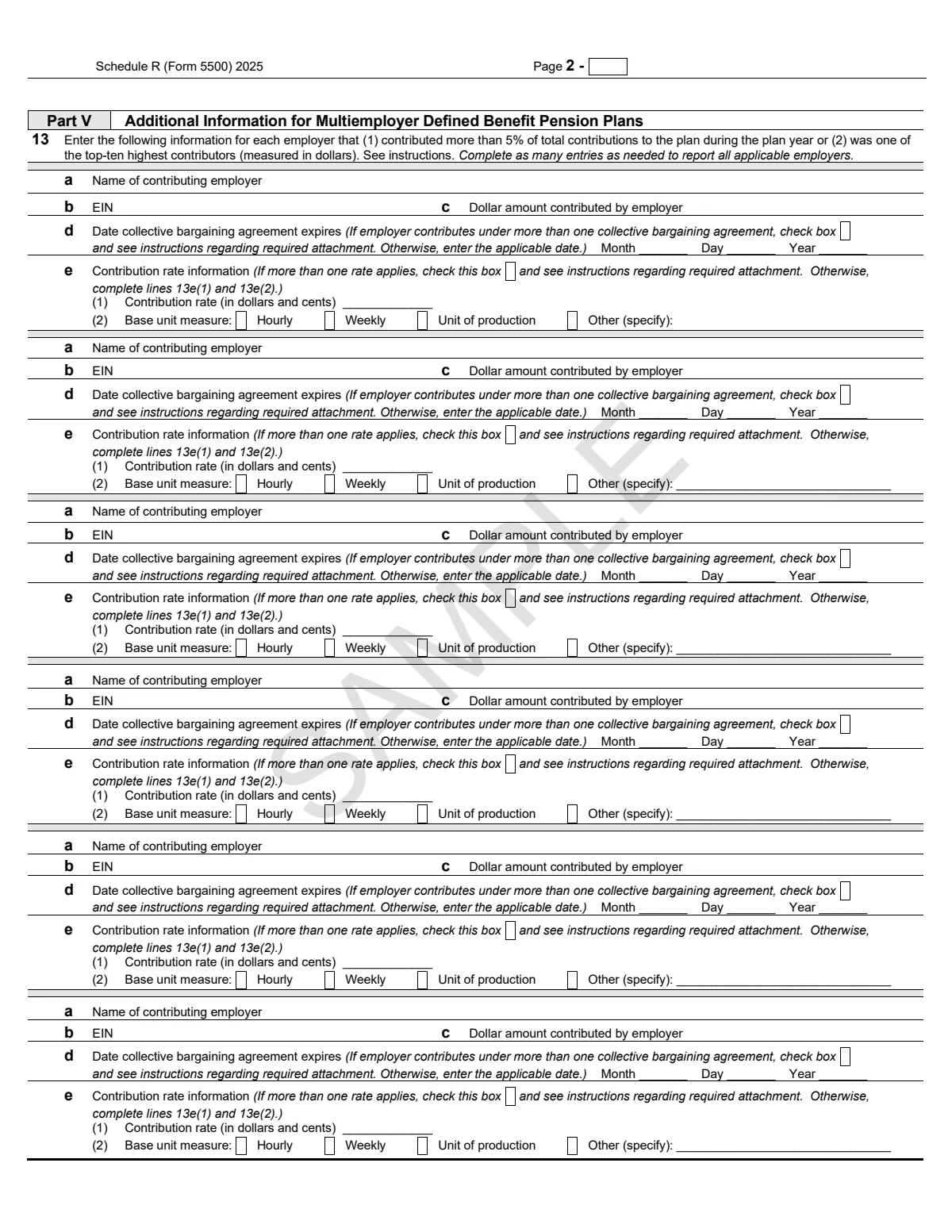
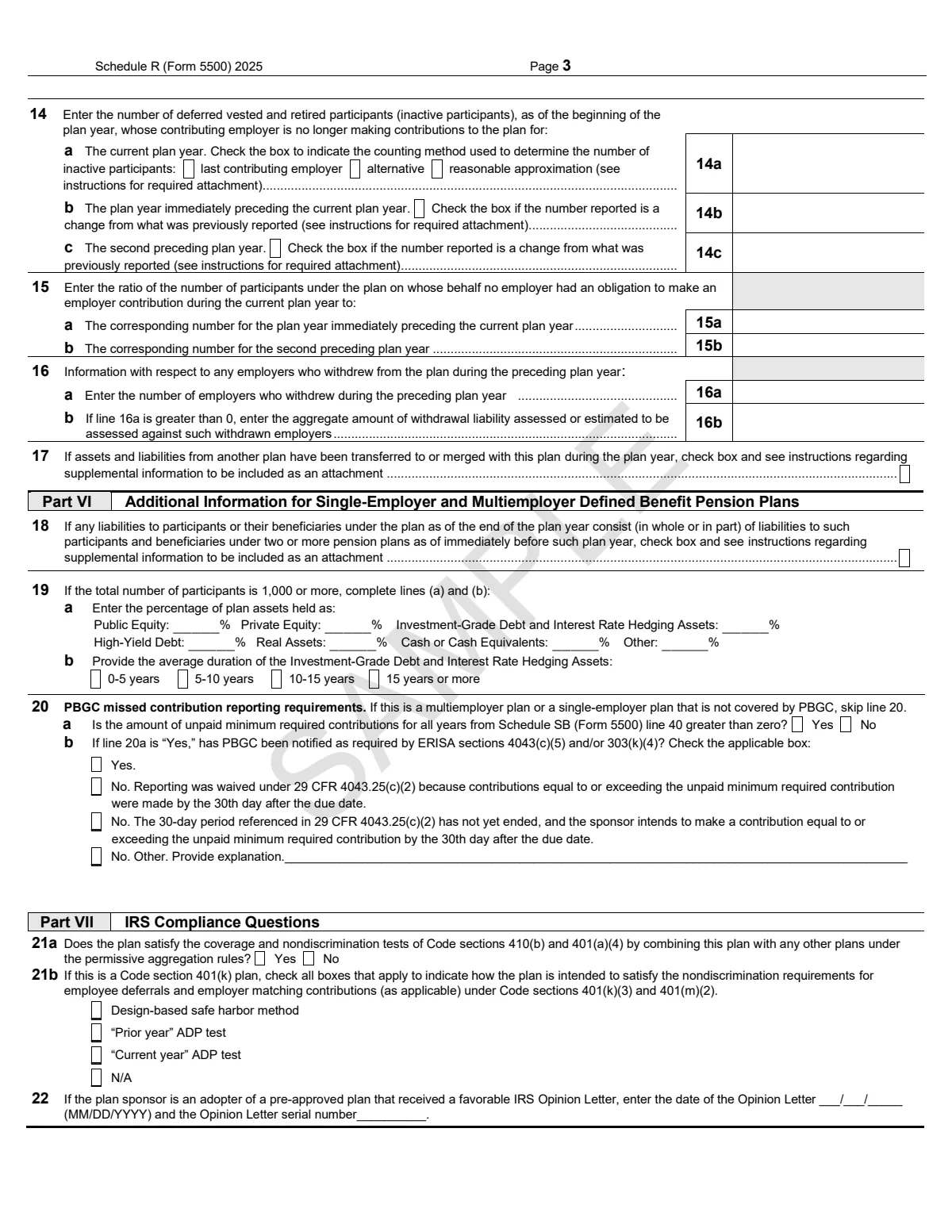
Schedule R is three pages. Page 1 holds Parts I to IV, page 2 holds the multiemployer employer list in Part V, and page 3 holds the rest of Part V and Parts VI and VII. Use the page buttons to switch pages.
Swipe sideways to see the whole page, or pinch to zoom. Tap a box once for its note, again to jump to the line.
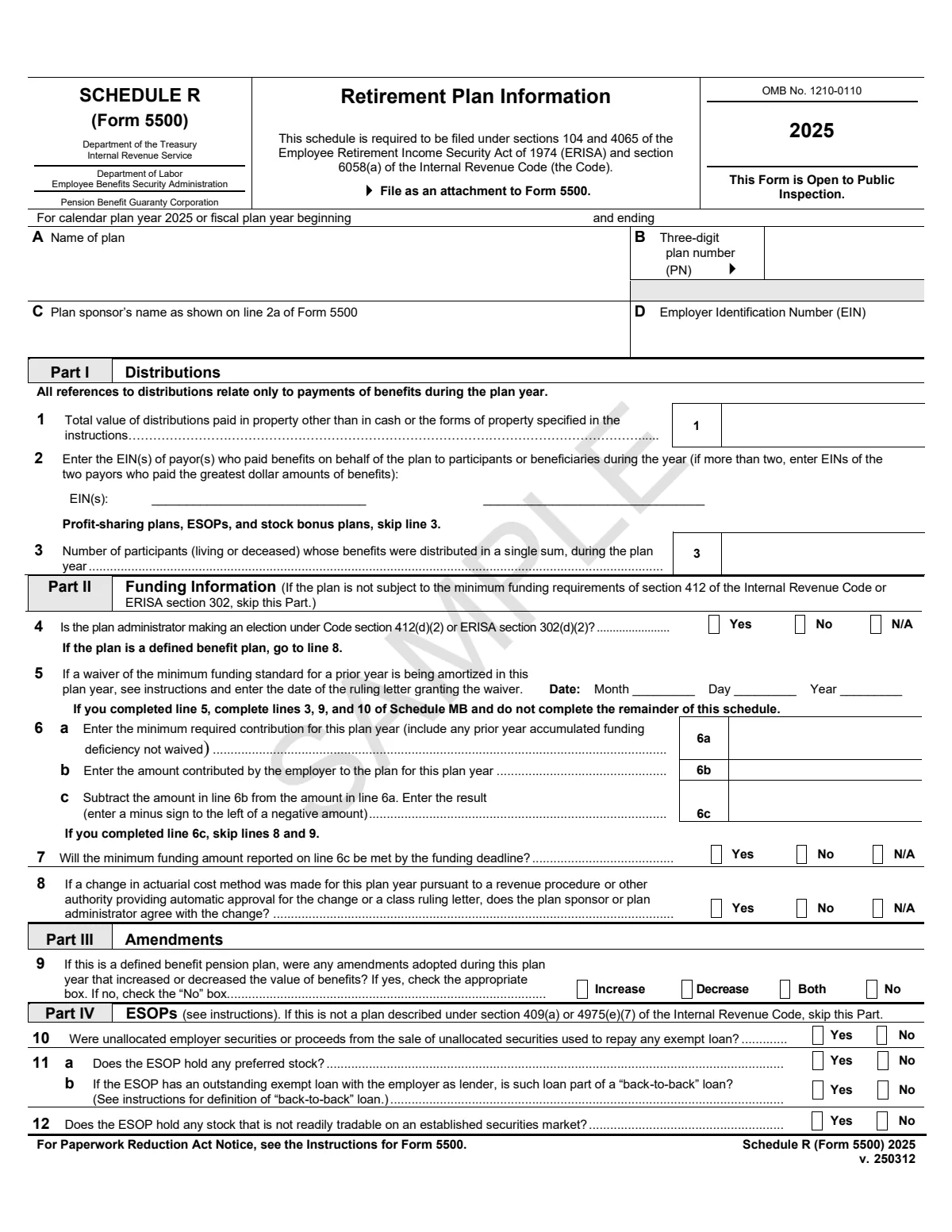
Part I and Part II: distributions and funding
Part I is for every pension plan that files Schedule R (line 3 is skipped by profit-sharing plans, ESOPs and stock bonus plans). Part II is only for plans subject to minimum funding under Code section 412 or ERISA section 302. Defined benefit plans answer line 4 and then go to line 8; their funding detail is on Schedule SB or MB.
| Line | Label | What goes there |
|---|---|---|
| A-D | Plan and sponsor identification | Must match Part II of the Form 5500. Schedule R and its attachments are public, and the instructions warn that an SSN or any part of one on the schedule or an attachment may result in rejection of the filing. |
| 1 | Distributions paid in property | Count distributions made during the year in any form other than cash, annuity contracts issued by an insurance company, life insurance contracts, marketable securities under Code section 731(c)(2), or plan loan offsets. “Do not include eligible rollover distributions paid directly to eligible retirement plans in a direct rollover under Code section 401(a)(31) unless such direct rollovers include property other than that enumerated in the preceding sentence.” A plan loan offset is a distribution for Part I, but a loan deemed distributed under Code section 72(p) is not. |
| 2 | EINs of other payors | List payors other than the plan sponsor or the administrator on Form 5500 line 2b or 3b. Use the EIN that appears on the Forms 1099-R issued to report the payments. Include the trust's EIN if it differs from the sponsor's or administrator's. Annuity payments from an insurer count only in the year the contract was purchased. |
| 3 | Single-sum distributions | A distribution stays single-sum even if a small supplemental payment follows for later earnings. Direct rollovers to a qualified plan or IRA trustee count. Profit-sharing plans, ESOPs and stock bonus plans skip this line. |
| 4 | Election under 412(d)(2) | The election lets an amendment adopted within 2 1/2 months after the plan year (two years for a multiemployer plan) count as made on the first day of the year, if it does not reduce accrued benefits as the instructions describe. The statement of election is filed with the Form 5500. Defined benefit plans go to line 8 after this line. |
| 5 | Waiver being amortized | Only for a money purchase plan (including a target benefit plan) amortizing a waiver of the minimum funding standard. Complete lines 3, 9 and 10 of Schedule MB and attach it; that Schedule MB does not need an actuary's signature. |
| 6a | Minimum required contribution | For a money purchase plan the minimum required contribution is the amount the plan document formula requires for the year. Add any accumulated funding deficiency from a prior year that was not waived. |
| 6b | Employer contribution for the year | Include contributions for the plan year made within 8 1/2 months after year end. “Show only contributions actually made to the plan by the date the form is filed.” Receivable contributions do not count here. |
| 6c | Line 6a minus line 6b | If the required contribution exceeds what was paid within 8 1/2 months, the excess is an accumulated funding deficiency. File IRS Form 5330 to pay the excise tax; there is a separate penalty for filing Form 5330 late. If you completed line 6c, skip lines 8 and 9. |
| 7 | Will the shortfall be paid in time? | Check Yes if the remaining contribution will be made within 8 1/2 months after the plan year. If it is actually paid by then, “then there will be no reportable deficiency and IRS Form 5330 will not need to be filed”. |
| 8 | Funding method change agreement | Revenue Procedure 2017-56 and Revenue Procedure 2000-40 automatic approvals generally apply only if the administrator or an authorized sponsor representative agrees, so this line is generally Yes when such a change applies this year. Check N/A where awareness of the change is enough, or where the change was not made under that kind of authority (for example, under a regulation). The change itself is reported on Schedule SB line 25 or Schedule MB lines 5k to 5m. |
Part III and Part IV: amendments and ESOPs
Line 9 is for defined benefit plans. Lines 10 to 12 are only for ESOPs described in Code section 409(a) or 4975(e)(7).
| Line | Label | What goes there |
|---|---|---|
| 9 | Amendments that changed benefits | Increase covers more benefits or faster accruals, better lump sum factors, COLAs, faster vesting, new payment forms or earlier eligibility. “This includes a decrease in future accruals, closure of the plan to new employees, or accruals being frozen for some or all participants.” Some benefits up and others down: check Both. |
| 10 | Exempt loan repaid with unallocated shares | Part IV applies only to a plan described in Code section 409(a) or 4975(e)(7). Any other plan skips lines 10 to 12. |
| 11a | Preferred stock | Only plans described in Code section 409(a) or 4975(e)(7) answer the Part IV questions; every other plan skips them. |
| 11b | Back-to-back loan | A back-to-back loan means the employer's loan to the ESOP is an exempt loan under 29 CFR 2550.408b-3 and Treasury Regulations 54.4975-7 and 54.4975-11, and its repayment terms are substantially similar to the commercial lender's loan to the employer. |
| 12 | Stock not readily tradable | This is the last ESOP question. Plans that are not ESOPs skip lines 10 to 12. |
Part V: multiemployer plans
If this is not a multiemployer plan, skip Part V. Lines 13 to 17 give the agencies contributor, inactive participant and withdrawal data.
| Line | Label | What goes there |
|---|---|---|
| 13 | Major contributing employers | Only multiemployer defined benefit plans subject to minimum funding complete Part V. Report each employer that, for the plan year, “(1) contributed more than five (5) percent of the plan's total contributions or (2) was one of the top-ten highest contributors”. List them in descending order of dollars. Plans in endangered, critical or critical and declining status also attach a summary of the funding improvement or rehabilitation plan and any update. |
| 13a | Name of contributing employer | Enter the employer's name. Complete as many blocks as needed; the form page shows six. |
| 13b-c | Employer EIN and dollars contributed | Enter the EIN, not an SSN: the form is public and an SSN may get the filing rejected. Line 13c is the total the employer contributed for all covered workers in all locations, without the part of an aggregated contribution that went to a welfare plan or another pension plan. |
| 13d | Bargaining agreement expiration | Enter the agreement's expiration date. With more than one agreement requiring contributions, check the box and attach every expiration date, labeled as the instructions direct, with the plan name, sponsor name and EIN. |
| 13e | Contribution rate and base unit | If the rate changed during the year, enter the last rate in effect. Different rates for different employee classes or places of business: check the box and attach each rate and base unit. |
| 14a | Inactive participants, current year | Use the last contributing employer method, the alternative method, or a reasonable approximation (which needs an attachment explaining it). “Generally, if there has been a prior withdrawal, unless all former vested participants of the withdrawn employer have been reemployed with a currently contributing employer, this line should not be zero.” Withdrawal liability payments are not contributions for this count. |
| 14b | Inactive participants, prior year | Enter the count for the plan year immediately preceding the current one. If it differs from the number reported on line 14a for that year, check the box and attach the reason. |
| 14c | Inactive participants, second prior year | Enter the count for the second preceding plan year. A change from the number previously reported needs the box checked and an explanation attached. |
| 15 | Ratios of participants with no contributing employer | Count all participants of withdrawn employers and all deferred vested and retired participants of employers still in the plan, unless the bargaining agreement requires contributions for them. Line 15a compares the 2025 count to 2024; line 15b compares it to 2023. Withdrawal liability payments are not contributions here. |
| 16a | Employers that withdrew | Use the definitions of withdrawal in ERISA section 4203. In building and construction, entertainment or other industries with special rules, count an employer only if its withdrawal meets those rules. |
| 16b | Withdrawal liability assessed | Report the aggregate amount. Where liability for a withdrawing employer is not determined yet, include the estimate. |
| 17 | Transfers and mergers in | The attachment names every plan that transferred assets and liabilities to or merged with this plan, with EINs, and the actuarial valuation of total assets and liabilities for each plan, including this one, for the year before the transfer. |
Part VI: defined benefit plans
Part VI is for single-employer and multiemployer defined benefit plans. Line 19 applies only at 1,000 or more participants; line 20 only to single-employer plans covered by PBGC.
| Line | Label | What goes there |
|---|---|---|
| 18 | Liabilities from two or more plans | The attachment lists each plan that supplied part of the liabilities, with names, EINs, plan numbers and each plan's funded percentage as of the last day of the 2024 plan year. For a terminated plan, write Terminated where the funded percentage would go. |
| 19a | Asset allocation (1,000 or more participants) | “This line must be completed for all defined benefit pension plans (except DFEs) with 1,000 or more participants at the beginning of the plan year.” Use Schedule SB line 3d(1) or Schedule MB line 2b(4)(1) for the count. Use market value, leave out receivables, and split assets held in trusts, funds and accounts among the seven categories so the percentages add to 100. REITs go in Public Equity. |
| 19b | Duration of investment-grade debt | Use effective duration or another generally accepted measure. With several debt portfolios, report the dollar-weighted average of their durations. |
| 20a | Unpaid minimum required contributions | Line 20 must be completed for all single-employer defined benefit plans covered by PBGC. If Schedule SB line 40 is more than $0, check Yes and complete line 20b; otherwise check No and skip 20b. |
| 20b | Was PBGC notified? | “With the exception of situations where the accumulated value of missed contributions exceeds $1 million, PBGC waives reporting if contributions equal to or exceeding the missed amount are made by the 30th day after the due date.” The instructions point to 29 CFR 4043.25 and 4043.81 and the PBGC Form 10 and 200 instructions. |
Part VII: IRS compliance questions
These questions are for qualified retirement plans. Multiple-employer plans and pooled employer plans skip lines 21a and 21b.
| Line | Label | What goes there |
|---|---|---|
| 21a | Permissive aggregation | Multiple-employer plans and pooled employer plans can skip this question. Plans permissively aggregated for the ratio percentage or nondiscriminatory classification test under Code section 410(b) must also be treated as one plan for the 401(a)(4) test. |
| 21b | 401(k) testing method | Design-based safe harbor covers SIMPLE 401(k) plans, 401(k)(12) safe harbor plans and qualified automatic contribution arrangements. Check all boxes that apply when groups are tested separately; check N/A if the plan need not test under 401(k)(3), such as a plan in which no HCE is benefiting. Multiple-employer and pooled employer plans skip it. |
| 22 | Pre-approved plan Opinion Letter | The serial number is a capital letter followed by six numbers. If changes to the plan negate the Opinion Letter, the sponsor is no longer an adopting employer and the plan is treated as individually designed. |
Which parts your plan completes
The parts follow plan type. This table reads the skip instructions printed on the form together with the line instructions.
| Plan type | Part I | Part II | Part III | Part IV | Part V | Part VI | Part VII |
|---|---|---|---|---|---|---|---|
| 401(k) or profit-sharing plan (not an ESOP) | Lines 1 and 2 (skip 3) | Skip (not subject to minimum funding) | Skip | Skip | Skip | Skip | Yes |
| Money purchase plan, no waiver | Yes | Lines 4 and 6a to 7 (skip 8) | Skip | Skip | Skip | Skip | Yes |
| Money purchase plan amortizing a waiver | Yes | Line 5, then Schedule MB lines 3, 9 and 10 | Skip the rest of Schedule R | ||||
| ESOP | Lines 1 and 2 (skip 3) | Only if subject to minimum funding | Skip | Yes | Skip | Skip | Yes |
| Single-employer defined benefit plan | Yes | Line 4, then line 8 | Yes | Skip | Skip | Yes | Yes |
| Multiemployer defined benefit plan | Yes | Line 4, then line 8 | Yes | Skip | Yes | Yes | Yes |
Line 5 is a full stop for a money purchase plan amortizing a waiver: the form says complete lines 3, 9 and 10 of Schedule MB “and do not complete the remainder of this schedule”.
Two other rules drive the money purchase lines. The 8½-month window on lines 6b and 7 is the funding deadline, and a deficiency left on line 6c is reported to the IRS on Form 5330. Defined benefit plans never use lines 5 to 7: their minimum required contribution is on Schedule SB (single-employer and multiple-employer plans) or Schedule MB (multiemployer plans).
Attachments
“All attachments to Schedule R must be properly identified, must include the name of the plan, plan sponsor's EIN, and plan number.” Put the words Schedule R and the line number at the top of each one. The attachments the instructions call for:
| Line | When | What to attach |
|---|---|---|
| 4 | Election under 412(d)(2) | The statement of election described in Treasury Temporary Regulations section 11.412(c)-7(b). |
| Part V | Endangered, critical, or critical and declining multiemployer plan | Summary of the funding improvement or rehabilitation plan, and any update made during the year. |
| 13d | More than one bargaining agreement | Expiration date of each agreement. |
| 13e | More than one contribution rate | Each rate and base unit. |
| 14a to 14c | Reasonable approximation method, or a changed prior count | Explanation of the method, or the reason for the change. |
| 17 | Transfer or merger into this plan | Plans involved, EINs, and actuarial valuations of assets and liabilities. |
| 18 | Liabilities from two or more plans | Plans involved and each plan's funded percentage. |
Common mistakes
- Attaching Schedule R to a Form 5500-SF. It belongs only with the Form 5500.
- Filing Schedule R for a DCG. Each participating plan answers the IRS questions on its own Schedule DCG.
- Leaving the Form 5500 line 10a(1) box unchecked. The EFAST2 filing tips say “The information you enter in the checklist on Line 10 of the Form 5500 must match schedules that are submitted with the Form 5500.”
- Counting receivables on line 6b. Only contributions actually paid by the filing date count.
- Reporting zero on line 14 after an employer withdrew, without checking whether all of its former vested participants went to work for a contributing employer.
- Putting an SSN in line D, line 13b or an attachment. The instructions say this may result in rejection of the filing.
Questions filers ask
Does my 401(k) plan file Schedule R?
Yes, if it files Form 5500. A profit-sharing or 401(k) plan that is not subject to minimum funding completes Part I (skipping line 3) and the Part VII IRS compliance questions. A small plan filing Form 5500-SF does not attach Schedule R.
Is a cash distribution reported on line 1?
No. Line 1 is only for distributions in property other than cash, insurer annuity contracts, life insurance contracts, marketable securities or plan loan offsets.
Who answers lines 21a and 21b?
Qualified plans other than multiple-employer plans and pooled employer plans, which the instructions say can skip both questions. Line 21b applies only to Code section 401(k) plans.
When does line 19 apply?
To defined benefit plans, other than DFEs, with 1,000 or more participants at the beginning of the plan year, counted from Schedule SB line 3d(1) or Schedule MB line 2b(4)(1).
What if a funding shortfall is paid after 8½ months?
It is an accumulated funding deficiency on line 6c, and the excise tax is paid with IRS Form 5330.