At a glance
The instructions give Schedule D two jobs. Part I gives information about the entities, meaning the master trust investment accounts (MTIAs), common/collective trusts (CCTs), pooled separate accounts (PSAs) and 103-12 investment entities (103-12 IEs) a plan or DFE invested in. “When the Form 5500 is filed for a DFE, Part II provides information about plans participating in the DFE.”
For plans, the trigger is any participation during the year, not a year-end balance. Schedule D “must be attached to a Form 5500 filed for an employee benefit plan that participated or invested in one or more CCTs, PSAs, MTIAs, or 103-12 IEs at any time during the plan year”. That applies to small plans filing the Form 5500 as well as large ones: the small pension and small welfare plan lists in the instructions both call for Schedule D, Part I, listing any CCTs, PSAs, MTIAs and 103-12 IEs the plan participated in during the year.
For DFEs, the schedule is attached to a Form 5500 filed for a CCT, PSA, MTIA, 103-12 IE or group insurance arrangement (GIA) filing as a DFE. A defined contribution group reporting arrangement (DCG) attaches Schedule D, “with Part I completed, only if the DCG invested in 103-12 IEs, CCTs or PSAs filing as DFEs”.
| Filer | Part I | Part II |
|---|---|---|
| Plan filing Form 5500 (small or large) that invested in an MTIA, CCT, PSA or 103-12 IE | Yes: one entry per entity | No |
| MTIA, CCT, PSA, 103-12 IE or GIA filing as a DFE | Yes, for entities the DFE itself invested in | Yes: every participating plan |
| DCG | Only if it invested in 103-12 IEs, CCTs or PSAs filing as DFEs | No: plans go on Schedule DCG |
| Plan with no DFE investments | Not filed | Not filed |
Schedule D is part of the Form 5500 return/report, so it is due when the Form 5500 is due: the last day of the 7th calendar month after the plan year ends for plans, DCGs and GIAs, and “no later than 9½ months after the end of the DFE year” for other DFEs (see the Form 5500 due date). The schedule says “File as an attachment to Form 5500.” It is filed electronically with the Form 5500 through EFAST2, using IFILE or approved software (see how to file in EFAST2). “Check the Schedule D box on the Form 5500 (Part II, line 10b(5)) if a Schedule D is attached to the Form 5500.”
Schedule D and its attachments are open to public inspection. Use EINs only, never Social Security numbers, in line D and in every EIN-PN element.
The form, line by line
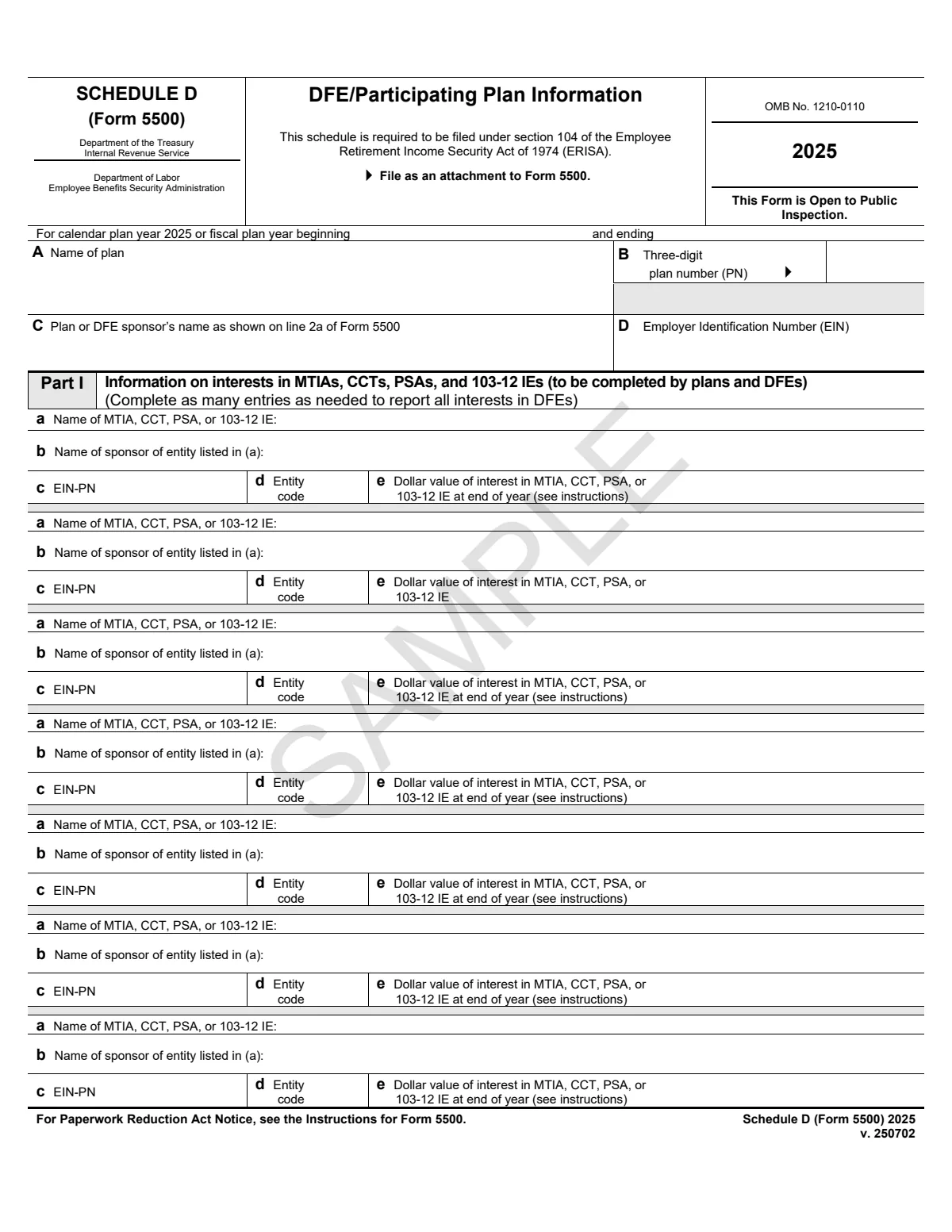
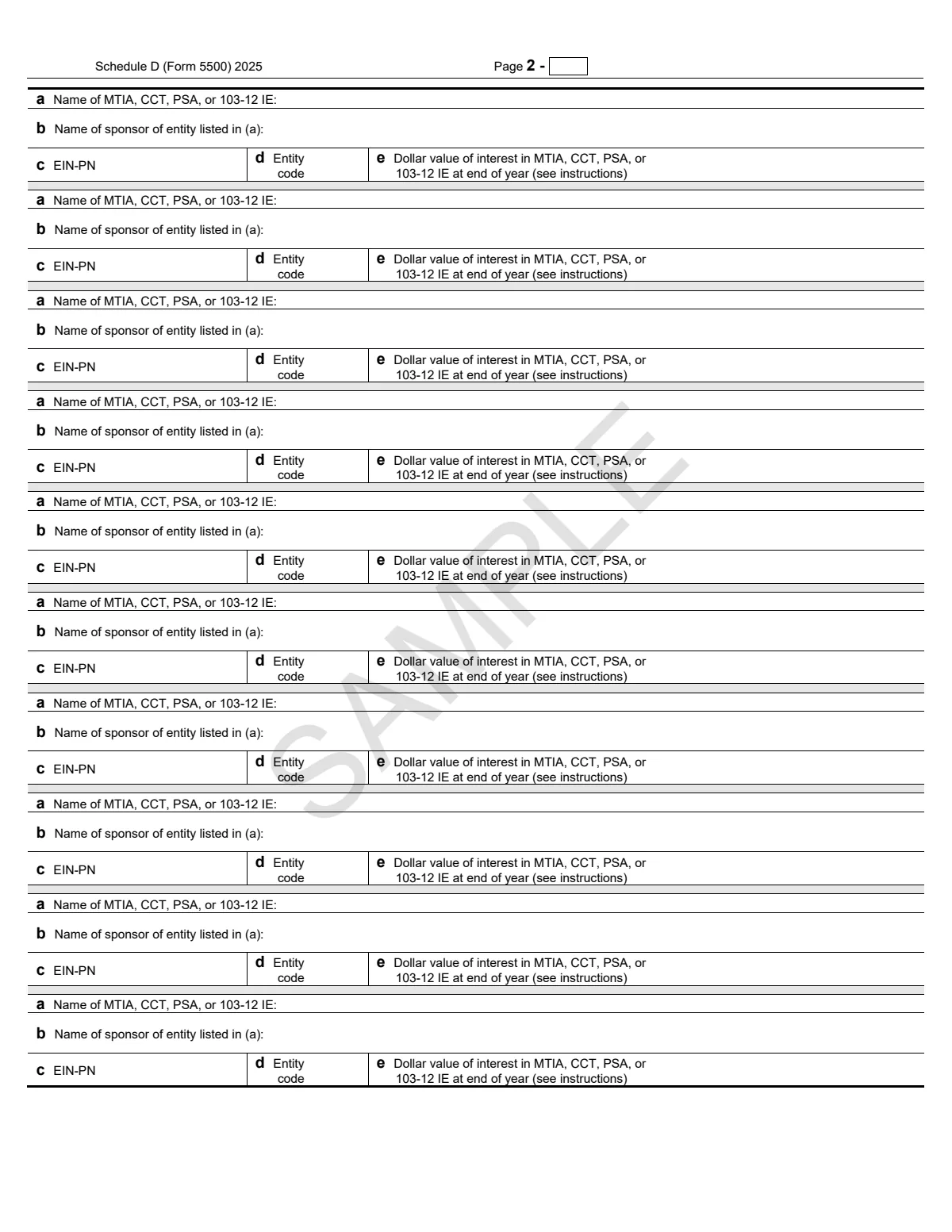
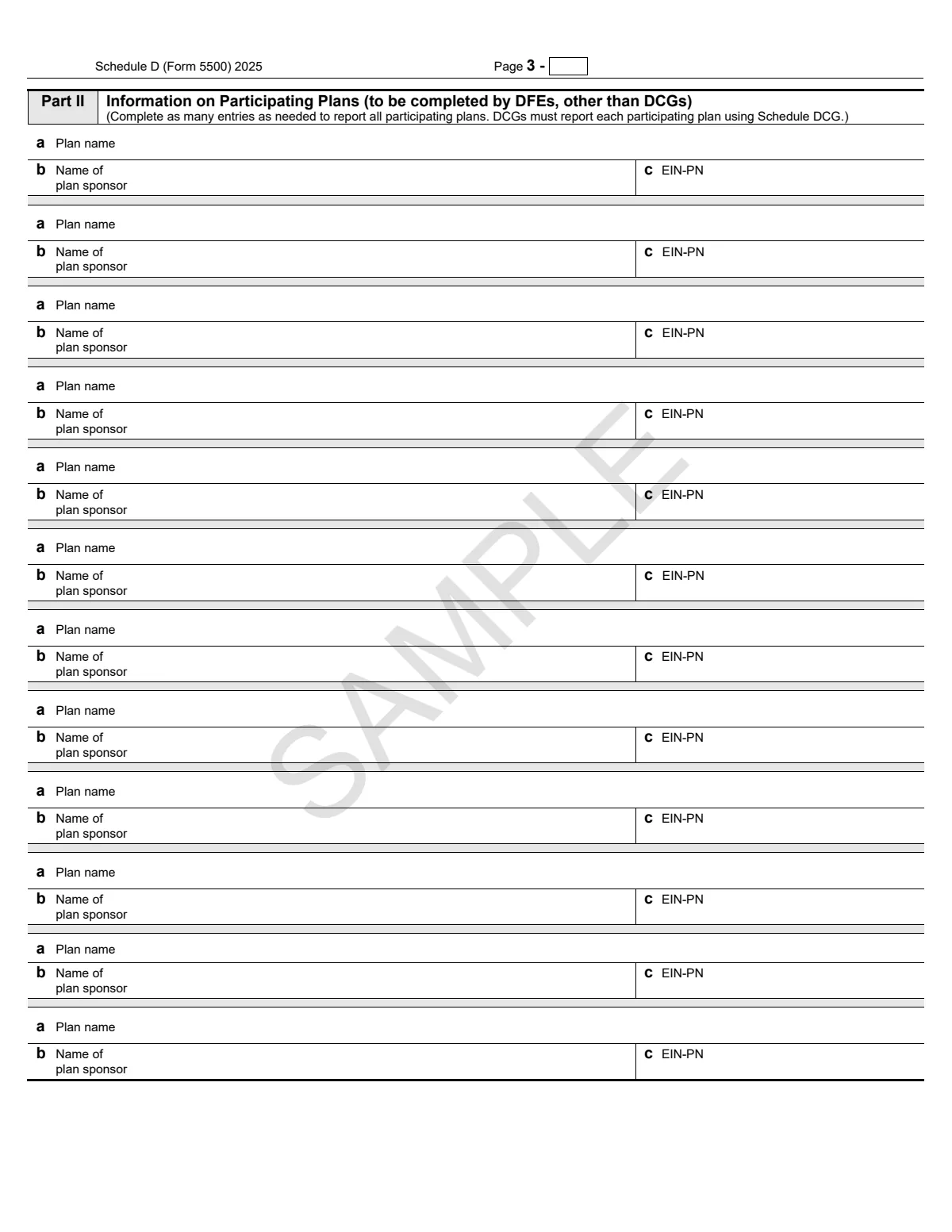
Hover over or tap a box to see what goes there; click it to jump to the full note in the tables below. Page 1 holds the header and the first seven Part I entries, page 2 holds ten more Part I entries, and page 3 is Part II.
Swipe sideways to see the whole page, or pinch to zoom. Tap a box once for its note, again to jump to the line.
Lines A to D: identification
| Line | Label | What goes there |
|---|---|---|
| Year | Plan or DFE year beginning and ending | Blank for a calendar plan or DFE year. For a fiscal year, the same dates as the Form 5500. |
| A | Name of plan | Lines A, B, C and D must match the Form 5500: “The information must be the same as reported in Part II of the Form 5500 to which this Schedule D is attached.” |
| B | Three-digit plan number (PN) | Same PN as Form 5500 line 1b (a DFE uses its own DFE number). |
| C | Plan or DFE sponsor's name | As shown on line 2a of the Form 5500. |
| D | Employer Identification Number (EIN) | The sponsor's EIN from line 2b. Do not use a Social Security number: the schedule is public, and an SSN can cause the filing to be rejected. The EBSA does not issue EINs; the IRS does. |
Part I: interests in MTIAs, CCTs, PSAs and 103-12 IEs
The instructions walk through a worked example. If a plan participates in an MTIA, the MTIA goes in element (a), its sponsor in element (b), and its EIN and PN in element (c), an M goes in element (d), and the year-end value of the plan's interest goes in element (e). A CCT that did not file a Form 5500 gets its EIN followed by 000, and a PSA that did file gets its own EIN and PN, for example 98-7655555-001.
| Line | Label | What goes there |
|---|---|---|
| Part I | Information on interests in MTIAs, CCTs, PSAs and 103-12 IEs | Completed by plans and DFEs. Complete a separate entry, elements (a) through (e), for each entity. |
| I(a) | Name of MTIA, CCT, PSA or 103-12 IE | Each entity the plan or DFE participated in at any time during the year. An entity the plan left during the year still gets an entry. |
| I(b) | Name of sponsor of entity listed in (a) | The sponsor of the MTIA, CCT, PSA or 103-12 IE named in (a). |
| I(c) | EIN-PN | The nine-digit EIN and three-digit PN of the entity, which must match lines 2b and 1b of the Form 5500 filed for that DFE. “If a Form 5500 was not filed for a CCT or PSA named in element (a), enter the EIN for the CCT or PSA and enter 000 for the PN.” Example from the instructions: 99-8765432-000 for a CCT that did not file. |
| I(d) | Entity code | Enter M (MTIA), C (CCT), P (PSA) or E (103-12 IE). See the code table below. |
| I(e) | Dollar value of interest in MTIA, CCT, PSA or 103-12 IE at end of year | The plan's or DFE's interest as of the end of the year. If the filer had no interest in the entity at the end of the year, the instructions say to enter 0. These values tie to Schedule H lines 1c(9) to 1c(12) for a large plan. |
| I-rows | Further Part I entries (page 1) | Each repeat of (a) to (e) follows the same rules. Add as many repeating entries as needed to report every entity. |
| I-page2 | Part I continued (page 2) | Ten more entries. Page 2 is only used when the filer has more entities to list. |
Part II: participating plans (DFEs only)
Part II is the DFE's list of the plans that put money in it. Each participating plan, in turn, lists the DFE in its own Part I, so the two schedules should agree: the DFE's EIN-PN in the plan's element (c) matches the DFE's Form 5500, and the plan's EIN-PN in the DFE's element (c) matches the plan's Form 5500 or 5500-SF.
| Line | Label | What goes there |
|---|---|---|
| Part II | Information on participating plans | To be completed only by DFEs, except DCGs. List every plan that invested or participated in the DFE at any time during the DFE year. “DCGs are not required to complete Part II.” A DCG reports its plans on Schedule DCG. |
| II(a) | Plan name | The name of each plan that invested or participated in the DFE. “GIAs need not complete element (a).” |
| II(b) | Name of plan sponsor | Enter the sponsor of every plan that invests or participates in the DFE. |
| II(c) | EIN-PN | “This is the EIN and PN entered on lines 2b and 1b of the plan’s Form 5500 or Form 5500-SF.” A GIA enters the EIN of the sponsor named in element (b). No Social Security numbers. |
| II-rows | Further Part II entries | Repeat (a) to (c) for every participating plan, on page 3 and in added entries. |
Rules that matter
Entity codes
| Type of entity | Enter in element (d) | Must it file its own Form 5500? |
|---|---|---|
| Master trust investment account (MTIA) | M | Yes: an MTIA must always file its own Form 5500 |
| Common/collective trust (CCT) | C | Optional; if it does not, use its EIN and PN 000 |
| Pooled separate account (PSA) | P | Optional; if it does not, use its EIN and PN 000 |
| 103-12 investment entity (103-12 IE) | E | Optional, but it is a DFE only if it files |
The instructions say a Form 5500 is optional for a CCT, PSA or 103-12 IE, a DCG or a GIA. Whether a CCT or PSA files matters on the plan's own return: for a large plan, “The value of the plan’s or DFE’s interest in each DFE at the end of the plan or DFE year must be reported on the Schedule D (Form 5500).” The plan's interest in a CCT or PSA that did not file as a DFE may not go on Schedule H lines 1c(9) or 1c(10); its share of the underlying assets is allocated to the other asset lines instead. See Schedule H.
The DFE's return is part of the plan's return
“Any Form 5500 filed for a DFE is an integral part of the annual report of each participating plan”, and the plan administrator may face penalties for an incomplete annual report unless both the DFE's Form 5500 and the plan's Form 5500 are properly filed. A DFE's Form 5500 reports the DFE year that ends with or within the participating plan's year.
Who cannot be in an MTIA
“DCGs and multiple-employer pension plans that are pooled employer plans cannot participate in an MTIA.” A DCG or pooled employer plan should never show code M in element (d).
Repeating entries
The paper image shows 17 Part I slots and 12 Part II slots, but the count is not a limit. The instructions say to complete as many repeating entries as needed, and IFILE and approved software add them.
Common mistakes
- Leaving out an entity the plan exited during the year. Part I covers every entity the plan participated in at any time during the year. List it and enter 0 in element (e).
- Making up a PN for a CCT or PSA that did not file. Use the entity's EIN and 000. Use a real DFE PN only when a Form 5500 was filed for that DFE.
- Using the plan's EIN-PN in Part I. Element (c) in Part I is the DFE's number, not the filer's.
- A DCG filling in Part II. DCGs report participating plans on Schedule DCG, one per plan.
- Not checking box 10b(5) on the Form 5500, or checking it with no Schedule D attached.
- A Social Security number anywhere on the schedule, which can get the filing rejected.
Questions filers ask
Does a small plan that invests through a pooled separate account need Schedule D?
Yes, if it files the Form 5500. The small pension and small welfare plan filing lists both include Schedule D, Part I, for any CCTs, PSAs, MTIAs and 103-12 IEs the plan participated in during the year.
What PN do I enter for a collective trust that never filed a Form 5500?
Enter the CCT's EIN and 000 as the PN, for example 99-8765432-000, and code C in element (d).
We moved out of a CCT in March. Do we still list it?
Yes. Part I covers every entity the plan participated in at any time during the plan year. Enter 0 in element (e) because the plan had no interest at year end.
Does a DCG file Schedule D?
Only Part I, and only if the DCG invested in 103-12 IEs, CCTs or PSAs that file as DFEs. Its participating plans are reported on Schedule DCG, not Part II.
Who completes Part II for a group insurance arrangement?
The GIA, as the DFE filer. It lists the sponsor of each participating plan and the sponsor's EIN; it does not have to give the plan names in element (a).