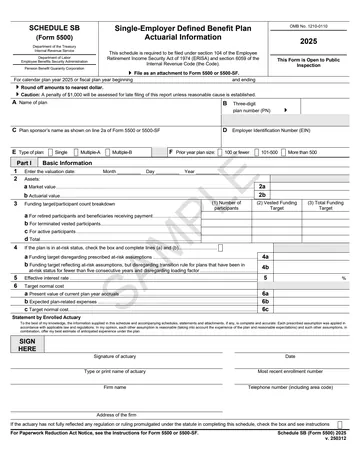
- At a glance
- The actuary signs, the administrator files
- The form, line by line
- Header and Part I
- Part II: carryover and prefunding balances
- Parts III and IV: percentages and contributions
- Parts V and VI: assumptions and miscellaneous
- Parts VII to IX: minimum required contribution
- Required attachments
- Common mistakes
- Questions filers ask
At a glance
| Question | Answer from the 2025 instructions |
|---|---|
| Who files | The plan administrator of a single-employer defined benefit plan, including a multiple-employer defined benefit plan, that is subject to the minimum funding standards. |
| Who does not | Multiemployer plans and money purchase plans amortizing a waiver: they use Schedule MB. Plans for years after the plan year that includes the termination date, if the termination actually occurs. |
| Prepared and signed by | The plan's enrolled actuary. |
| Attach to | Form 5500 (check Part II, line 10a(3)) or Form 5500-SF (answer line 11 Yes). Not filed with the 5500-EZ, but kept with the records. |
| Due | With the return: the last day of the 7th month after the plan year ends, or the extended date. See Form 5500 due date. |
| How filed | The data entered electronically in EFAST2, plus a PDF of the signed schedule. See how to file in EFAST2. |
| Late filing | A $1,000 penalty for each failure to file the actuarial statement, under Code section 6692 (as stated in the 2025 instructions). |
The schedule is printed with a warning on page 1: “A penalty of $1,000 will be assessed for late filing of this report unless reasonable cause is established.” Code section 6692 says the administrator who fails to file the report “shall pay a penalty of $1,000 for each such failure unless it is shown that such failure is due to reasonable cause”. That penalty is separate from the DOL and IRS penalties for a late Form 5500; see Form 5500 penalties.
The actuary signs, the administrator files
Schedule SB is the one Form 5500 schedule that the filer does not write. The administrator “must obtain a completed Schedule SB (including attachments) that is prepared and signed by the plan's enrolled actuary” and keep that signed copy with the plan records. Then three things happen:
- The information on the actuary's Schedule SB is entered electronically into the Form 5500 or 5500-SF, in IFILE or approved software, with every field required for the plan type completed.
- An electronic copy of the signed Schedule SB and its attachments is attached as a PDF. “This electronic reproduction must be labeled "SB Actuary Signature"”.
- The plan administrator or another authorized signer signs the return electronically with EFAST2 credentials. The actuary does not need EFAST2 signer credentials: the EFAST2 processing FAQs say “The actuary and accountant electronic signature images are not EFAST2-issued electronic signature credentials and do not require registration for Filing Signer credentials.”
For a one-participant plan on the Form 5500-EZ, “The Schedule SB (Form 5500) does not have to be filed with the Form 5500-EZ”, but the enrolled actuary still completes and signs it and gives it to the person filing the 5500-EZ, who keeps it. A plan on the Form 5500-SF answers line 11 Yes when a Schedule SB is required to be prepared, even when it is not attached.
This page explains what each line asks for and the rules the instructions state. The numbers themselves come from the actuary's valuation under Code sections 430 and 436; do not compute or change them yourself.
The form, line by line
Schedule SB is three pages. Lines A to F are completed for all plans. Parts I through VIII are completed for all single and multiple-employer defined benefit plans, regardless of size, except where line 27 says otherwise, and Part IX only if an extended amortization election was made.
Swipe sideways to see the whole page, or pinch to zoom. Tap a box once for its note, again to jump to the line.
Header and Part I
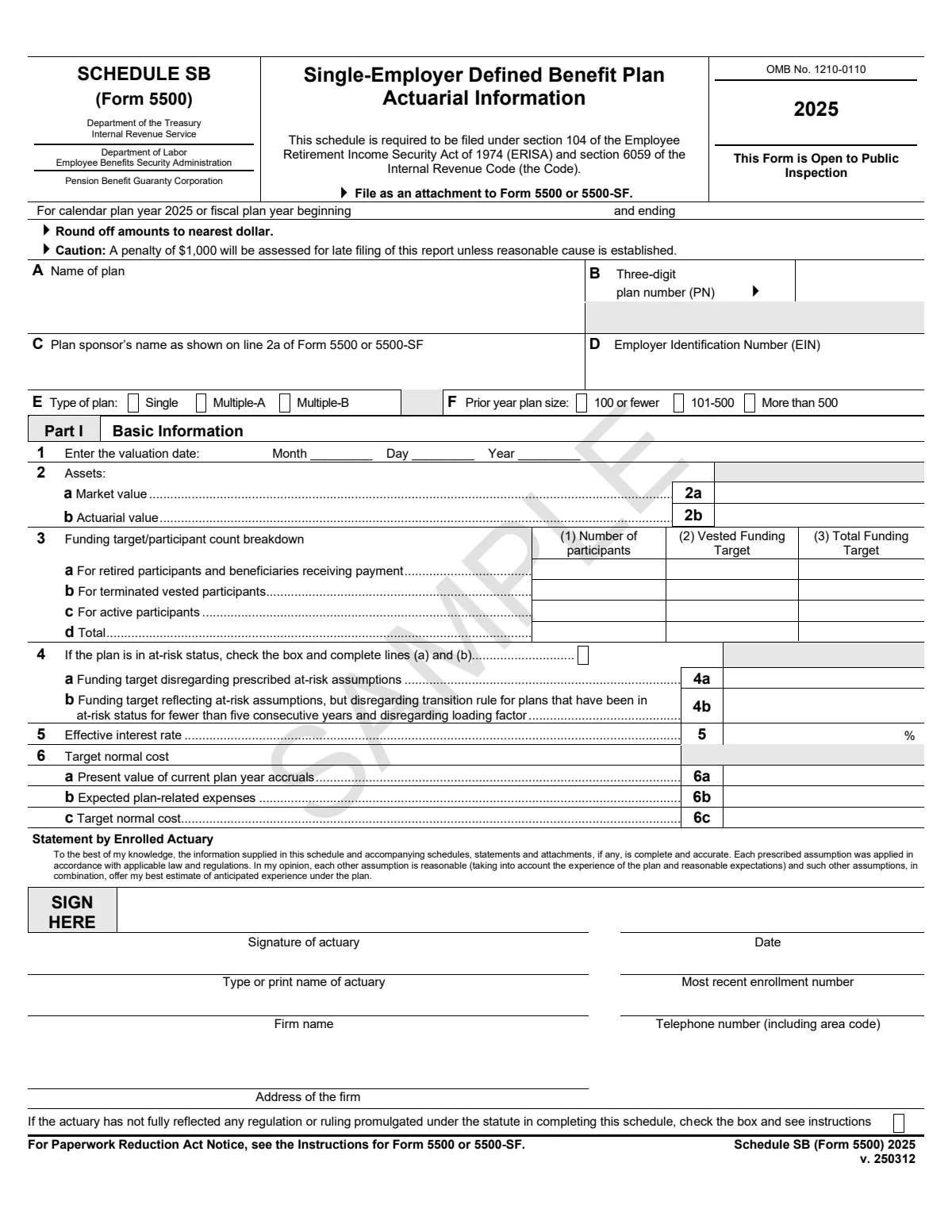
Part I reports assets, liabilities and normal cost as of the valuation date. Lines 2 through 6 come straight from the valuation.
| Line | Label | What goes there |
|---|---|---|
| A-D | Plan and sponsor identification | Lines A through F are completed for all plans. Do not use an SSN in line D: the schedule is public when filed with a Form 5500 or 5500-SF, and an SSN may get the filing rejected. |
| E | Type of plan | Single includes a plan kept by more than one member of the same controlled group. If Multiple-A is checked, every entry except the Part III percentages is the sum of the amounts for each employer, and each employer's data is attached. |
| F | Prior year plan size | Count active and inactive participants (vested terminated, retirees and beneficiaries) on any day of the preceding year in all defined benefit plans of the employer and its controlled group, counting each person once. Participants whose only defined benefit plan is a multiemployer plan are not counted. |
| 1 | Valuation date | “A plan qualifies for this small-plan exception if there were 100 or fewer participants on each day of the prior plan year.” All Part I entries are reported as of the valuation date, using the assumptions generally used for the minimum required contribution. |
| 2 | Assets: market and actuarial value | On line 2a include contributions for a prior year paid after the valuation date (within 8½ months after that year ended), adjusted for interest. “Contributions made for the current plan year must be excluded from the amount reported in line 2a.” Leave out rollovers and individual accounts not available for defined benefits. If an averaging method is used on line 2b, the value must fall within 90% to 110% of fair market value. |
| 3 | Funding target and participant count | Column (1) counts participants and beneficiaries; column (2) is the funding target for vested benefits (including benefits vested for PBGC premium purposes); column (3) is the funding target for all benefits. Enter 0 for an empty category. At-risk plans report amounts reflecting the at-risk assumptions, the loading factor and the transition rule where they apply. |
| 4 | At-risk status | Do not complete line 4 if the plan is not at risk for the current year. “Generally, a plan is in at-risk status for a plan year if it had more than 500 participants on any day during the preceding plan year” and its prior-year FTAP was under 80% and its at-risk FTAP under 70%. An at-risk plan attaches a description of the at-risk assumptions for the assumed form of payment. |
| 5 | Effective interest rate | This is the rate that, used instead of the line 21 rates, would give the funding target on line 3d column (3), or line 4a for an at-risk plan. If the funding target is zero, the rate is solved against target normal cost instead. |
| 6 | Target normal cost | Line 6a includes increases from actual or projected pay raises this year, even when the raise affects benefits for earlier service. Line 6b is plan-related expenses expected to be paid from plan assets. Line 6c is 6a plus 6b, reduced but not below zero by expected mandatory employee contributions. |
| Sign | Statement by Enrolled Actuary | An enrolled actuary must sign. The signature may be qualified, as Treasury Regulations section 301.6059-1(d) permits. The actuary may sign by hand or type the name followed by handwritten initials, and “a stamped or machine produced signature is not acceptable”. The administrator keeps this signed copy with the plan records. |
| Regs | Regulation not fully reflected | When the box is checked, the attachment labeled as the Statement by Enrolled Actuary says whether an unpaid required contribution or a contribution that is not wholly deductible would result if the regulation, ruling or notice were fully reflected. |
Part II: carryover and prefunding balances
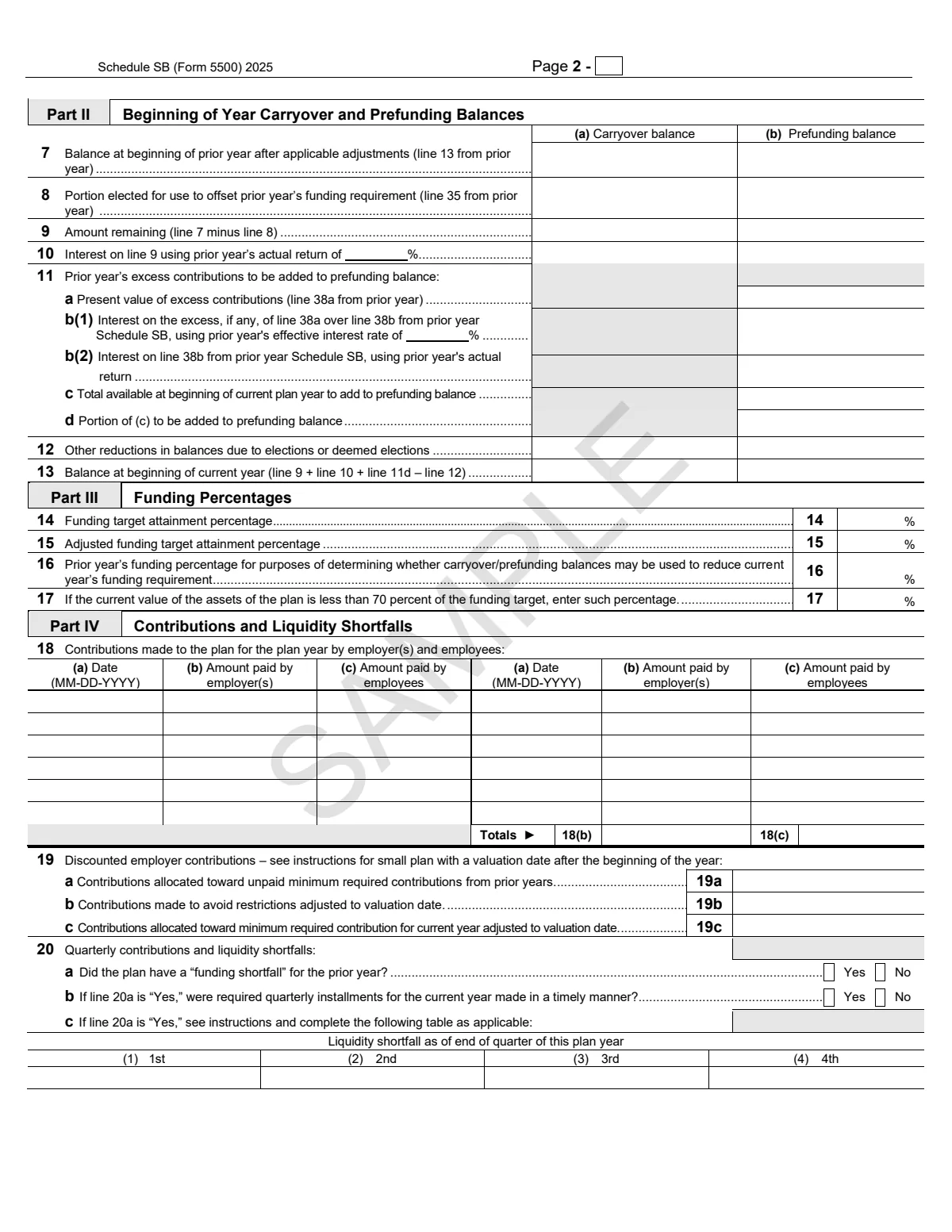
Part II rolls the funding standard carryover balance (column a) and prefunding balance (column b) forward from last year's Schedule SB. Most entries tie to a line on the prior-year schedule.
| Line | Label | What goes there |
|---|---|---|
| 7 | Beginning balances of the prior year | If last year's balance was adjusted so it no longer matches line 13 of the prior-year Schedule SB, attach an explanation. Elections to add excess contributions or reduce balances have deadlines and generally cannot be changed once made. |
| 8 | Portion used last year | Report the full amount from prior-year line 35, even if it was more than that year's requirement and the excess was not revoked. With a valuation date other than the first day of the year, discount it to the start of the prior year. A late election to apply balances to quarterly installments can make line 8 differ from line 35; attach an explanation. |
| 9 | Amount remaining | In the first year under Code section 430, enter any credit balance at the end of the pre-effective year in column (a) and leave column (b) blank. |
| 10 | Interest at last year's actual return | Enter a minus sign for a negative return. The interest in each column is the rate times line 9 in that column. |
| 11a | Prior year's excess contributions | This line starts the roll-forward of last year's excess contributions. Leave lines 11a to 11d blank in the first year under Code section 430. |
| 11b | Interest on the excess | If last year's valuation date was not the first day of the year (small plans only), follow the step-by-step calculation in the instructions instead of a simple product. Line 11b(1) is zero if last year's valuation date was the last day of the year. |
| 11c | Total available to add | Add lines 11a, 11b(1) and 11b(2). |
| 11d | Portion added to prefunding balance | This is the sponsor's election, not a calculation, and it cannot be greater than line 11c. |
| 12 | Other reductions in balances | This line covers reductions elected under Code section 430(f) or deemed elected under Code section 436(f)(3). It cannot exceed the column's lines 9, 10 and 11d. Adjust to the first day of the year if the valuation date is later. |
| 13 | Balance at beginning of current year | Leave column (b) blank in the first year the plan is subject to Code section 430. |
Parts III and IV: percentages and contributions
Part III reports the funding percentages that drive benefit restrictions and the use of balances. Part IV lists contributions and quarterly and liquidity information.
| Line | Label | What goes there |
|---|---|---|
| 14 | FTAP | Enter all Part III percentages truncated at .01%, so 82.649% is reported as 82.64%. The funding target is line 3d column (3), or line 4a for an at-risk plan. |
| 15 | AFTAP | “Report the final certified AFTAP for the plan year”. If no AFTAP was certified, attach an explanation and report 100% if the adjusted funding target is zero, or leave the line blank otherwise. If the AFTAP does not match this valuation, attach a reconciliation of each certification. |
| 16 | Prior year's funding percentage | Under Code section 430(f)(3), balances “may not be applied toward minimum contribution requirements unless the ratio of plan assets for the preceding plan year to the funding target for the preceding plan year” is 80% or more. Use last year's line 2b less last year's line 13 column (b), divided by last year's funding target. |
| 17 | Assets below 70% of funding target | This ratio is required by ERISA section 103(d)(11). |
| 18 | Contributions made | Do not adjust contributions for interest on this line. Show only employer contributions made within 8½ months after the plan year (or before the schedule is signed, if earlier). Include contributions made for the liquidity requirement and to avoid benefit restrictions. |
| 19a | Contributions toward prior unpaid amounts | Payments go first to the earliest year with an unpaid minimum required contribution. Increase the effective rate by 5 percentage points for late quarterly installments. Line 19a cannot be larger than line 28. Attach the schedule of discounted contributions the instructions describe. |
| 19b | Contributions to avoid restrictions | Report contributions made to avoid or terminate benefit restrictions under Code section 436 and ERISA section 206(g). |
| 19c | Contributions toward current year | Small plans with a valuation date after the start of the year increase contributions made before the valuation date with interest to that date, and leave them out of lines 2a and 2b. |
| 20a | Funding shortfall last year? | Use the figures from last year's Schedule SB. A plan can have a funding shortfall for this purpose even if it is exempt from establishing a shortfall amortization base. |
| 20b | Quarterly installments on time? | If line 20a is No, the plan is not subject to the quarterly contribution rules and this line is not completed. |
| 20c | Liquidity shortfalls by quarter | If the special rule for nonrecurring circumstances is used, attach the actuary's certification. A liquidity shortfall not paid on time is subject to a 10% excise tax paid with Form 5330, unless the tax was waived. |
Parts V and VI: assumptions and miscellaneous
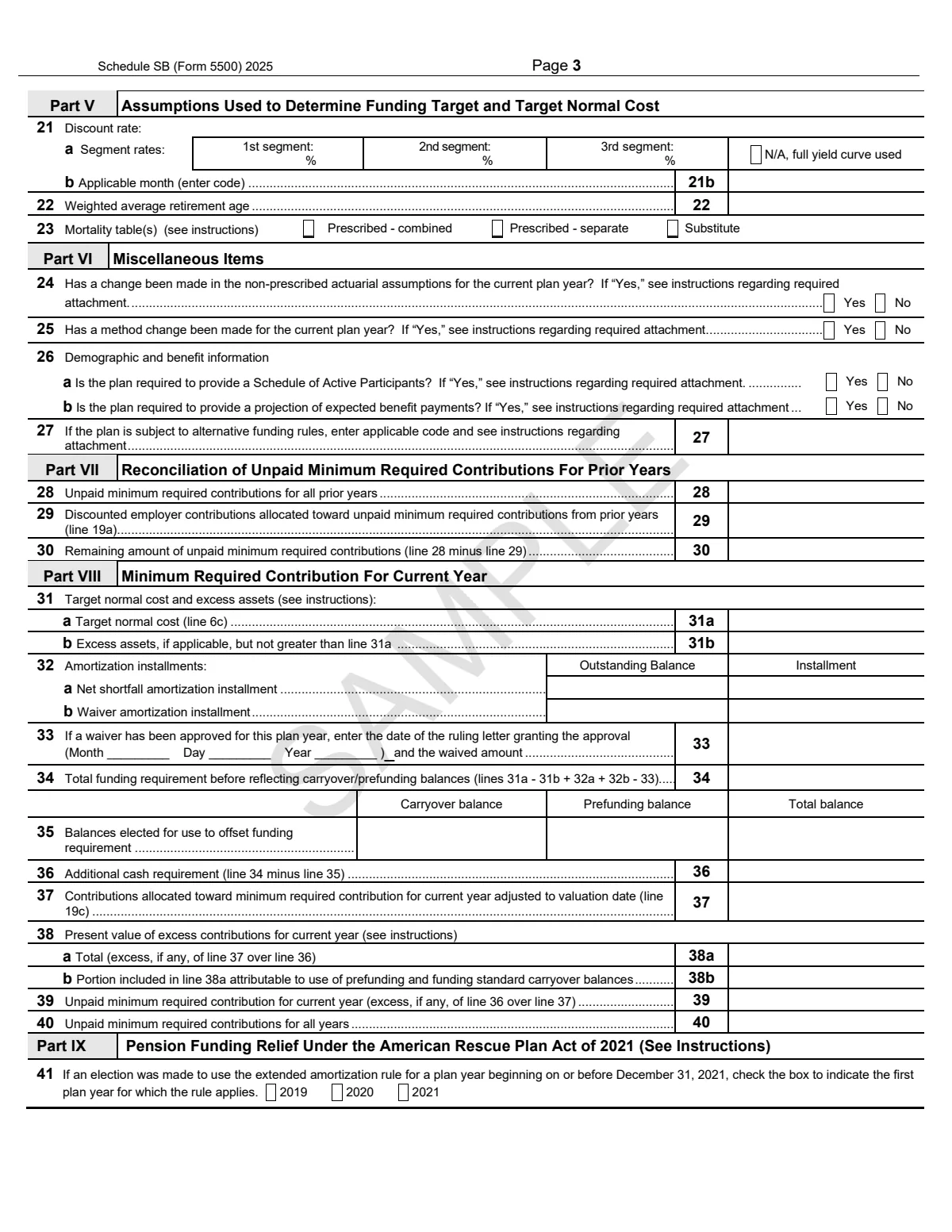
Part V reports the assumptions used for the funding target and target normal cost. Part VI flags changes and the demographic attachments.
| Line | Label | What goes there |
|---|---|---|
| 21a | Segment rates | All discount rates are used as published by the IRS and applied as annual rates without adjustment. |
| 21b | Applicable month code | Example from the instructions: a January 1 valuation using rates published for November is code 2. The sponsor's interest rate election generally cannot be changed without IRS approval. |
| 22 | Weighted average retirement age | If the valuation uses rates of retirement at several ages, enter the nearest whole age that is the weighted average, and attach the rates and the weighting method. |
| 23 | Mortality tables | Plans with 500 or fewer participants on line 3d column (1) may elect the combined tables. Substitute tables need a statement covering the populations, mortality ratios, credibility and the last year of IRS approval. |
| 24 | Change in non-prescribed assumptions | Attach a description and justification of any change. If non-prescribed assumptions changed in a way that decreases the funding shortfall, approval may be required. |
| 25 | Change in method | Attach a description with the IRS approval date, or the reason the change was automatically approved under Revenue Procedure 2017-56. The sponsor's agreement to certain method changes goes on Schedule R line 8. |
| 26a | Schedule of active participant data | Plans with 1,000 or more active participants also show average compensation, and cash balance plans of that size show average account balances; no averages in a cell with fewer than 20 participants. The schedule may be a structured CSV attachment. |
| 26b | Projection of expected benefit payments | Project benefits for active, terminated vested and retired participants and the whole plan for each of the next fifty years, assuming no new accruals or entrants and experience in line with the valuation assumptions. |
| 27 | Alternative funding rules code | Codes 2, 5 and 8 are no longer used, and 3 is reserved. Code 4 is for binding agreements with PBGC to maintain balances, 6 for airlines on the 17-year schedule, 7 for an interstate transit company. CSEC plans (code 1) complete only some lines and attach a 2007 Schedule B. |
Parts VII to IX: minimum required contribution
Part VII reconciles unpaid contributions from earlier years. Part VIII builds this year's minimum required contribution and shows whether it was met. Part IX records the ARPA extended amortization election.
| Line | Label | What goes there |
|---|---|---|
| 28 | Unpaid minimum contributions, prior years | In the first year under Code section 430, enter the accumulated funding deficiency at the end of the pre-effective year (line 9p of the 2007 Schedule B). |
| 29 | Contributions allocated to them | Enter the same amount as line 19a. |
| 30 | Remaining unpaid amount | Subtract line 29 from line 28. |
| 31a | Target normal cost | Copy line 6c. |
| 31b | Excess assets | With a valuation date after the first day of the year, adjust the balances for interest before subtracting. Limit the result to line 31a. |
| 32a | Net shortfall amortization | A new shortfall base is generally the funding shortfall less the outstanding balances of earlier bases, and is amortized over 15 annual payments at the line 21 rates. Attach a schedule of all amortization bases. |
| 32b | Waiver amortization | A waiver base for the current year is amortized over 5 annual payments starting next year, so it first shows on next year's Schedule SB. |
| 33 | Funding waiver | “If a waiver is pending, do not complete this line.” If it is granted after the Form 5500 is filed, file an amended Form 5500 with an amended Schedule SB. |
| 34 | Total funding requirement | Line 31a minus 31b plus 32a plus 32b minus 33. |
| 35 | Balances elected to offset | No part of the prefunding balance can be used unless the full remaining carryover balance is used first. Amounts generally cannot exceed line 13, except for interest adjustments when the valuation date is not the first day of the year. |
| 36 | Additional cash requirement | Line 34 minus the total on line 35, not less than zero. |
| 37 | Contributions toward current year | Enter the same amount as line 19c. |
| 38a | Excess contributions | This amount, plus interest if applicable, is the most the sponsor may elect to add to the prefunding balance. |
| 38b | Part of the excess from using balances | It flows to next year's line 11b calculations. |
| 39 | Unpaid contribution, current year | A positive amount here is an unpaid minimum required contribution for the current year. |
| 40 | Unpaid contributions, all years | If this amount is more than zero, file IRS Form 5330 and pay the 10% excise tax on the unpaid minimum required contributions. A PBGC-covered plan also files PBGC Form 10 or 200 unless reporting is waived, and answers Schedule R line 20. |
| 41 | ARPA extended amortization | The election is under Code section 430(c)(8) or ERISA section 303(c)(8), added by the American Rescue Plan Act of 2021. |
Required attachments
“All attachments to the Schedule SB must be properly identified as attachments to the Schedule SB, and must include the name of the plan, plan sponsor's EIN, plan number, and line number to which the schedule relates.” The ones the line instructions call for:
| Line | When | Attachment |
|---|---|---|
| E | Multiple-A plan | Schedule SB data for each individual employer |
| Statement | Regulation not fully reflected | Statement by Enrolled Actuary |
| 4 | At-risk status | At-risk assumptions for the assumed form of payment |
| 7, 8, 9 | Balance does not match the prior year, or a late election | Explanation of the discrepancy |
| 15 | AFTAP differs from the valuation, or none certified | Reconciliation of each certified AFTAP |
| 19 | Contributions made on other dates | Schedule of discounted employer contributions |
| 20c | Nonrecurring circumstances rule used | Actuary's liquidity requirement certification |
| 22 | Always | Description of weighted average retirement age |
| 23 | Substitute or multiple mortality tables | Information on the tables used |
| Part V | Always | Statement of actuarial assumptions and methods, and summary of plan provisions |
| 24, 25 | Yes answers | Change in actuarial assumptions; change in method |
| 26a, 26b | Yes answers | Schedule of active participant data; projection of expected benefit payments (CSV allowed) |
| 27 | Alternative funding rule code | The attachment that code requires |
| 32 | Any shortfall or waiver bases | Schedule of amortization bases |
For a plan retroactively adopted under SECURE Act section 201 in 2025, the actuary also completes and signs a 2024 Schedule SB, which is attached as a PDF to the 2025 Schedule SB.
Common mistakes
- Sending one combined PDF from the actuary. The EFAST2 processing FAQs say the listed actuarial attachments “you must upload them separately with the appropriate attachment tag, or EFAST2 may generate an error message”.
- Adding both Schedule SB and Schedule MB. The IFILE user guide treats the two as mutually exclusive: once one is added, the other is removed.
- Forgetting the signed PDF labeled SB Actuary Signature, or attaching a stamped or machine-produced signature.
- Leaving line 40 above zero without filing Form 5330 or answering Schedule R line 20.
Questions filers ask
Who signs Schedule SB?
The plan's enrolled actuary, on page 1. The plan administrator signs the Form 5500 itself in EFAST2 and keeps the actuary's signed Schedule SB with the plan records.
Does a one-participant plan file Schedule SB?
Not with the Form 5500-EZ. The actuary still completes and signs it and gives it to the person who files the 5500-EZ, and it must be kept.
Can a small plan use a valuation date other than the first day of the year?
Yes, if it had 100 or fewer participants on each day of the prior plan year. The valuation date may then be any date in the plan year.
What is the penalty for not filing Schedule SB?
$1,000 for each failure to file the actuarial statement, under Code section 6692, unless the failure is due to reasonable cause. Other Form 5500 penalties are separate.