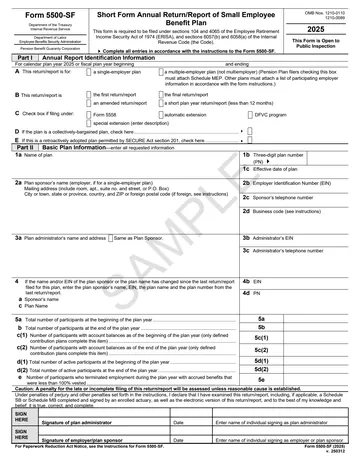
At a glance
The 5500-SF is an option, not a requirement: a plan required to file “may file the Form 5500-SF instead of the Form 5500 only if you meet all of the eligibility conditions listed below.” The conditions, from the 2025 instructions:
- Fewer than 100 participants at the beginning of the 2025 plan year, or eligible under the 80-120 rule because the plan filed as a small plan for 2024 and had no more than 120 participants at the beginning of 2025 (see the 80-120 rule).
- No employer securities at any time during the plan year.
- 100% invested in eligible plan assets at all times during the year (line 6a).
- Eligible for the IQPA audit waiver under 29 CFR 2520.104-46, but not by reason of enhanced bonding (line 6b).
- Not a multiemployer plan, not a pooled employer plan, and not filing as or in a DCG reporting arrangement.
- Not required to file a Form M-1 during the plan year.
“Employee Stock Ownership Plans (ESOPs) and Direct Filing Entities (DFEs) (including DCGs) may not file the Form 5500-SF.” A single-employer defined benefit plan on the 5500-SF still attaches Schedule SB; a money purchase plan amortizing a funding waiver attaches Schedule MB; a multiple-employer pension plan attaches Schedule MEP. IFILE offers only Schedules MB, SB and MEP for a 5500-SF. Not sure which form fits? Try the which form checker.
| Question | Answer for the 2025 Form 5500-SF |
|---|---|
| Due date | Last day of the 7th calendar month after the plan year ends |
| Extension | Form 5558 (up to 2½ months) or the automatic extension tied to the employer's tax return |
| How filed | Electronically in EFAST2, through IFILE or approved software; it is posted publicly on the internet |
| Penalty | DOL civil penalty up to $2,739 a day under ERISA section 502(c)(2) (2025 amount, 90 FR 1854; no 2026 adjustment, 91 FR 31358); IRS penalty under Code section 6652(e) |
The form, line by line
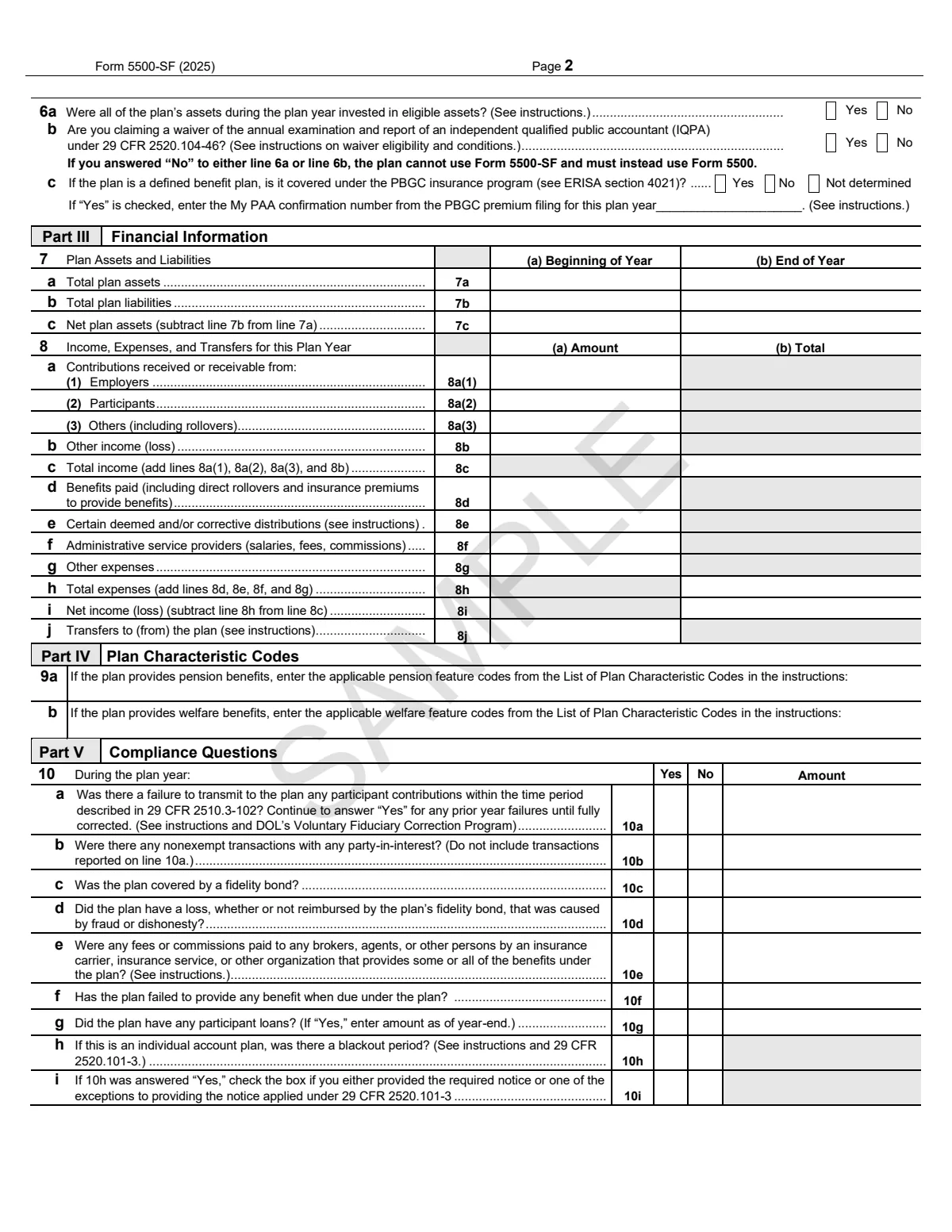
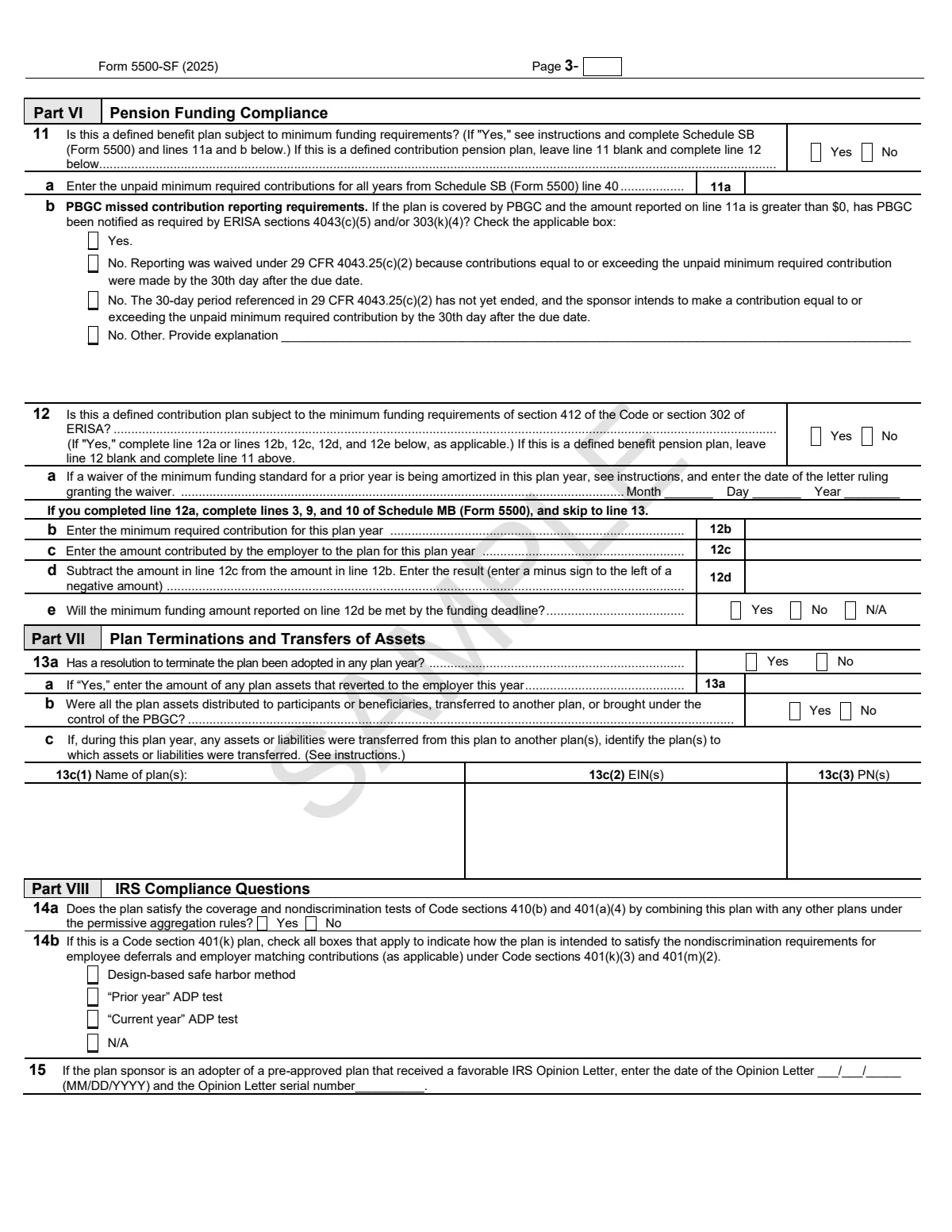
Hover or tap any box to see what goes there; click it to jump to the full note. Use the page buttons for pages 2 and 3.
Swipe sideways to see the whole page, or pinch to zoom. Tap a box once for its note, again to jump to the line.
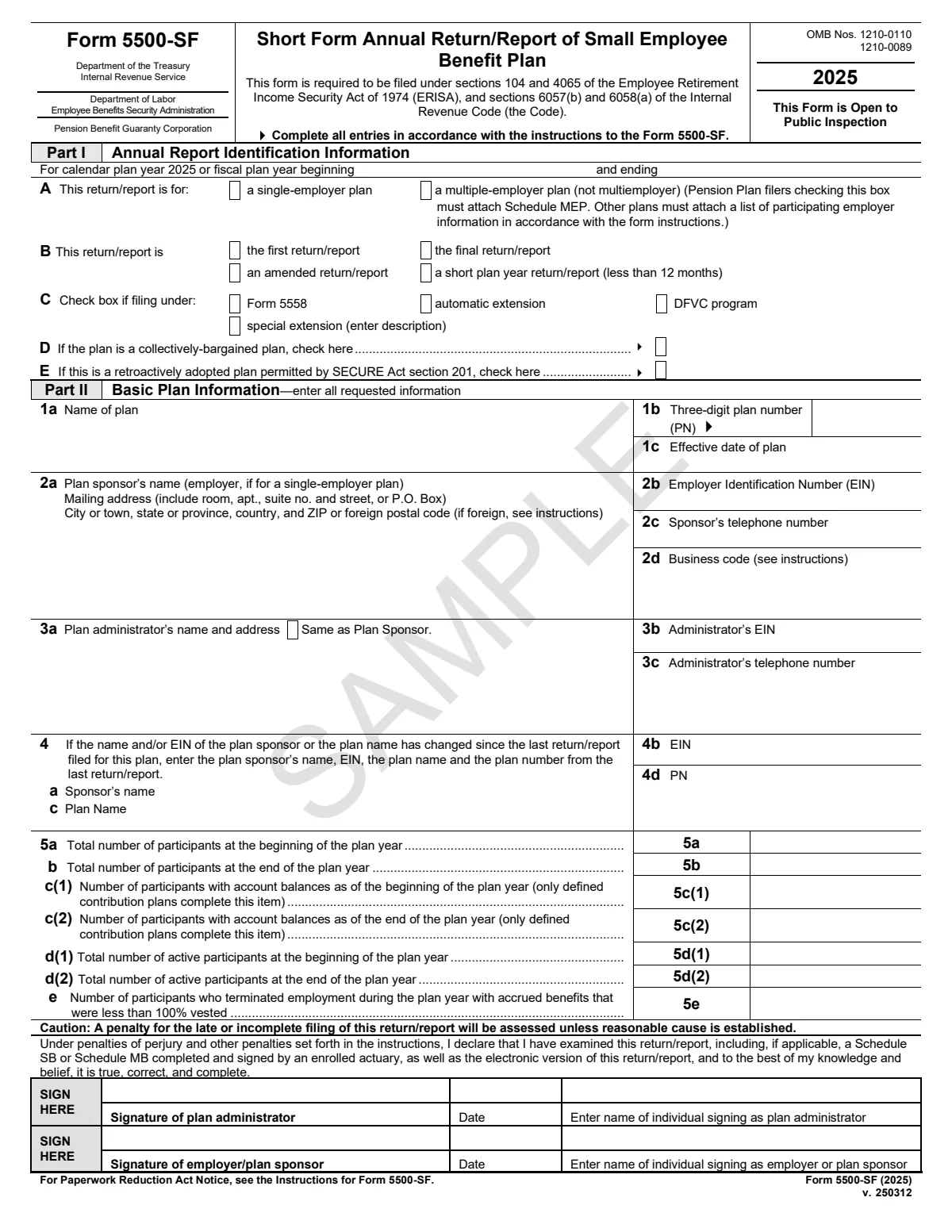
Part I: identification
| Line | Label | What goes there |
|---|---|---|
| Year | Plan year beginning and ending | File the 2025 Form 5500-SF for a plan year that began in 2025 and enter the beginning and ending dates. A short plan year gets its own dates plus the short plan year box on line B. |
| A | This return/report is for | Check only one box. A controlled group is generally one employer. A multiple-employer pension plan attaches Schedule MEP. “Multiemployer plans, pooled employer plans and DCG reporting arrangements cannot use the Form 5500-SF”; they file the Form 5500. |
| B | This return/report is | First return: no annual return/report was filed before (a Form 5500-EZ does not count). Amended: check it if a 2025 filing already has a Filing_Received, Filing_Error or Filing_Stopped status, and resubmit the whole filing. An eligible plan may amend on the 5500-SF even if the original was a Form 5500; a plan that filed the 5500-SF but was not eligible amends on the Form 5500 or 5500-EZ. Final: only when all assets are distributed or transferred and, for a welfare plan, all benefit liabilities are satisfied. |
| C | Check box if filing under | Check Form 5558 if you filed one (keep a copy), automatic extension if you rely on the employer's income tax extension, or special extension with a description. Checking the DFVC box does not enter the program; you apply and pay separately (see DFVCP). |
| D | Collectively-bargained plan | Check the box when the contributions to the plan and/or the benefits paid by the plan are subject to the collective bargaining process. They do not have to be identical for all employees. |
| E | Retroactively adopted plan (SECURE Act section 201) | No 2024 return is required for such a plan. A defined benefit plan includes the 2024 Schedule SB as an attachment to the 2025 Schedule SB. |
Part II: plan information and eligibility
Lines 1 to 4 match the Form 5500. Line 5 differs: it puts all the counts on one page, and line 6 is the eligibility gate.
| Line | Label | What goes there |
|---|---|---|
| 1a | Name of plan | Use the same name or abbreviation as on prior filings of any type (Form 5500, 5500-EZ or 5500-SF), and never reuse it for another plan. A changed name goes on line 4. |
| 1b | Three-digit plan number (PN) | Assign 001 to the first plan with codes on line 9a (pension) and 501 to the first plan with codes only on line 9b (welfare), numbering others consecutively. Do not use 888 or 999, and never reuse a number. |
| 1c | Effective date of plan | Enter the date the plan first became effective. |
| 2a | Plan sponsor's name and address | A multiple-employer plan with no association sponsor names one participating employer, and a controlled group names one member; use the same name in later filings. Use IRS Form 8822-B for an address change. |
| 2b | Employer Identification Number (EIN) | Enter the employer's nine-digit EIN; an SSN may get the filing rejected because the form is posted on the internet. A trust EIN is generally not required here. Keep the same EIN every year or report the change on line 4. |
| 2c | Sponsor's telephone number | Numbers only, including the area code, with no special characters. |
| 2d | Business code | Use the six-digit code from the 2025 list that best describes the sponsor's business. Avoid 525100 and 813930 unless that is truly the active participants' industry. |
| 3a | Plan administrator's name and address | The administrator is the person or group named in the plan instrument, the PEO for a PEO plan, or the sponsor if none is named. An employee who does administrative work is not the administrator unless the plan document designates that employee. |
| 3b | Administrator's EIN | A plan administrator must have an EIN for Form 5500-SF reporting; an employee designated as administrator must obtain one. |
| 3c | Administrator's telephone number | Numbers only, including the area code. |
| 4 | Change in sponsor name, EIN or plan name (4a to 4d) | Leaving it blank after a change could result in correspondence from the DOL and/or the IRS. |
| 5a | Total participants at the beginning of the plan year | Defined benefit pension plans and welfare plans use line 5a to test 5500-SF eligibility. Welfare plans do not count covered dependents; pension plans do not count alternate payees under a QDRO. |
| 5b | Total participants at the end of the plan year | Count active, retired or separated, and deceased participants with beneficiaries, as defined in the instructions for line 5. |
| 5c(1) | Participants with account balances, beginning of year | Participants included on line 5a with account balances at the beginning of the year. Welfare and defined benefit plans do not complete line 5c. Defined contribution plans test eligibility on 5c(1). |
| 5c(2) | Participants with account balances, end of year | Participants included on line 5b with account balances at the end of the year. A defined contribution plan that checks the first return box uses 5c(2) instead of 5c(1). |
| 5d(1) | Active participants at the beginning of the plan year | Active participants include anyone eligible to elect 401(k) deferrals and nonvested employees still earning service. |
| 5d(2) | Active participants at the end of the plan year | Same definition as 5d(1), counted at year end. |
| 5e | Participants who terminated with less than 100% vesting | Include each individual who terminated employment during the year with accrued benefits less than 100% vested, whether or not the person had a break in service or received a cash or deemed distribution. |
| 6a | Were all plan assets eligible plan assets? | Eligible plan assets have a readily determinable fair market value, are not employer securities, and are held or issued by a regulated financial institution: mutual fund shares, insurer or bank investment contracts valued at least annually, publicly traded stock held by a broker-dealer, cash held by a bank, and participant loans. “If the answer to line 6a is “No” you CANNOT file the Form 5500-SF and must file the Form 5500.” |
| 6b | Claiming the IQPA audit waiver under 29 CFR 2520.104-46? | Small welfare plans are exempt from the audit. A small pension plan qualifies under 29 CFR 2520.104-46 when at least 95% of its assets were qualifying plan assets at the end of the prior year, the SAR carries the waiver disclosure, and the administrator gives copies of institution statements on request. If the plan relies on an enhanced fidelity bond instead, “the plan does not satisfy the conditions for filing the Form 5500-SF and must file the Form 5500”. See the audit requirement. |
| 6c | Defined benefit plan covered by PBGC? | If Yes, enter the My PAA confirmation number for this plan year's premium filing (the amended filing's number if you amended). If unsure, check Not determined and contact PBGC. Defined contribution and welfare plans skip line 6c. |
Part III: financial information
The cash, modified cash or accrual basis may be used, as long as it is used consistently. “Round off all amounts reported on the Form 5500-SF to the nearest dollar.” Current value means fair market value where available.
| Line | Label | What goes there |
|---|---|---|
| 7a | Total plan assets | Column (a) must match the prior return's end of year amount (Schedule I line 1a or Schedule H line 1f after a Form 5500) and leaves out 2025 contributions. Column (b) excludes a deemed distributed loan that is a directed investment of the participant's account with repayment stopped. EFAST2 warning Z-008 flags a mismatch. |
| 7b | Total plan liabilities | Liabilities do not include the value of future pension payments. Accrual basis filers include approved but unpaid claims (including IBNR welfare claims), accounts payable and acquisition indebtedness. |
| 7c | Net plan assets (7a minus 7b) | “Line 7c, column (b), must equal the sum of line 7c, column (a), plus lines 8i (net income (loss)) and 8j (transfers to (from) the plan).” |
| 8a(1) | Contributions from employers | Report total cash contributions received and (for accrual basis plans) due. Accrual basis plans must not include contributions designated for years before 2025. |
| 8a(2) | Contributions from participants | For pension plans, include elective contributions under a 401(k) arrangement; for welfare plans, all employee contributions, including elective contributions under a Code section 125 cafeteria plan. |
| 8a(3) | Other contributions (including rollovers) | Enter the current value, at the date contributed, of all other contributions, including rollovers from other plans. |
| 8b | Other income (loss) | Include interest, dividends (accrual plans include declared dividends), net gain or loss on sales, and unrealized appreciation or depreciation. Transfers from other plans go on line 8j. |
| 8c | Total income | Add lines 8a(1) through 8a(3) and 8b. Enter a minus sign to the left of a negative number. |
| 8d | Benefits paid | Include payments to participants (including eligible rollover distributions), premiums paid to insurers and HMOs for benefits, and payments to other benefit providers. Form 1099-R distributions go here, not on line 8j. |
| 8e | Certain deemed and/or corrective distributions | Include excess deferrals, excess contributions and excess aggregate contributions distributed with income, and a deemed distributed loan only when both line 7a conditions apply. Reduce it if a participant resumes repaying a loan reported in an earlier year. |
| 8f | Administrative service providers | Include fees paid (or for accrual plans, incurred) for accounting, actuarial, legal, investment management and advice, brokerage, contract administration and individual trustees. |
| 8g | Other expenses | Other administrative and miscellaneous expenses paid by or charged to the plan. |
| 8h | Total expenses | Add lines 8d, 8e, 8f and 8g. |
| 8i | Net income (loss) | Subtract line 8h from line 8c. |
| 8j | Transfers to (from) the plan | Enter the net value of assets transferred to and from the plan, including mergers and spinoffs. Transfers out at year end count as made during the year. Do not submit Form 1099-R with the filing. |
Parts IV and V: codes and compliance
Answer every line 10 question Yes or No; a Yes on lines 10a to 10g needs an amount.
| Line | Label | What goes there |
|---|---|---|
| 9a | Pension feature codes | Enter all applicable codes from the List of Plan Characteristic Codes in the Form 5500 instructions. An eligible combined plan enters codes for both its defined benefit and defined contribution features. New for 2025: code 1G for a variable annuity benefit formula. |
| 9b | Welfare feature codes | A welfare plan that becomes exempt for the next year enters 4R and does not check the final return box; one that resumes filing enters 4S. |
| 10a | Late participant contributions | Participant contributions become plan assets as soon as they can reasonably be segregated. For a plan with fewer than 100 participants, an amount deposited “not later than the 7th business day following the day on which such amount is received by the employer” is treated as timely (29 CFR 2510.3-102(a)(2)). Report the aggregate late amount, and report it again each year through the plan year in which the violation is fully corrected. A nonexempt prohibited transaction may also require Form 5330 unless VFCP and PTE 2002-51 relief applies. |
| 10b | Nonexempt transactions with a party-in-interest | Leave out statutorily or administratively exempt transactions, those exempt under Code section 4975(c) or (d), welfare contributions held under Technical Release 92-01, and amounts on line 10a. Transactions corrected under VFCP with PTE 2002-51 relief count as exempt. |
| 10c | Fidelity bond | The plan (not the sponsor) must be a named insured under a bond covering plan officials against fraud or dishonesty (ERISA section 412, 29 CFR Part 2580). Fiduciary liability insurance “cannot be reported as fidelity bonds on line 10c”. |
| 10d | Loss from fraud or dishonesty | Report the full amount of any loss suffered or discovered, even if reimbursed. Willful failure to report is a criminal offense under ERISA section 501. |
| 10e | Insurance fees and commissions paid to brokers or agents | Include persistency and profitability bonuses. Occasional gifts under $50 (and under $100 a year from one source) need not be reported. The insurer must give you the figures under ERISA section 103(a)(2). |
| 10f | Failure to provide benefits when due | Include unpaid required minimum distributions and amounts unpaid from earlier years. Unpaid RMDs for missing participants being searched for need not be reported, absent other guidance. |
| 10g | Participant loans | Check Yes if loans were outstanding at any time during the year and enter the amount outstanding at year end; enter 0 if none remain at year end. |
| 10h | Blackout period | “A blackout period is a temporary suspension of more than three consecutive business days” during which participants could not direct or diversify, borrow or take distributions. Regularly scheduled, disclosed suspensions and QDRO-related suspensions are not blackout periods. Other filers leave line 10h blank. |
| 10i | Blackout notice provided | Answer Yes if the required notice was given not less than 30 nor more than 60 days in advance, or an exception under 29 CFR 2520.101-3 applied. |
Parts VI to VIII: funding, terminations, IRS questions
Part VI applies only to plans subject to the minimum funding rules of Code section 412 or ERISA section 302. Profit-sharing and stock bonus plans are generally outside them.
| Line | Label | What goes there |
|---|---|---|
| 11 | Defined benefit plan subject to minimum funding? | If Yes, attach a completed and signed Schedule SB. A defined contribution plan leaves line 11 blank and completes line 12. |
| 11a | Unpaid minimum required contributions | Enter the amount from line 40 of Schedule SB. |
| 11b | PBGC missed contribution reporting | Complete it only if the plan is covered by PBGC and line 11a is more than $0. Check Yes if PBGC was notified; otherwise check the waiver, the 30-day period not yet ended, or Other with an explanation (see 29 CFR 4043.25). |
| 12 | Defined contribution plan subject to minimum funding? | A plan amortizing a funding waiver completes 12a and skips to line 13; other Yes plans complete 12b to 12e. DC plans not subject to minimum funding check No. |
| 12a | Funding waiver letter ruling date | Complete lines 3, 9 and 10 of Schedule MB; for a money purchase plan it need not be signed by an enrolled actuary. |
| 12b | Minimum required contribution | The amount required under the plan document formula, plus any accumulated funding deficiency from a prior year that has not been waived. |
| 12c | Employer contributions for the plan year | “Include all contributions for the plan year made not later than 8½ months after the end of the plan year.” Show only contributions actually made by the filing date. |
| 12d | Funding deficiency (12b minus 12c) | An excess of 12b over contributions made within 8½ months is an accumulated funding deficiency; file Form 5330 to pay the excise tax. |
| 12e | Will the minimum funding amount be met? | If Yes and the contribution is made by that date, there is no reportable deficiency and no Form 5330. |
| 13a | Resolution to terminate; reversion to employer | Enter the plan assets that reverted to the employer this year, or 0. A return is still due each year the plan has assets. |
| 13b | All plan assets distributed or transferred? | Check No for a welfare plan still liable for claims incurred before termination but not yet paid. |
| 13c | Transfers to other plans | Never use an SSN in place of an EIN. IRS Form 5310-A must be filed at least 30 days before a merger, consolidation or transfer. |
| 14a | Permissive aggregation for coverage and nondiscrimination | Plans aggregated for the minimum coverage test must also be treated as one plan for the nondiscrimination test under Code section 401(a)(4). |
| 14b | 401(k) nondiscrimination method | Design-based safe harbor covers SIMPLE 401(k), 401(k)(12) safe harbor and QACA plans. Check N/A when no test is required, such as when no HCE benefits. Multiple-employer plans skip it. |
| 15 | Pre-approved plan opinion letter | The serial number is a capital letter followed by six numbers. A plan modified in a way that negates the opinion letter is treated as an individually designed plan. |
Signatures
| Line | Label | What goes there |
|---|---|---|
| Sig-PA | Signature of plan administrator | “A Form 5500-SF that is not electronically signed by the plan administrator will be subject to rejection and civil penalties under Title I of ERISA.” An entity administrator signs through an authorized person. A service provider may sign under the e-signature option with a PDF of the manually signed form attached. |
| Sig-ER | Signature of employer/plan sponsor | This signature does not replace the plan administrator's. There is no DFE signature line because DFEs cannot file the 5500-SF. |
Common mistakes
| Mistake | Line | Fix |
|---|---|---|
| Filing the 5500-SF for a plan that holds a limited partnership, real estate or other hard-to-value asset | 6a | Answer No and file the Form 5500 with Schedule I |
| Beginning of year assets that do not match last year's ending assets (EFAST2 Z-008) | 7a | Carry forward the prior year's end of year figures exactly |
| Net assets that do not roll forward | 7c, 8i, 8j | 7c(b) must equal 7c(a) plus 8i plus 8j |
| Late deferrals reported only in the year they happened | 10a | Report them each year through the year they are fully corrected |
| Fiduciary liability insurance reported as a fidelity bond | 10c | Report only an ERISA bond naming the plan as insured |
| A one-participant plan filing the 5500-SF (EFAST2 I-207SF) | 5 | File the Form 5500-EZ |
A Yes on 6a and 6b is a statement that the plan qualifies. If either answer is No, the plan cannot use the 5500-SF and must instead file the Form 5500 with its schedules.
Questions filers ask
Can a plan with 110 participants file the 5500-SF?
Yes, if it filed as a small plan for 2024, had no more than 120 participants at the beginning of 2025, and meets every other condition, including eligible assets and the audit waiver.
Which count does a 401(k) plan use for the 100-participant test?
Line 5c(1), participants with account balances at the beginning of the year. A plan filing its first return uses line 5c(2). Defined benefit and welfare plans use line 5a.
Do I attach Schedule A or Schedule C to a 5500-SF?
No. The only schedules that go with the 5500-SF are Schedule SB, Schedule MB and Schedule MEP, when the plan type requires them. Insurance commissions go on line 10e instead.
Can a one-participant plan use the 5500-SF?
No. The 5500-EZ instructions say a one-participant plan or foreign plan cannot file on Form 5500 or 5500-SF, even if it did before. It files the 5500-EZ, on paper or through EFAST2.