At a glance
Schedule C is attached to the Form 5500 filed for a large pension or welfare plan, an MTIA, a 103-12 IE, a DCG or a GIA. Part I is required if a service provider “received, directly or indirectly, $5,000 or more in reportable compensation” in connection with services to the plan or their position with it. Part II reports service providers who failed or refused to give the information Part I needs, and Part III reports a terminated accountant or enrolled actuary. Small plans do not file Schedule C: the quick reference chart marks it not required for small pension and welfare plans. Check box 10b(4) on the Form 5500 when it is attached.
“Health and welfare plans that meet the conditions of the limited exemption at 29 CFR 2520.104-44 or Technical Release 92-01 are not required to complete and file a Schedule C.” Four kinds of people are also left out of Part I: plan employees whose only compensation was under $25,000 for the year; employees of a sponsor or business that is itself listed as a service provider, if they were not separately paid; persons whose only compensation is insurance fees and commissions listed on Schedule A; and anyone paid directly by the sponsor without reimbursement from the plan. “Do not list PBGC or the IRS on Schedule C as service providers.”
The schedule is due with the Form 5500, which “must be filed by the last day of the 7th calendar month after the end of the plan, DCG or GIA year”. “Your 2025 Form 5500 must be electronically filed in the ERISA Filing Acceptance System (EFAST2).” Use the cash or accrual basis consistently.
The form, page by page
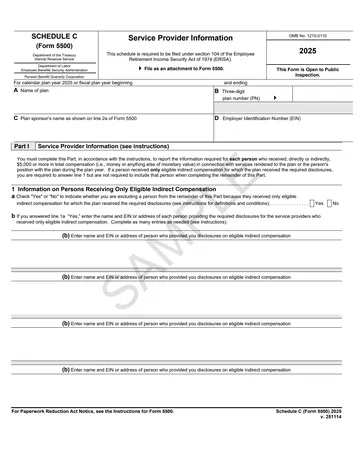
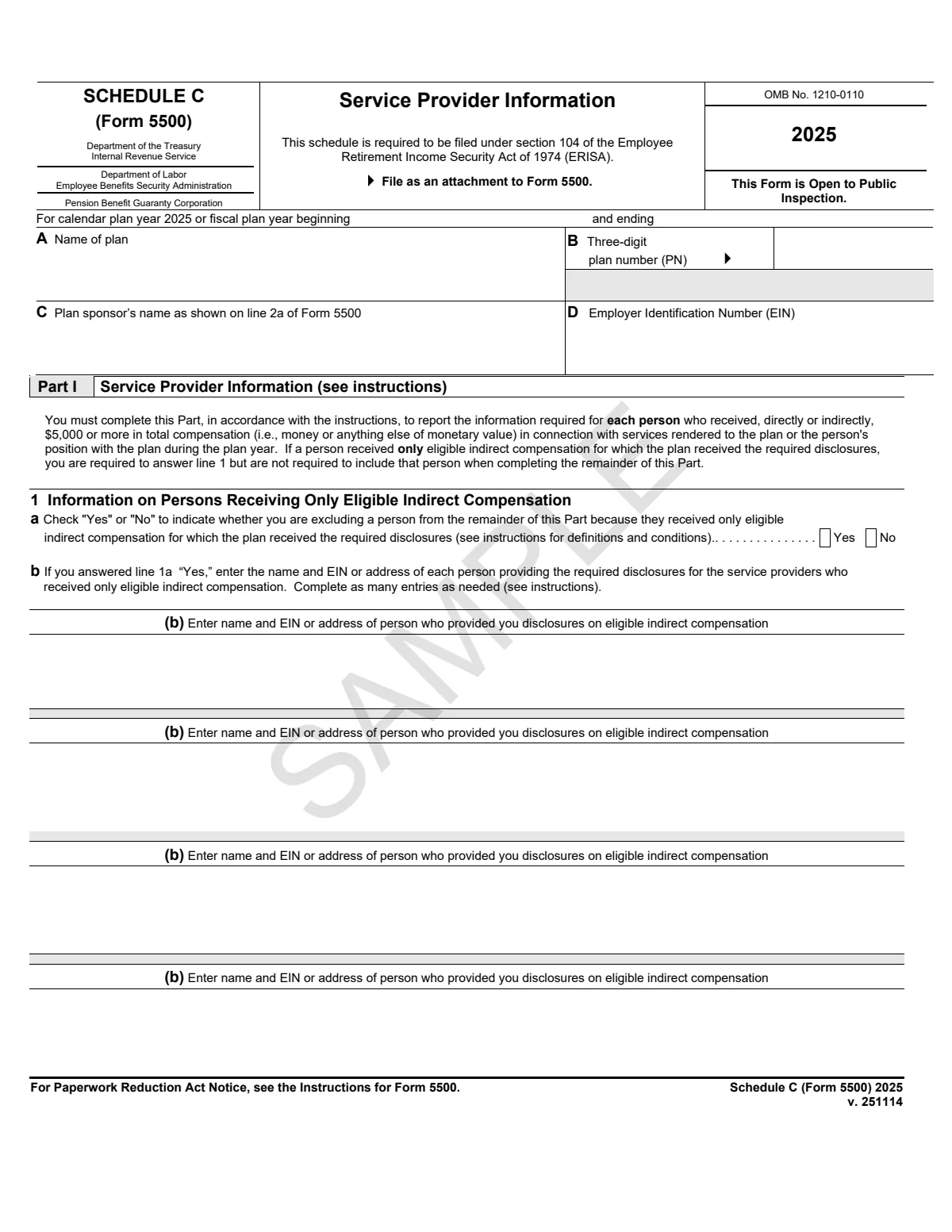
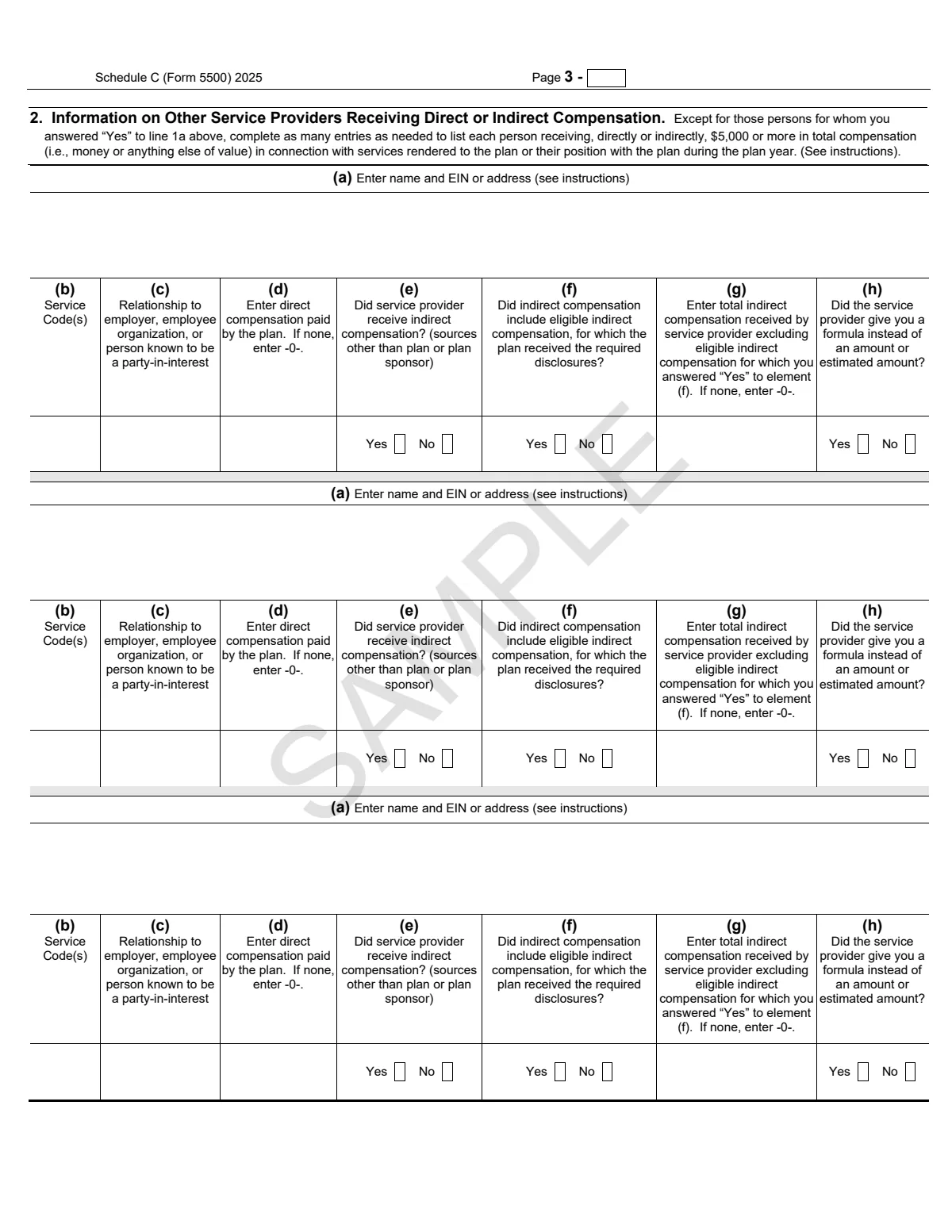
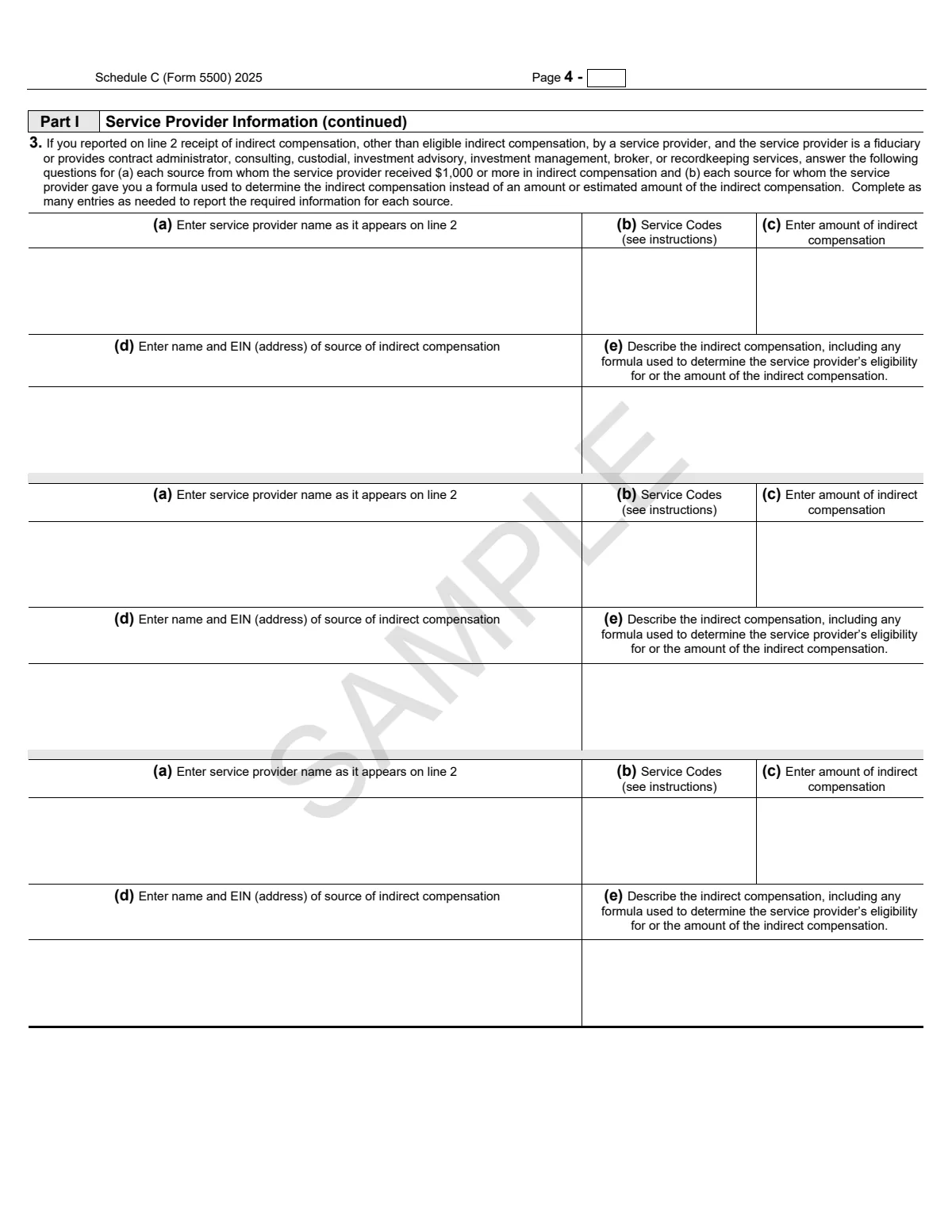
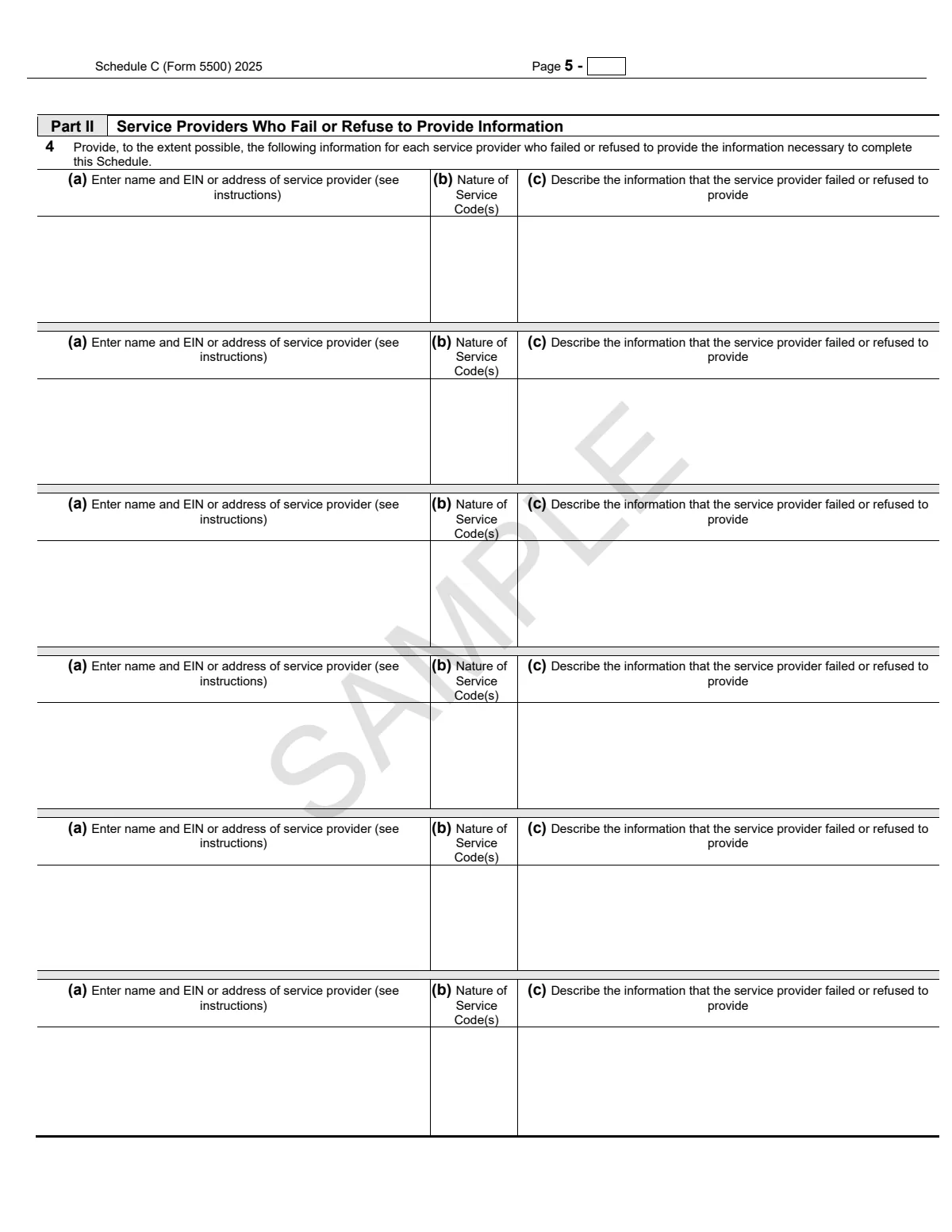
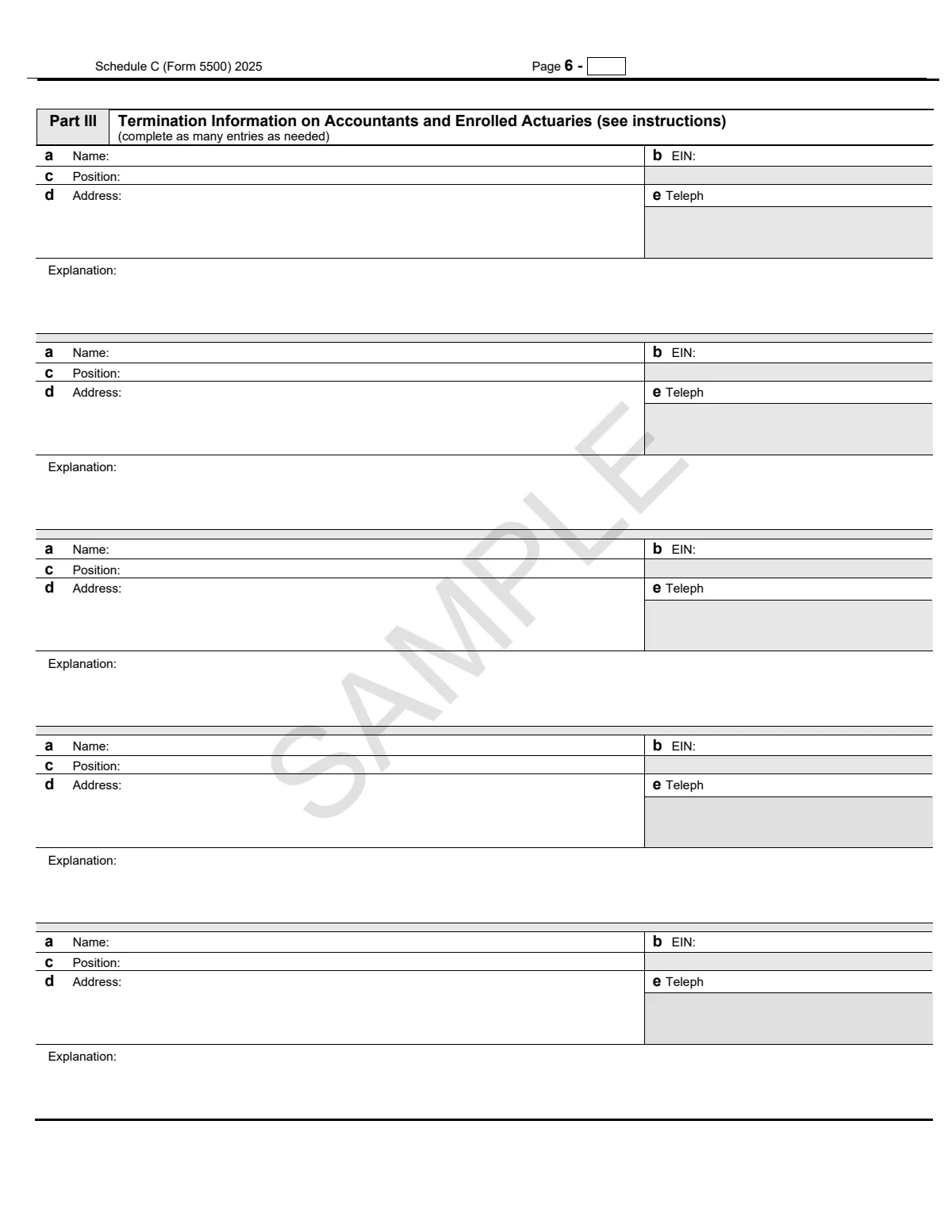
The 2025 Schedule C has six pages: line 1 on pages 1 and 2, line 2 on page 3, line 3 on page 4, Part II on page 5 and Part III on page 6. Most pages repeat the same entry several times; the first entry on each page carries the hotspots.
Swipe sideways to see the whole page, or pinch to zoom. Tap a box once for its note, again to jump to the line.

Part I: service provider information
| Line | Label | What goes there |
|---|---|---|
| A-D | Plan name, plan number, sponsor, EIN | Must match Part II of the Form 5500. Use the sponsor's EIN, never a Social Security number; the schedule is public. |
| Part-I | Who must be listed | Each person who rendered services to or had transactions with the plan and received $5,000 or more in total direct or indirect compensation for those services or their position with the plan. In the instructions' example, providers paid $12,000 and $6,000 are listed, and providers paid $4,500 and $430 are not. See the exceptions below the table. |
| 1a | Persons receiving only eligible indirect compensation | Check Yes if you are using the alternative reporting option to leave out a person or persons who received only eligible indirect compensation for which the plan received the required written disclosures. Those persons are then not listed on line 2. |
| 1b | Name and EIN or address of the person who provided the disclosures | If 1a is Yes, list each person who gave you the disclosures about eligible indirect compensation, not necessarily each person who was paid. Use as many entries as needed. |
| 1b-more | Additional line 1b entries (page 2) | Page 2 continues line 1b. |
| 2(a) | Name and EIN or address | List each person, other than those excluded on line 1, who received $5,000 or more, starting with the highest paid and going down. Enter the EIN; for an individual without one, the employer's EIN; for a self-employed person without one, the address and telephone number. Never an SSN. |
| 2(b) | Service code(s) | “Select from the list below all codes that describe both the kind of services provided and the type of compensation received.” Enter as many as apply; the full list is in the code table on this page. |
| 2(c) | Relationship to employer, employee organization or party-in-interest | For example, employee of employer, vice-president of employer, union officer or affiliate of plan recordkeeper. |
| 2(d) | Direct compensation paid by the plan | Compensation received directly from the plan. If a fee is offset by revenue from someone else (a commission recapture or other offset), enter only what the plan paid after the offset. Amounts the sponsor paid and the plan reimbursed count as direct payments. “Do not leave element (d) blank. If no direct compensation was received, enter “0”.” |
| 2(e) | Did the service provider receive indirect compensation? | Yes if the person or any related person received indirect compensation for services to the plan or their position with it. If No, skip (f) to (h). |
| 2(f) | Did indirect compensation include eligible indirect compensation? | Yes if any of it was eligible indirect compensation for which the plan received the required disclosures; No if none was. |
| 2(g) | Total indirect compensation, excluding eligible indirect compensation | All indirect compensation that is not eligible indirect compensation with the required disclosures. Do not leave it blank: enter 0 if none. |
| 2(h) | Did the provider give you a formula instead of an amount? | Yes if, for some or all of the indirect compensation, you received a formula or description of the method instead of an amount or estimate. |
| 2-more | Additional line 2 entries | Repeat (a) to (h) for each person, in descending order of compensation. |
| 3(a) | Service provider name, as on line 2 | Complete line 3 for each person on line 2 who is a fiduciary or provides contract administrator, consulting, custodial, investment advisory, investment management, broker or recordkeeping services, for each source that paid the person indirect compensation of $1,000 or more, or for which the plan received a formula instead of an amount. |
| 3(b) | Service codes | The provider's service and compensation codes from the code table. |
| 3(c) | Amount of indirect compensation | The indirect compensation the provider received from the source named in 3(d). |
| 3(d) | Name and EIN or address of the source | Who paid the indirect compensation, for example a mutual fund or its investment adviser. |
| 3(e) | Description of the indirect compensation | What it is, including any formula used to determine the provider's eligibility for it or its amount. |
| 3-more | Additional line 3 entries | One entry per source. |
Part II: providers who fail to provide information
| Line | Label | What goes there |
|---|---|---|
| 4(a) | Name and EIN or address of the service provider | Each fiduciary or service provider you believe failed or refused to provide information needed for Part I. Before listing anyone, “you should contact the fiduciary or service provider to request the necessary information” and tell them you will list them if they do not provide it. |
| 4(b) | Nature of service code(s) | The provider's codes from the code table. |
| 4(c) | Information not provided | Describe the information the provider failed or refused to provide. |
| 4-more | Additional line 4 entries | One entry per provider. |
Part III: terminated accountants and actuaries
| Line | Label | What goes there |
|---|---|---|
| III(a)-(b) | Name and EIN | Complete Part III if an accountant or enrolled actuary was terminated during the 2025 plan year, on the Form 5500 for the year the termination occurred. For an accounting firm, report when the firm was terminated. “An enrolled actuary is by definition an individual and not a firm”. For an individual with no EIN, enter the employer's EIN. |
| III(c) | Position | Accountant or enrolled actuary. |
| III(d)-(e) | Address and telephone | Contact details. |
| III-expl | Explanation | The reasons for the termination. “Include a description of any material disputes or matters of disagreement concerning the termination, even if resolved prior to the termination.” The administrator must also give the terminated accountant or actuary a copy of the explanation and the Notice to Terminated Accountant or Enrolled Actuary printed in the instructions, which invites comments to EBSA's Office of Enforcement. |
| III-more | Additional Part III entries | One entry per terminated accountant or enrolled actuary. If an accountant finishes the 2024 audit and is terminated in the 2025 plan year, report it on the 2025 Schedule C. |
Direct and indirect compensation
Reportable compensation is money and anything else of value, such as gifts, awards and trips, received directly or indirectly from the plan, including fees charged as a percentage of assets and deducted from investment returns. Direct compensation is paid by the plan itself: out of a plan account, from forfeiture or fee recapture accounts, from the trust before allocation, or charged to participant accounts. “Payments made by the plan sponsor, which are not reimbursed by the plan, are not subject to Schedule C reporting requirements even if the sponsor is paying for services rendered to the plan.”
“Compensation received from sources other than directly from the plan or plan sponsor is reportable on Schedule C as indirect compensation” if it was received in connection with services to the plan or the person's position with it. Examples in the instructions: a mutual fund's management fee to its adviser, sub-transfer agency fees, shareholder servicing fees, account maintenance fees, 12b-1 fees, finder's fees, float revenue, brokerage commissions and soft dollars. Ordinary fund operating expenses such as attorneys', accountants' and printers' fees are not reportable indirect compensation, and neither is brokerage inside a mutual fund's portfolio. The investment of plan assets and the payment of insurance premiums are not, by themselves, payments for services.
Eligible indirect compensation
Eligible indirect compensation lets you report a person on line 1 instead of line 2. Two tests must both be met.
The type of compensation. It must be “fees or expense reimbursement payments charged to investment funds and reflected in the value of the investment or return on investment of the participating plan or its participants”, or finder's fees, soft dollar revenue, float revenue, or brokerage commissions or other transaction-based fees not paid directly by the plan or sponsor. Investment funds include mutual funds, bank commingled trusts (including CCTs), insurance company pooled separate accounts and other pooled or separately managed accounts.
The written disclosures. The plan must have received written materials that disclose and describe:
- the existence of the indirect compensation;
- the services provided for it, or the purpose of the payment;
- the amount or an estimate, or a description of the formula used to calculate it; and
- the identity of the parties paying and receiving it.
For a bundled arrangement, the disclosures must separately describe each element that would otherwise have to be reported. The option is all or nothing per person: if anyone received eligible indirect compensation plus direct compensation or other indirect compensation, “you cannot rely on the alternative reporting option for that person and must complete line 2 for each such person who received $5,000 or more in direct and indirect compensation.” On line 2, element (f) then says whether part of that person's indirect compensation was eligible, and element (g) leaves the eligible part out.
- Was the person paid only through fees charged to an investment fund, finder's fees, soft dollars, float or transaction-based fees?
- Did the plan receive written disclosures covering existence, services, amount or formula, and payer and recipient?
- If both are yes, answer Yes on 1a and list the person who provided the disclosures on 1b. If either is no, or the person was also paid other compensation, report the person on line 2.
Service and compensation codes
Element 2(b), and the codes on lines 3 and 4, use the list in the instructions. In the list, codes 10 to 49 name services and codes 50 to 99 name types of compensation, and you enter every code that applies to the person.
| Code | Service |
|---|---|
| 10 | Accounting (including auditing) |
| 11 | Actuarial |
| 12 | Claims processing |
| 13 | Contract Administrator |
| 14 | Plan Administrator |
| 15 | Recordkeeping and information management (computing, tabulating, data processing, etc.) |
| 16 | Consulting (general) |
| 17 | Consulting (pension) |
| 18 | Custodial (other than securities) |
| 19 | Custodial (securities) |
| 20 | Trustee (individual) |
| 21 | Trustee (bank, trust company, or similar financial institution) |
| 22 | Insurance agents and brokers |
| 23 | Insurance services |
| 24 | Trustee (discretionary) |
| 25 | Trustee (directed) |
| 26 | Investment advisory (participants) |
| 27 | Investment advisory (plan) |
| 28 | Investment management |
| 29 | Legal |
| 30 | Employee (plan) |
| 31 | Named fiduciary |
| 32 | Real estate brokerage |
| 33 | Securities brokerage |
| 34 | Valuation (appraisals, etc.) |
| 35 | Employee (plan sponsor) |
| 36 | Copying and duplicating |
| 37 | Participant loan processing |
| 38 | Participant communication |
| 40 | Foreign entity (e.g., an agent or broker, bank, insurance company, etc. not operating within jurisdictional boundaries of the United States) |
| 49 | Other services |
| Code | Type of compensation |
|---|---|
| 50 | Direct payment from the plan |
| 51 | Investment management fees paid directly by plan |
| 52 | Investment management fees paid indirectly by plan |
| 53 | Insurance brokerage commissions and fees |
| 54 | Sales loads (front end and deferred) |
| 55 | Other commissions |
| 56 | Non-monetary compensation |
| 57 | Redemption fees |
| 58 | Product termination fees (surrender charges, etc.) |
| 59 | Shareholder servicing fees |
| 60 | Sub-transfer agency fees |
| 61 | Finders' fees/placement fees |
| 62 | Float revenue |
| 63 | Distribution (12b-1) fees |
| 64 | Recordkeeping fees |
| 65 | Account maintenance fees |
| 66 | Insurance mortality and expense charge |
| 67 | Other insurance wrap fees |
| 68 | ‘Soft dollars’ commissions |
| 70 | Consulting fees |
| 71 | Securities brokerage commissions and fees |
| 72 | Other investment fees and expenses |
| 73 | Other insurance fees and expenses |
| 99 | Other fees |
Special rules
Gifts and meals. Non-monetary compensation of insubstantial value that is tax deductible to the giver and not taxable to the recipient may be excluded if each gift is under $50 and the gifts from one source total under $100 for the calendar year (gifts under $10 do not count toward the $100). “If the $100 aggregate value limit is exceeded, then the value of all the gifts over $10 will be reportable.”
Fully insured benefits. Reasonable payments by an insurer from its general assets for administrative work it needs to provide benefits reported on Schedule A, with no charge to the plan beyond the premium, are not indirect compensation. Sales-related payments such as finder's fees and brokerage commissions do not qualify, and insurance investment contracts are not eligible for this exception.
Bundled arrangements. Direct payments to a bundled provider are reported as its direct compensation and need not be allocated among affiliates or subcontractors, unless an affiliate's or subcontractor's pay is set per transaction. Fees charged against investments, such as fund management fees, float, commissions, 12b-1, account maintenance and shareholder servicing fees, are reported as separate compensation of the person who receives them, subject to the eligible indirect compensation option.
Several plans. A provider may allocate compensation among plans by any reasonable method disclosed to the administrator, and the $5,000 test uses the share attributable to the filing plan. For a DCG, every provider to the DCG and its plans is reported, and the $5,000 threshold uses the provider's total from all sources, not a per-plan share. Compensation already reported on an MTIA's or 103-12 IE's Schedule C is not repeated on the participating plans' Schedules C.
Common mistakes
- Blank elements. Elements (d) and (g) must show 0 when there is nothing to report.
- Listing PBGC or the IRS, or listing a broker whose only pay is Schedule A commissions.
- Using the eligible indirect compensation option for a person who also received direct compensation from the plan.
- Naming a provider in Part II without first asking for the information and warning that it will be listed.
- Forgetting Part III when the auditor or actuary changed, or the notice to the terminated accountant or actuary.
- An SSN in place of an individual's EIN. The schedule is public and the filing may be rejected.
An incomplete filing is exposed to the DOL's civil penalty of up to $2,739 a day under ERISA 502(c)(2) for a plan administrator who fails or refuses to file a complete and accurate report (the 2025 amount, 90 FR 1854; the DOL made no 2026 adjustment, 91 FR 31358). See Form 5500 penalties and, for the rest of the large plan filing, Schedule H.
Questions filers ask
Our plan has 60 participants. Do we file Schedule C?
No. Schedule C is filed with the Form 5500 for large plans, MTIAs, 103-12 IEs, DCGs and GIAs. The quick reference chart marks it not required for small plans.
The employer pays the auditor directly. Is the audit fee on Schedule C?
No, unless the plan reimburses the employer. Payments by the sponsor that the plan does not reimburse are not subject to Schedule C reporting.
A provider received $4,800 from the plan and $400 in 12b-1 fees. Is it reportable?
Direct and indirect compensation are added together for the $5,000 test, so this provider, at $5,200, is listed unless all of its pay qualifies for the eligible indirect compensation option, which it cannot here because it also received direct compensation.
What are eligible indirect compensation disclosures?
Written materials describing the compensation's existence, the services or purpose, the amount, estimate or formula, and who paid and received it.
When does line 3 apply?
For fiduciaries and providers of contract administrator, consulting, custodial, investment advisory, investment management, broker or recordkeeping services, for each source paying $1,000 or more in indirect compensation, or for which you received a formula.
Our audit firm resigned after finishing last year's audit. Where does it go?
On Part III of the Schedule C for the plan year in which the termination occurred, with an explanation including any disputes. The administrator also sends the firm a copy and the notice from the instructions.