At a glance
| Question | Answer from the 2025 instructions |
|---|---|
| Who files | Multiemployer defined benefit plans subject to the minimum funding standards, and money purchase plans (including target benefit plans) currently amortizing a funding waiver. |
| Who does not | Single-employer and multiple-employer defined benefit plans (they use Schedule SB); money purchase plans subject to funding that are not amortizing a waiver; a terminated multiemployer plan for years after the plan year in which it terminates. |
| Prepared and signed by | The plan's enrolled actuary, except for a money purchase plan amortizing a waiver, which needs no actuary's signature. |
| Attach to | Form 5500 (check Part II, line 10a(2)) or Form 5500-SF for an eligible money purchase plan. Not filed with the 5500-EZ, but kept with the records. |
| Due | With the return: the last day of the 7th month after the plan year ends, or the extended date. See Form 5500 due date. |
| How filed | The data entered electronically in EFAST2, plus a PDF of the signed schedule when a signature is required. |
| Late filing | A $1,000 penalty for each failure to file the actuarial statement, under Code section 6692 (as stated in the 2025 instructions). |
A multiemployer plan cannot use the short form: “Multiemployer plans, pooled employer plans and DCG reporting arrangements cannot use the Form 5500-SF to satisfy their annual reporting obligations.” So a multiemployer defined benefit plan files its Schedule MB with the Form 5500, along with Schedule R, whose Part V lists major contributing employers.
Who prepares and who files
The plan administrator of a multiemployer defined benefit plan “must obtain a completed Schedule MB (Form 5500) that is prepared and signed by the plan's enrolled actuary”, keeps it with the plan records, and makes sure its information is entered electronically in the return. The administrator also attaches a PDF of the signed schedule: “This electronic reproduction must be labeled "MB Actuary Signature"”.
The money purchase case is different. For a money purchase or target benefit plan amortizing a waiver, “lines 3, 9, and 10 of Schedule MB must be completed but it need not be signed by an enrolled actuary”. The return includes the Schedule MB with those lines but no signed PDF. Schedule R line 5 sends these plans here.
This page explains what each line asks for and the rules the instructions state. The figures come from the actuary's valuation and funding standard account under Code sections 431 and 432; the administrator enters them as the actuary prepared them.
Schedule MB is not filed with the Form 5500-EZ. If it is required, it must be retained with the 5500-EZ records, and the funding standard account must continue to be maintained even though the schedule is not filed.
The form, line by line
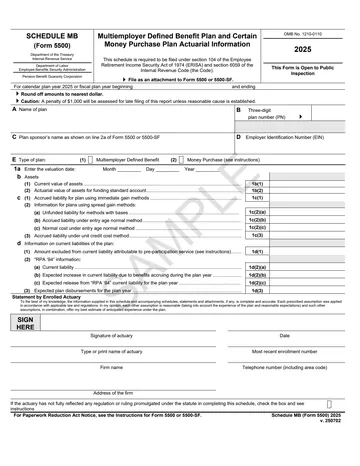
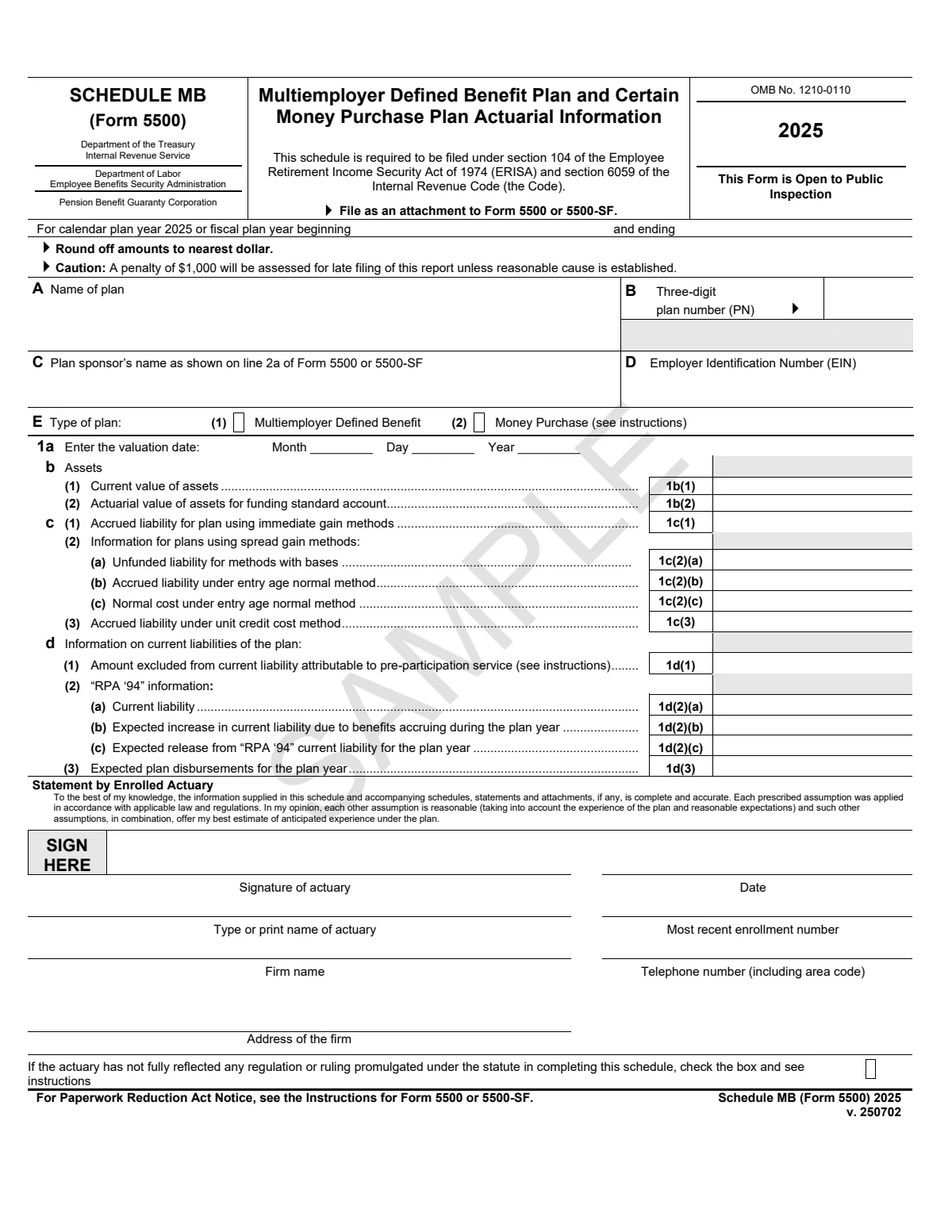
Schedule MB is four pages and has no Part numbers. Page 1 holds the header, line 1 and the actuary's statement; pages 2 to 4 hold lines 2 to 11. Use the page buttons to switch pages.
Swipe sideways to see the whole page, or pinch to zoom. Tap a box once for its note, again to jump to the line.
Header and line 1: valuation results
Lines A through E are completed for all plans. All line 1 entries are reported as of the valuation date.
| Line | Label | What goes there |
|---|---|---|
| A-D | Plan and sponsor identification | Lines A through E must be completed for all plans. Do not use an SSN in line D: the schedule and attachments are public and an SSN may result in rejection of the filing. |
| E | Type of plan | A money purchase plan (including a target benefit plan) amortizing a waiver of the minimum funding standard completes only lines 3, 9 and 10 and needs no actuary's signature. Its filing includes the Schedule MB but no signed PDF. |
| 1a | Valuation date | “The valuation for a plan year may be as of any date in the plan year, including the first or last day of the plan year.” Valuations must be performed within the period in Code section 431(c)(7) and ERISA section 304(c)(7). |
| 1b | Assets | Current value is fair market value. Do not adjust for the credit balance or outstanding amortization bases, and leave out rollovers and individual accounts not available for defined benefits. If the plan received special financial assistance under ERISA section 4262 on or before the valuation date, exclude the special financial assistance account. Line 1b(1) may differ from line 2a, for example when the valuation date is not the first day of the year. If insurance contracts are left out of line 1b(1), the liabilities they satisfy are left out of lines 1c(1), 1c(2) and 1d(2). |
| 1c(1) | Accrued liability, immediate gain methods | Revenue Ruling 81-213 defines immediate gain methods. |
| 1c(2) | Spread gain method information | Line 1c(2)(a) is only for the frozen initial liability or attained age normal method. Lines 1c(2)(b) and (c) are used for the full funding limitation. |
| 1c(3) | Accrued liability, unit credit | Line 4a divides line 1b(2) by this amount to get the funded percentage for monitoring the plan's status. |
| 1d(1) | Amount excluded from current liability | The instruction is one sentence: “Leave line 1(d)(1) blank.” |
| 1d(2) | RPA 94 current liability | All multiemployer plans complete it, whatever their size. Current liability uses the mortality tables in Treasury Regulations section 1.431(c)(6)-1, counts credited service only through the end of the prior year, and uses no salary projection. Line 1d(2)(b) may reflect one year's salary scale. |
| 1d(3) | Expected plan disbursements | Include all disbursements expected for the year. |
| Sign | Statement by Enrolled Actuary | Unless the plan is a money purchase plan amortizing a waiver, an enrolled actuary must sign. The signature may be qualified under Treasury Regulations section 301.6059-1(d). The actuary may sign by hand or type the name followed by handwritten initials; a stamped or machine produced signature is not acceptable. |
| Regs | Regulation not fully reflected | The attachment is labeled as the Statement by Enrolled Actuary. The actuary may add other comments on the schedule there. |
Lines 2 to 5: liabilities, contributions and status
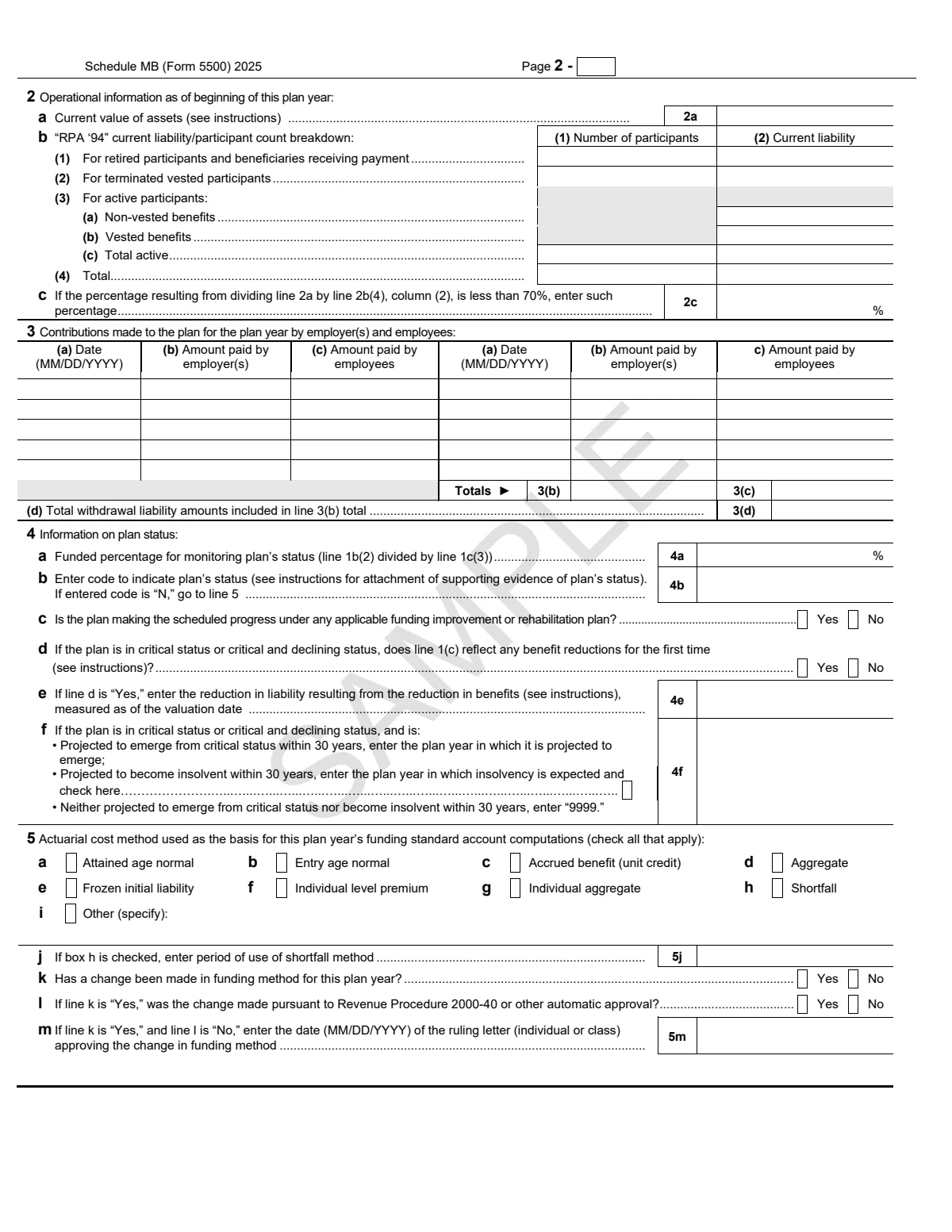
Line 2 is as of the beginning of the plan year. Lines 3 and 4 report contributions and the plan's status under Code section 432. Line 5 identifies the actuarial cost method.
| Line | Label | What goes there |
|---|---|---|
| 2a | Current value of assets, start of year | All line 2 entries are as of the beginning of the 2025 plan year and leave out rollover or individual account amounts and benefits for which an insurer made an irrevocable commitment. Contributions designated for 2025 are not included. Exclude any special financial assistance account. |
| 2b | RPA 94 current liability and counts | Do not include the expected increase from benefits accruing during the year. If the valuation date is later than the first day of the year, derive the counts from that valuation consistently with column (2). |
| 2c | Assets below 70% of current liability | This calculation is required under ERISA section 103(d)(11). Leave it blank when the ratio is 70% or greater. |
| 3 | Contributions made | Include employer contributions made within 2½ months after the plan year (or the later date allowed under Code section 431(c)(8)). “Show only contributions actually made to the plan by the date this Schedule MB is signed.” Every contribution must be credited to a particular plan year. |
| 3(d) | Withdrawal liability in line 3(b) | Attach a list of each withdrawal liability payment by date, split into periodic and lump sum amounts. A payment counts as a lump sum only if the whole liability is paid at once or a periodic payer settles the rest in one payment. The list may be a structured CSV attachment. |
| 4a | Funded percentage for monitoring status | All multiemployer plans, whatever their size, complete line 4. |
| 4b | Plan status code | The code is the status certified by the actuary, or elected by the sponsor under Code section 432(b)(4)(A). For any status other than N, attach the actuarial certification and an illustration supporting it. A plan that received special financial assistance is deemed critical through the last plan year ending in 2051. |
| 4c | Scheduled progress | Answer only if a scheduled progress certification was required under Code section 432(b)(3)(A)(ii) in the year the Schedule MB is filed. |
| 4d | Benefit reductions reflected for the first time | For critical status, count only adjustable benefits protected under Code section 411(d)(6). For critical and declining status, also count suspensions under Code section 432(e)(9) and partition reductions under ERISA section 4233, and attach a description of any suspension or partition. |
| 4e | Reduction in liability | Report only reductions first reflected in line 1c(3) this year, not amounts reported on an earlier Schedule MB. |
| 4f | Emergence or insolvency year | The third choice is for a plan “Neither projected to emerge from critical status nor become insolvent within 30 years, enter” 9999. Insolvency and 9999 answers both need the cash flow projection attachment. |
| 5 | Actuarial cost method | Enter the primary method. The projected unit credit method falls under accrued benefit (unit credit). If a method other than 5a through 5g is used, check 5i and describe it. |
| 5j | Period of use of shortfall method | Only certain plans may elect the shortfall method; see Treasury Regulations section 1.412(c)(1)-2. |
| 5k | Change in funding method | Changes in funding method include changes in actuarial cost method, asset valuation method and valuation date, and generally need IRS approval. The sponsor's agreement to certain changes goes on Schedule R line 8. |
| 5l | Automatic approval | PPA section 201(b) lets a plan adopt or stop the shortfall method without advance approval in the situations the instructions describe; then check Yes here. |
| 5m | Ruling letter date | Enter the date of the individual or class ruling letter. |
Lines 6 to 8: assumptions and miscellaneous
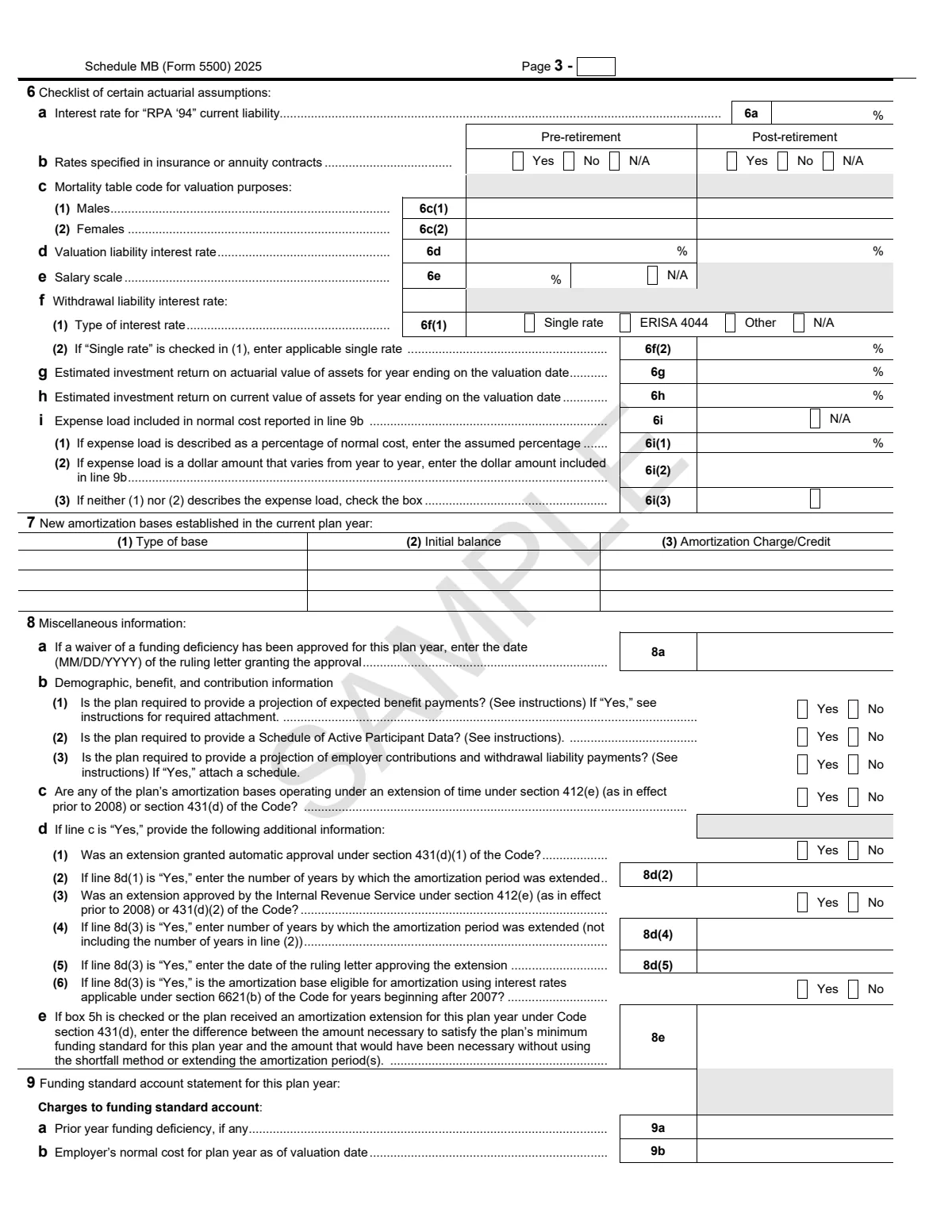
If gender-based assumptions are used, enter those rates where appropriate; unisex tables go in both the male and female lines.
| Line | Label | What goes there |
|---|---|---|
| 6a | Current liability interest rate | The rate must follow IRS guidelines and, under PPA, be no more than 5 percent above and no more than 10 percent below the weighted average of 30-year Treasury rates for the 4 years ending before the plan year. Attach the statement of actuarial assumptions and methods and the summary of plan provisions for line 6. |
| 6b | Rates in insurance or annuity contracts | Check N/A if the question does not apply. |
| 6c | Mortality table code | Codes from the instructions: 1 (base year in the 1970s or earlier), 2 (1980s), 3 (1990s), 4 (table under section 1.431(c)(6)-1), 5 (RP-2014), 6 (RP-2014 Blue Collar), 7 (RP-2014 adjusted to 2006), 8 (Pri-2012), 9 (Pri-2012 Blue Collar), A (other), 0 (none). Add F for a female table, P and the year for a projection, and a plus or minus with years for a setback or set forward. Unisex tables go on both lines. |
| 6d | Valuation liability interest rate | Enter rates to the nearest .01 percent. |
| 6e | Salary scale | Enter to the nearest .01 percent. |
| 6f | Withdrawal liability interest rate | If the present value of vested benefits for withdrawal liability was not determined by the time the Form 5500 is filed, check N/A. If Other is checked, attach a description of the rate. |
| 6g | Estimated return on actuarial value | I is the investment return under the plan's asset valuation method, A the actuarial value a year ago, B the actuarial value now. “Use the above formula even if the actuary feels that the result of using the formula does not represent the true estimated rate of return”; the actuary may attach a separate estimate. |
| 6h | Estimated return on current value | Enter to the nearest .1 percent, with a minus sign for a negative number. |
| 6i | Expense load in normal cost | A percentage load is stated as a percent of the unloaded normal cost: a 5% load on $100,000 is entered as 5%, not 4.8%. |
| 7 | New amortization bases | List bases before any combining. Type codes: 1 experience gain or loss, 2 shortfall gain or loss, 3 plan amendment, 4 assumption change, 5 cost method change, 6 waiver, 7 initial unfunded liability, 8 COVID-related losses in the first two plan years ending after February 29, 2020. |
| 8a | Funding waiver date | If a waiver or extension is approved after the Schedule MB is filed, “an amended Schedule MB must be filed with Form 5500 to report the waiver or extension approval”. |
| 8b | Demographic and contribution schedules | Line 8b(1) and 8b(3) are Yes only for a plan covered by Title IV with 1,000 or more total participants at the start of the year; 8b(2) is Yes for a Title IV plan with active participants. Each Yes needs its schedule, which may be a structured CSV attachment. |
| 8c | Amortization extensions | If line 8c is Yes, complete line 8d. Line 9c(3) and line 9o(2) also report bases extended and amortized at the 6621(b) interest rate. |
| 8d | Extension details | Lines 8d(2) and 8d(4) show the number of years added to the amortization period. |
| 8e | Effect of shortfall method or extension | Complete when box 5h is checked or an extension under Code section 431(d) applies this year. |
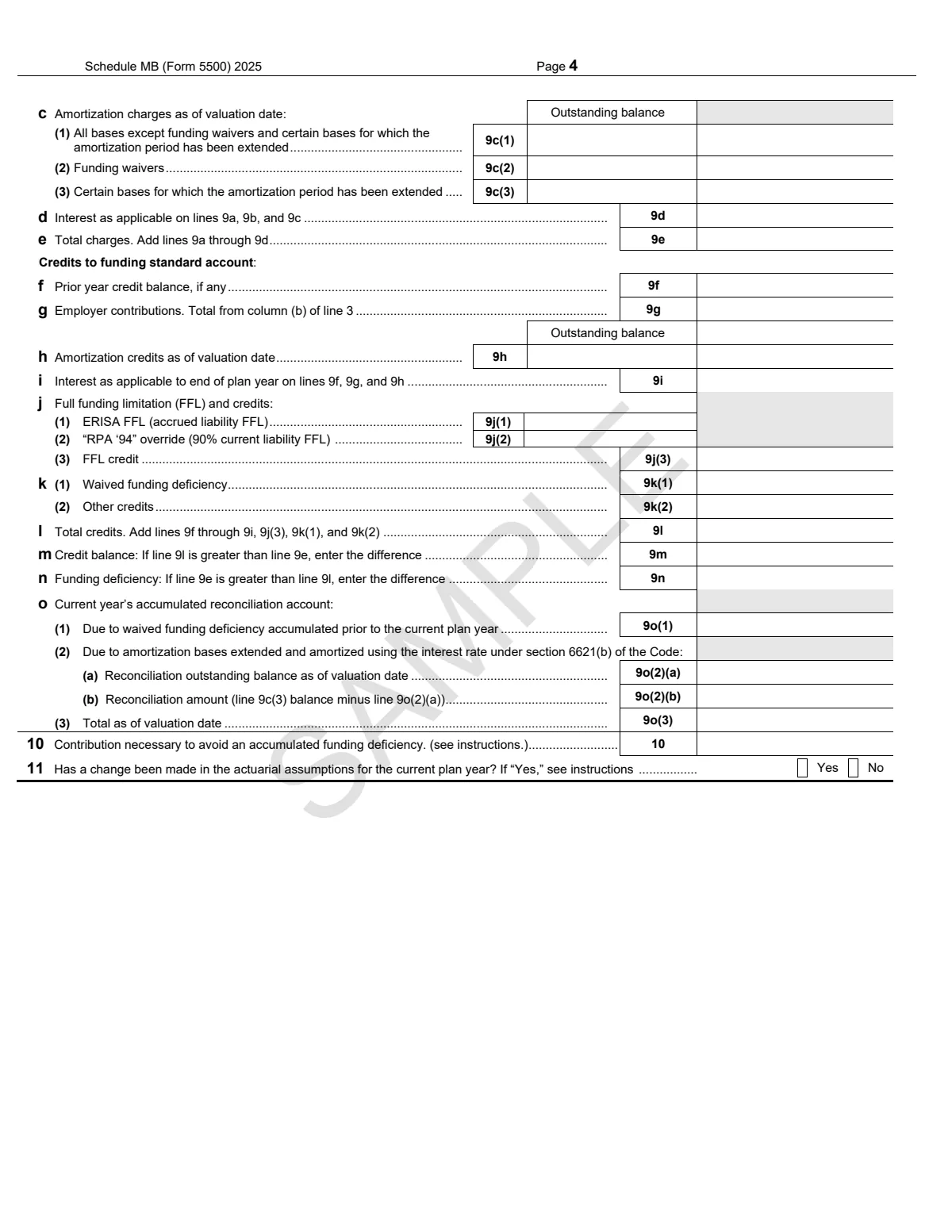
Lines 9 to 11: funding standard account
Line 9 is the funding standard account statement: charges, credits, and the resulting credit balance or funding deficiency. Outstanding balances and charges and credits are calculated as of the valuation date.
| Line | Label | What goes there |
|---|---|---|
| 9a | Prior year funding deficiency | Under the shortfall method, normal cost and each amortization installment are the charge per unit of production or service times the actual units for the year. |
| 9b | Employer's normal cost | If line 6i shows an expense load, it is included here. |
| 9c | Amortization charges | Attach a maintenance schedule of funding standard account bases showing each base's type, outstanding balance, years remaining and amortization amount, before and after any combining. Line 9c(3) is only for bases extended and amortized at the 6621(b) rate. |
| 9d | Interest on charges | Interest as applicable is charged to the last day of the plan year. |
| 9e | Total charges | This is the total that line 9l is compared against. |
| 9f | Prior year credit balance | The credit balance or deficiency at the end of one year should equal the beginning of the next; if not, attach an explanation. |
| 9g | Employer contributions | It must agree with the line 3 column (b) total. |
| 9h | Amortization credits | Bases with credits are listed in the same maintenance schedule as line 9c. |
| 9i | Interest on credits | Interest runs to the end of the plan year. |
| 9j | Full funding limitation and credits | “Instructions for this line are reserved pending published guidance.” That applies to lines 9j(1) and 9j(2). Line 9j(3) is the excess of the accumulated funding deficiency, disregarding the credit balance and this year's contributions, over the greater of 9j(1) or 9j(2). |
| 9k | Waived deficiency and other credits | “If a waiver of a funding deficiency is pending, report a funding deficiency.” If it is granted after the return is filed, file an amended Form 5500 or 5500-SF with an amended Schedule MB. |
| 9l | Total credits | Compare with line 9e: the larger side determines whether line 9m or 9n is filled. |
| 9m | Credit balance | A credit balance carries to next year's line 9f. |
| 9n | Funding deficiency | A deficiency here is also entered on line 10. |
| 9o | Reconciliation account | Valuation assets are not adjusted by the reconciliation account balance when computing the required minimum funding. Line 9o(3) is the sum of 9o(1) and 9o(2)(b). |
| 10 | Contribution needed to avoid a deficiency | Copy line 9n. If applicable, file IRS Form 5330 to pay the excise tax on the funding deficiency; there is a penalty for filing it late. |
| 11 | Change in actuarial assumptions | ERISA section 103(d)(3) requires the justification, attached and labeled for line 11. |
Codes used on Schedule MB
| Line | Code | Meaning |
|---|---|---|
| 4b | E | Endangered status |
| 4b | S | Seriously endangered status |
| 4b | C | Critical status |
| 4b | D | Critical and declining status |
| 4b | N | Not in endangered or critical status (go to line 5) |
| 4f | 9999 | Neither projected to emerge from critical status nor to become insolvent within 30 years |
| 7 | 1 to 8 | Type of new amortization base (see the line 7 row) |
| 6c | 1 to 9, A, 0 | Mortality table (see the line 6c row) |
Several attachments go with these lines: the actuarial certification and supporting illustration for line 4b, documentation for line 4c, cash flow projections for line 4f, the statement of actuarial assumptions and methods and the summary of plan provisions for line 6, the funding standard account bases for lines 9c and 9h, and the justification for line 11. “All attachments to the Schedule MB must be properly identified, and must include the name of the plan, the plan sponsor's EIN, and the plan number.” The withdrawal liability list for line 3(d) and the schedules for lines 8b(1) to 8b(3) may be structured data: the EFAST2 guide says these “can be submitted as structured data attachments with a Form 5500 or 5500-SF”.
Common mistakes
- Uploading the actuary's report as one file. Each actuarial attachment needs its own EFAST2 tag, or “EFAST2 may generate an error message”.
- Adding both Schedule MB and Schedule SB to one filing. IFILE treats them as mutually exclusive.
- Including contributions designated for 2025 in lines 1b or 2a.
- Entering an amount on line 1d(1), which the instructions say to leave blank.
- Reporting a waiver credit on line 9k(1) while the waiver is still pending.
- Leaving line 10 above zero without filing Form 5330.
Questions filers ask
Does a money purchase plan need an actuary for Schedule MB?
Not if it is a money purchase or target benefit plan amortizing a funding waiver. It completes lines 3, 9 and 10 only, and the schedule need not be signed by an enrolled actuary.
Can a multiemployer plan file Form 5500-SF with Schedule MB?
No. The 5500-SF instructions say multiemployer plans cannot use the Form 5500-SF. They file Form 5500 with Schedule MB and Schedule R.
What valuation date can a multiemployer plan use?
Any date in the plan year, including the first or last day, within the period required by Code section 431(c)(7).
What does code 9999 on line 4f mean?
The plan is in critical or critical and declining status and is neither projected to emerge from critical status nor to become insolvent within 30 years. It needs a 20-year cash flow projection attachment.
What if a funding waiver is approved after filing?
File an amended Form 5500 with an amended Schedule MB to report the waiver.