At a glance
Schedule G “must be attached to a Form 5500 filed for a large plan, MTIA, 103-12 IE, DCG or GIA” to report defaulted or uncollectible loans and fixed income obligations, defaulted or uncollectible leases, and nonexempt transactions. In practice the trigger is Schedule H: the filing lists tell large plans to file Schedule G if Schedule H lines 4b, 4c or 4d is checked Yes. Each Schedule H line points to one Part.
| Schedule H line answered Yes | Schedule G Part | Attachment |
|---|---|---|
| 4b: loans or fixed income obligations in default or uncollectible | Part I | Overdue Loan Explanation for each loan |
| 4c: leases in default or uncollectible | Part II | Overdue Lease Explanation for each lease |
| 4d: nonexempt transactions with a party in interest | Part III | None required |
The Schedule H instructions confirm the link: “Plans that check “Yes” must enter the amount and complete Part I of Schedule G.” Lines 4c and 4d say the same for Parts II and III.
Two groups of welfare plans file Part III without filing Schedule H at all:
- An unfunded, fully insured or combination welfare plan with 100 or more participants that is exempt from Schedule H under 29 CFR 2520.104-44. The instructions say such a plan “must still complete Schedule G, Part III, to report nonexempt transactions”.
- A welfare plan with fewer than 100 participants that must file Form M-1 and is exempt from Schedule I under 29 CFR 2520.104-44. It too must attach Part III for any nonexempt transactions. See Form M-1.
Small plans that file Schedule I answer the same questions on Schedule I lines 4b to 4d and enter the amounts there; Schedule G is not on the small plan filing list. Schedule G is due with the Form 5500, filed electronically through EFAST2 with the rest of the return. “Check the Schedule G box on the Form 5500 (Part II, line 10b(6)) if a Schedule G is attached to the Form 5500.”
The form, line by line
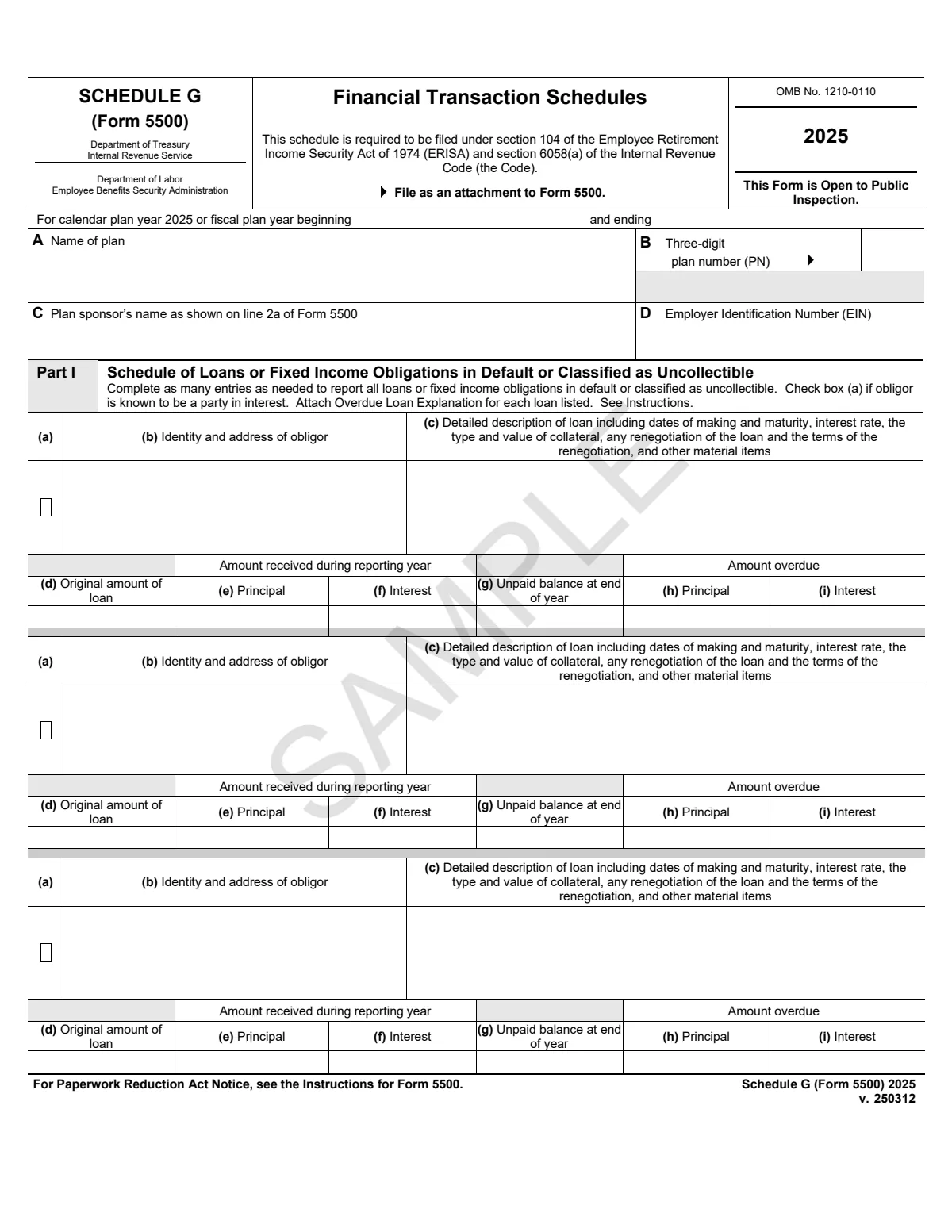
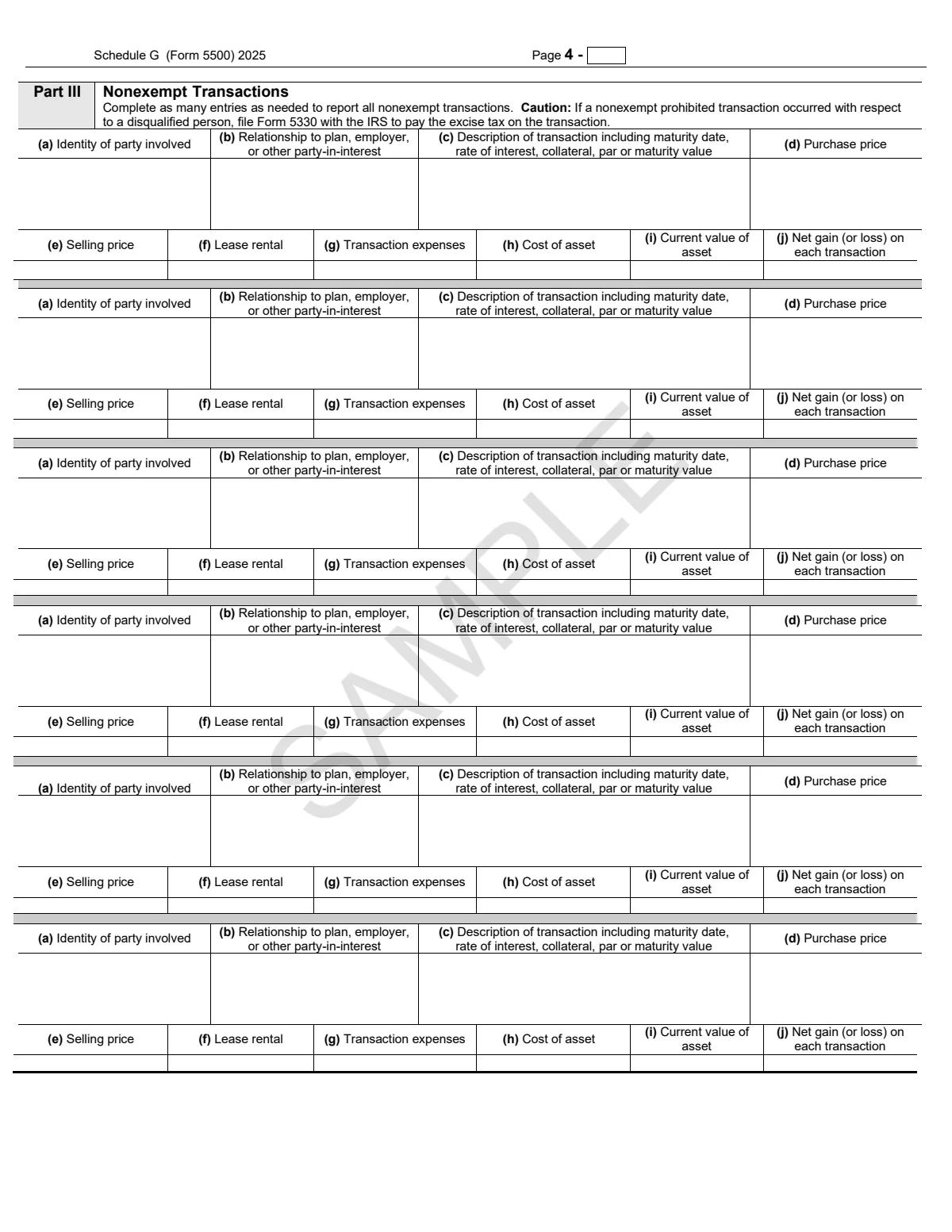
Hover over or tap a box to see the rule; click to jump to the full note. Use the page buttons to move between Part I (pages 1 and 2), Part II (page 3) and Part III (page 4).
Swipe sideways to see the whole page, or pinch to zoom. Tap a box once for its note, again to jump to the line.
Lines A to D: identification
| Line | Label | What goes there |
|---|---|---|
| Year | Plan year beginning and ending | Blank for a calendar year; otherwise the same fiscal year dates as the Form 5500. |
| A | Name of plan | Lines A to D must match Part II of the Form 5500 this schedule is attached to. |
| B | Three-digit plan number (PN) | Same as Form 5500 line 1b. |
| C | Plan sponsor's name | As shown on line 2a of the Form 5500. |
| D | Employer Identification Number (EIN) | Do not use a Social Security number: the schedule is public, and an SSN can cause the filing to be rejected. |
Part I: loans or fixed income obligations in default or classified as uncollectible
The instructions define default and uncollectible in plain terms. “A loan is in default when the borrower is unable to pay the obligation upon maturity.” Obligations repaid in installments can default at any time. A loan is generally uncollectible “when payment has not been made and there is little probability that payment will be made”. For every loan listed, attach an explanation of the steps taken or planned to collect the overdue amounts, labeled as Schedule G, Part I, Overdue Loan Explanation.
| Line | Label | What goes there |
|---|---|---|
| Part I | Schedule of loans or fixed income obligations in default or classified as uncollectible | List all loans or fixed income obligations in default or determined to be uncollectible as of the end of the plan year (or the fiscal year of the GIA, MTIA, DCG or 103-12 IE). Include obligations not paid by the due date, matured fixed income obligations that will not be paid, and “Loans that were in default even if renegotiated later during the year.” |
| I(a) | Party-in-interest box | Check (a) and name the obligor in (b) for every obligor known to be a party in interest to the plan. |
| I(b) | Identity and address of obligor | Name and address of the borrower or issuer. |
| I(c) | Detailed description of loan | As the form puts it: “Detailed description of loan including dates of making and maturity, interest rate, the type and value of collateral, any renegotiation of the loan and the terms of the renegotiation, and other material items”. A DCG adds the name of the plan or plans involved, with EINs and plan numbers, matching Part III of Schedule DCG. |
| I(d) | Original amount of loan | The amount lent or invested at the start. |
| I(e) | Amount received during reporting year: principal | Principal collected during the year. |
| I(f) | Amount received during reporting year: interest | Interest collected during the year. |
| I(g) | Unpaid balance at end of year | The balance still owed at year end. |
| I(h) | Amount overdue: principal | Principal that is past due. |
| I(i) | Amount overdue: interest | Interest that is past due. |
| I-rows | Further Part I entries | One entry per loan. Participant loans that do not qualify for the exclusion described below are each listed individually. |
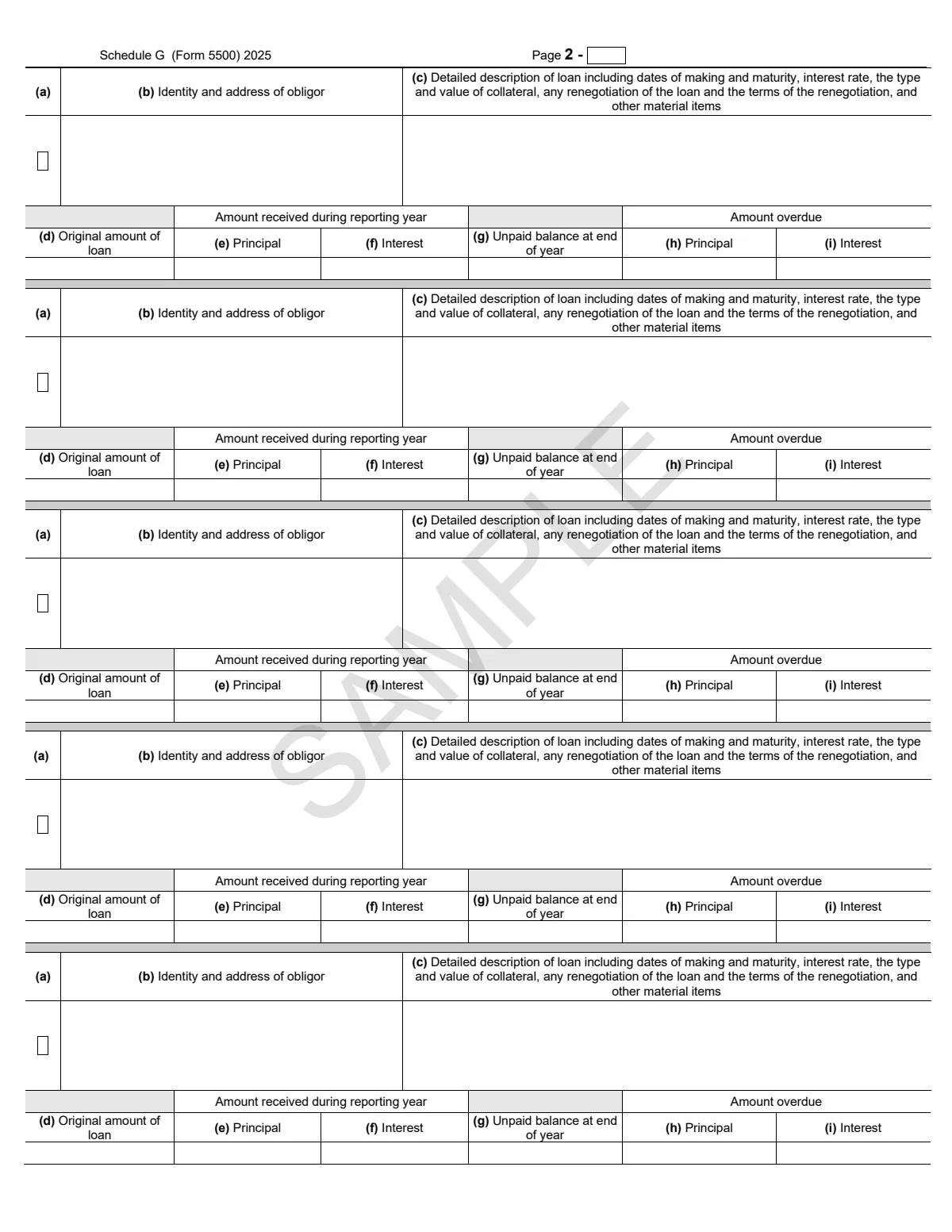
| I-page2 | Part I continued (page 2) | Five more entries. Add more in software or IFILE as needed. |
Part II: leases in default or classified as uncollectible
A lease, for this schedule, is an agreement conveying the right to use property, plant or equipment for a stated period. An uncollectible lease is one where the required payments have not been made and there is little probability they will be. Attach a collection explanation for each lease, labeled as Schedule G, Part II, Overdue Lease Explanation.
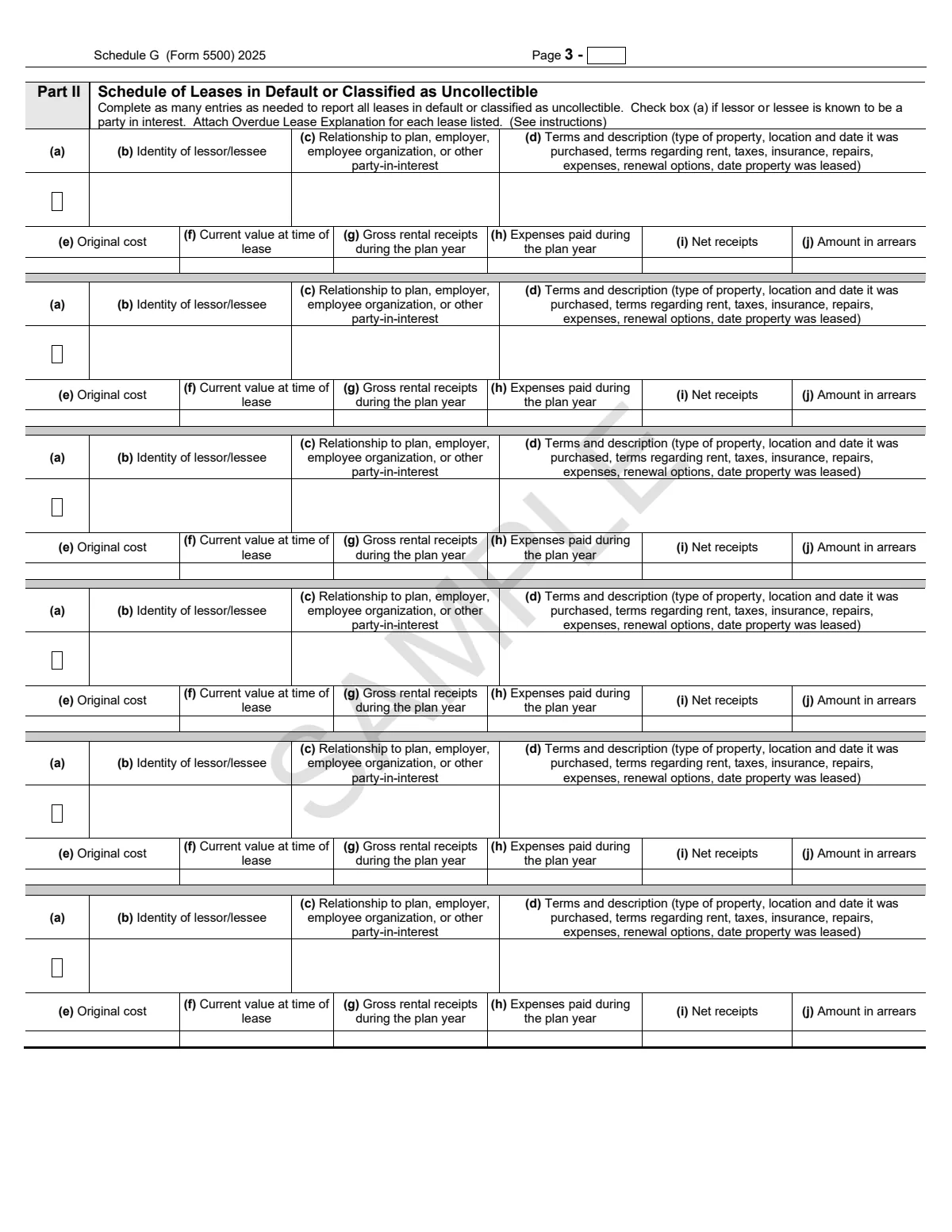
| Line | Label | What goes there |
|---|---|---|
| Part II | Schedule of leases in default or classified as uncollectible | List any leases in default or classified as uncollectible. “A lease is in default when the required payment(s) has not been made.” Attach an explanation of the collection steps for each lease (the Overdue Lease Explanation). |
| II(a) | Party-in-interest box | Check (a) if the lessor or lessee is known to be a party in interest. |
| II(b) | Identity of lessor/lessee | The other party to the lease. |
| II(c) | Relationship to plan, employer, employee organization, or other party-in-interest | Describe the relationship, if any. |
| II(d) | Terms and description | The form asks for the type of property, location and date it was purchased, terms regarding rent, taxes, insurance, repairs, expenses, renewal options, and the date the property was leased. For a DCG, name the plans involved with their EINs and plan numbers. |
| II(e) | Original cost | Original cost of the property. |
| II(f) | Current value at time of lease | Value when the lease was entered into. |
| II(g) | Gross rental receipts during the plan year | Total rent received in the year. |
| II(h) | Expenses paid during the plan year | Expenses the plan paid on the property. |
| II(i) | Net receipts | Gross receipts minus expenses. |
| II(j) | Amount in arrears | Rent owed and unpaid. |
| II-rows | Further Part II entries | One entry per lease. |
Part III: nonexempt transactions
The form itself carries a warning for pension plans: “Caution: If a nonexempt prohibited transaction occurred with respect to a disqualified person, file Form 5330 with the IRS to pay the excise tax on the transaction.” Form 5330 is filed separately with the IRS; see Form 5330.
| Line | Label | What goes there |
|---|---|---|
| Part III | Nonexempt transactions | “All nonexempt party-in-interest transactions must be reported, regardless of whether disclosed in the accountant’s report”, unless one of the six exceptions listed below applies. |
| III(a) | Identity of party involved | The party in interest. For this form, a party in interest includes a disqualified person under Code section 4975(e)(2). |
| III(b) | Relationship to plan, employer, or other party-in-interest | See the party-in-interest categories below. |
| III(c) | Description of transaction | Include maturity date, rate of interest, collateral, and par or maturity value. You may note that an application for an administrative exemption is pending. For a DCG, name the plan or plans involved with EINs and plan numbers. |
| III(d) | Purchase price | For a purchase by the plan. |
| III(e) | Selling price | For a sale by the plan. |
| III(f) | Lease rental | For a lease. |
| III(g) | Transaction expenses | Expenses of the transaction. |
| III(h) | Cost of asset | Cost of the asset involved. |
| III(i) | Current value of asset | Current value of the asset involved. |
| III(j) | Net gain (or loss) on each transaction | Gain or loss to the plan. |
| III-rows | Further Part III entries | One entry per nonexempt transaction. |
Rules that matter
What stays off Part III
A nonexempt transaction is reported unless it is one of six kinds the instructions exclude:
- Statutorily exempt under Part 4 of Title I of ERISA.
- Administratively exempt under ERISA section 408(a).
- Exempt under Code sections 4975(c) or 4975(d).
- The holding of participant contributions in the employer's general assets for a welfare plan that meets the conditions of ERISA Technical Release 92-01.
- A transaction of a 103-12 IE with parties other than the plan.
- A delinquent participant contribution or a delinquent participant loan repayment reported on Schedule H, line 4a.
Delinquent participant contributions are reported on Schedule H line 4a, and the instructions say they are “no longer required to be listed on Part III of the Schedule G”. Transactions corrected under the DOL Voluntary Fiduciary Correction Program that also meet Prohibited Transaction Exemption 2002-51 get the same treatment: “corrected transactions should be treated as exempt under Code section 4975(c) for the purposes of answering Schedule G, Part III”. If you are unsure whether a transaction is exempt, the instructions suggest asking the plan's independent qualified public accountant, legal counsel, or both.
What counts as a nonexempt transaction
The instructions list eight kinds of direct or indirect dealings with a party in interest, including a sale, exchange or lease of property; a loan or other extension of credit; furnishing goods, services or facilities; a transfer or use of plan income or assets for a party in interest; an acquisition of employer securities or employer real property in violation of ERISA section 407(a); and a fiduciary dealing with plan assets for its own interest or account.
Who is a party in interest
The list runs from A to I: any fiduciary, counsel or employee of the plan; a service provider; an employer whose employees are covered; an employee organization whose members are covered; a 50% or more owner of such an employer or organization; relatives of those individuals; entities 50% or more owned by them; employees, officers, directors and 10% or more shareholders of certain of those persons; and 10% or more partners or joint venturers of certain of those persons.
Participant loans
Not every defaulted participant loan goes on Part I. Leave off loans under an individual account plan with segregated investment experience that are made under 29 CFR 2550.408b-1 and secured solely by part of the participant's vested accrued benefit. “Report all other participant loans in default or classified as uncollectible on Part I, and list each such loan individually.”
Assets listed on Schedule G and the asset schedules
For the Schedule H line 4i schedule of assets held for investment, an investment the plan no longer held on the last day of the year is left off if it is already reported on Schedule G, Part I, II or III, or on the line 4j reportable transactions schedule.
DCGs
“In the case of a DCG, report the required information for all the plans in the DCG”, identifying each individual plan in the description element. The plan details must match Part III of Schedule DCG.
Common mistakes
- Schedule H and Schedule G disagree. A Yes on line 4b, 4c or 4d needs the matching Part; a Part with entries needs a Yes and an amount on the matching line.
- Listing delinquent participant contributions on Part III. They go on Schedule H line 4a instead.
- Listing qualifying participant loans on Part I. Loans that meet 29 CFR 2550.408b-1 and are secured only by the vested accrued benefit stay off.
- Leaving out a loan because it was renegotiated. A loan in default during the year is listed even if renegotiated later in the year.
- No collection explanation. Each loan in Part I and each lease in Part II needs the attached explanation of collection steps.
- Forgetting Part III on an insured welfare plan exempt from Schedule H under 29 CFR 2520.104-44.
Questions filers ask
Does a small plan file Schedule G?
Not usually. Small plans answer the default and nonexempt transaction questions on Schedule I lines 4b to 4d. The exception is a small welfare plan that files Form M-1 and is exempt from Schedule I under 29 CFR 2520.104-44: it must attach Schedule G, Part III, for any nonexempt transactions.
Are late 401(k) deferrals a nonexempt transaction for Schedule G?
They are reported on Schedule H line 4a, not on Schedule G Part III. The instructions list delinquent participant contributions reported on line 4a among the transactions that stay off Part III.
We corrected a prohibited transaction through the VFCP. Do we still list it?
If the conditions of PTE 2002-51 are met, the instructions say to treat the corrected transaction as exempt under Code section 4975(c) when answering Part III.
Does Schedule G replace Form 5330?
No. Form 5330 is a separate IRS return used to pay the excise tax when a qualified pension plan has a nonexempt prohibited transaction with a disqualified person.
What if an exemption application is pending?
List the transaction and say in the description that an application for an administrative exemption is pending.