At a glance
Schedule I is attached to a Form 5500 filed for a pension or welfare plan that “covered fewer than 100 participants as of the beginning of the plan year and that are not eligible to file Form 5500-SF”. Many small plans can use the shorter Form 5500-SF instead; which form to file walks through that choice.
Under the 80-120 rule, if a Schedule I or a Form 5500-SF was filed for 2024 and the plan covered fewer than 121 participants at the start of 2025, “the Schedule I may be completed instead of a Schedule H”. The form itself says: “Complete Schedule H if reporting as a large plan or DFE.” Certain insured, unfunded or combination welfare plans and certain fully insured pension plans are exempt from Schedule I.
Check box 10b(2) on the Form 5500 when Schedule I is attached. “Do not attach both a Schedule I and a Schedule H to the same Form 5500.” The due date is the Form 5500's: it “must be filed by the last day of the 7th calendar month after the end of the plan, DCG or GIA year”. “Your 2025 Form 5500 must be electronically filed in the ERISA Filing Acceptance System (EFAST2).” Use the cash, modified cash or accrual basis consistently, round to the nearest dollar, and report the plan's share of each line when two plans share one trust.
The form, page by page
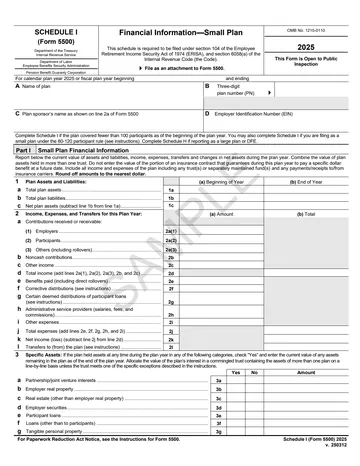
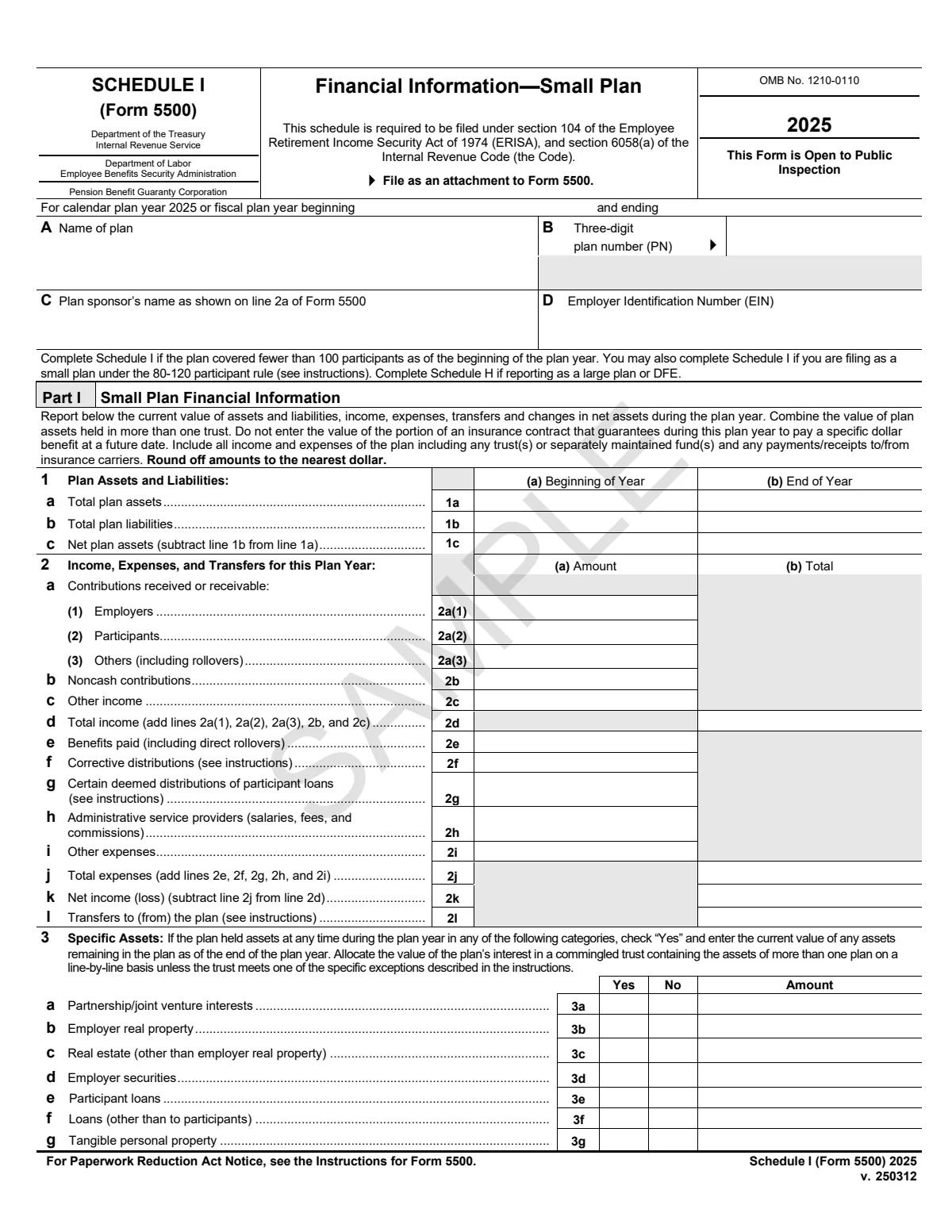
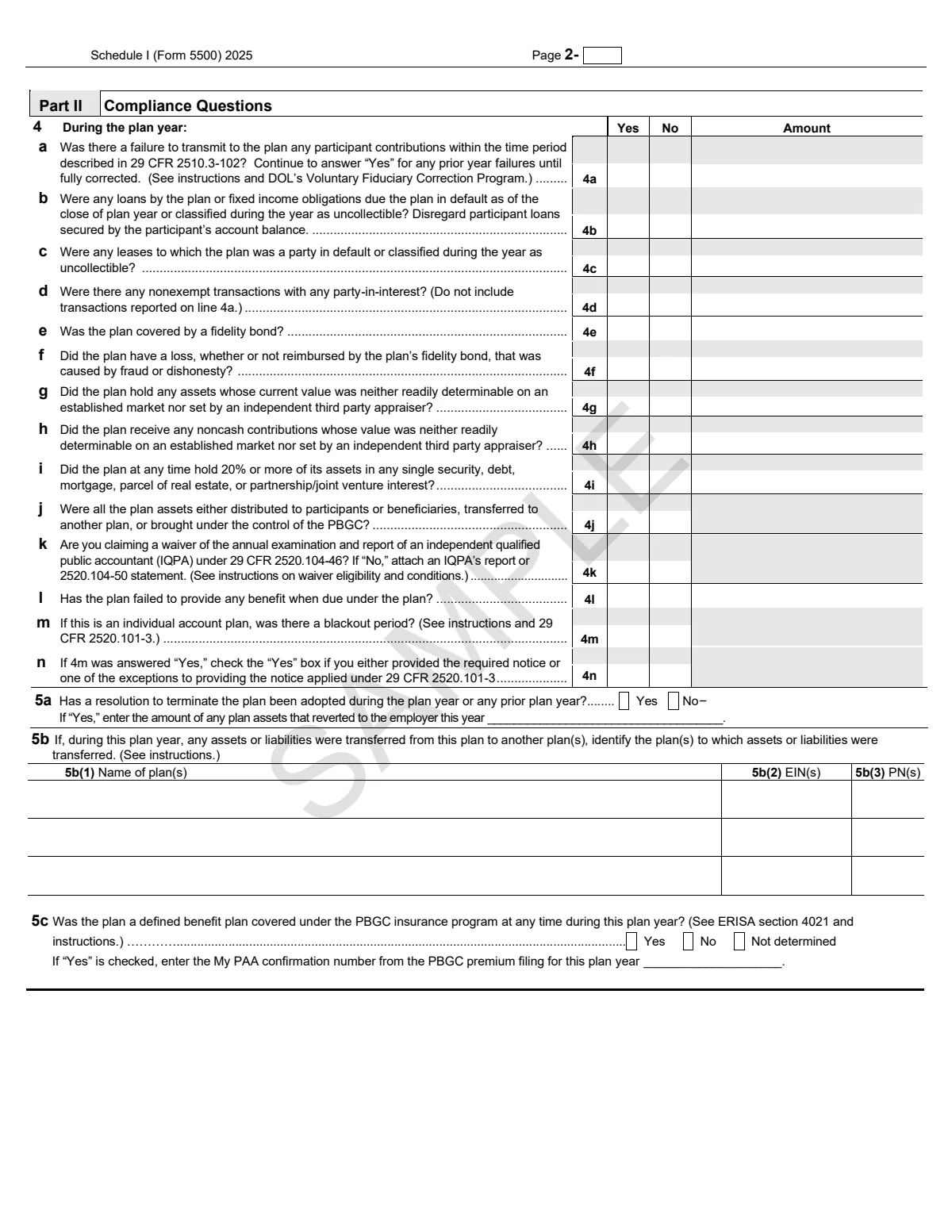
The 2025 Schedule I is two pages. Page 1 holds Part I: assets and liabilities (line 1), income and expenses (line 2) and specific assets (line 3). Page 2 holds Part II, the compliance questions on line 4, and line 5 on termination, transfers and PBGC coverage.
Swipe sideways to see the whole page, or pinch to zoom. Tap a box once for its note, again to jump to the line.
Part I: small plan financial information
Amounts for the beginning of the year on lines 1a, 1b and 1c must equal the end-of-year amounts on last year's return. Do not include contributions designated for 2025 in column (a). Current value means fair market value where available, otherwise fair value set in good faith by a trustee or named fiduciary.
| Line | Label | What goes there |
|---|---|---|
| A-D | Plan name, plan number, sponsor, EIN | Must match Part II of the Form 5500. Use the sponsor's EIN, never a Social Security number; the schedule is public. |
| 1a | Total plan assets | Current value of all assets at the beginning and end of the year. A plan with assets in CCTs, PSAs, MTIAs or 103-12 IEs must also attach Schedule D. Value an insurance company general account the same way as on Schedule A line 4 (or line 7). Leave out of column (b) a participant loan deemed distributed this year when the loan is a directed investment of the participant's account and repayment has stopped; report it on 2g. |
| 1b | Total plan liabilities | Liabilities at the beginning and end of the year, never including future pension payments. For accrual basis filers this includes approved but unpaid benefit claims (including incurred but not reported welfare claims), unpaid payables, acquisition debt and anything else the plan owes. |
| 1c | Net plan assets | Line 1a minus line 1b. “Line 1c, column (b) must equal the sum of line 1c, column (a) plus lines 2k and 2l.” |
| 2a | Contributions: (1) employers, (2) participants, (3) others including rollovers | Cash contributions received or, for accrual basis plans, due. Accrual basis plans must not include contributions designated for years before 2025 on line 2a(1). For pension plans, 2a(2) includes 401(k) elective deferrals; for welfare plans it includes all employee contributions, including cafeteria plan contributions. |
| 2b | Noncash contributions | Current value, at the date contributed, of securities or other noncash property. |
| 2c | Other income | Everything else the plan earned, in one figure: interest (including money market, sweep and STIF accounts), dividends (accrual basis plans include dividends declared but not received), rents, royalties, net gain or loss on sales, and unrealized appreciation or depreciation. Transfers from other plans go on 2l. |
| 2d | Total income | Lines 2a(1) through 2a(3), 2b and 2c. Enter a minus sign for a negative number. |
| 2e | Benefits paid (including direct rollovers) | Payments to or for participants in cash, securities or property at current value, including eligible rollover distributions to another plan or IRA; payments to insurers, Blue Cross Blue Shield and HMOs for benefits; and payments to other benefit providers such as legal, day care and training services. |
| 2f | Corrective distributions | Excess deferrals (Code section 402(g)(2)(A)(ii)), excess contributions (401(k)(8)) and excess aggregate contributions (401(m)(6)) distributed during the year, with allocable income, and elective deferrals or employee contributions returned. |
| 2g | Certain deemed distributions of participant loans | A loan included in line 1a, column (a), and deemed distributed under Code section 72(p), only if it is a directed investment solely of the participant's account and the participant is not repaying at year end. If repayment resumes on a loan reported in an earlier year, reduce 2g by that amount and put the loan back in line 1a, column (b). |
| 2h | Administrative service providers (salaries, fees, commissions) | Salaries of plan employees; fees for accounting, actuarial, legal, investment management, investment advice and securities brokerage; contract administrator fees; individual trustee fees and expenses; and valuation and appraisal fees. Paid or, for accrual basis plans, incurred. |
| 2i | Other expenses | Other administrative and miscellaneous expenses charged to the plan: office supplies and equipment, telephone, postage, rent and costs of a building used in plan operations. |
| 2j | Total expenses | All benefits on 2e, 2f and 2g plus expenses on 2h and 2i. |
| 2k | Net income (loss) | Line 2d minus line 2j. |
| 2l | Transfers to (from) the plan | The net value of assets moved to and from the plan, including mergers and spinoffs. A distribution reported on Form 1099-R “should not be included on line 2l but must be included in benefit payments reported on line 2e.” |
| 3a | Partnership/joint venture interests | For lines 3a to 3g, check Yes or No for each category held at any time during the year. If Yes, enter the year-end value, or 0 if nothing remains. Do not count the plan's interest in a CCT, PSA, MTIA or 103-12 IE. Line 3a excludes a partnership that is a 103-12 IE. |
| 3b | Employer real property | Real property and related personal property leased to an employer of covered employees or an affiliate, treated as acquired on the later of the purchase date or the lease date. |
| 3c | Real estate (other than employer real property) | Other real property the plan held during the year, at year-end value. |
| 3d | Employer securities | Any security issued by an employer of covered employees, including affiliates: stock, bonds, debentures, notes and commercial paper. |
| 3e | Participant loans | Unpaid principal plus accrued unpaid interest on participant loans, including residential mortgage loans subject to Code section 72(p), but not loans deemed distributed this year under the two conditions on line 2g. |
| 3f | Loans (other than to participants) | Construction, securities and mortgage loans not subject to 72(p) that the plan made or purchased. Money the plan borrowed is not a loan asset; it is a liability on line 1b. |
| 3g | Tangible personal property | Property with concrete existence, such as goods, furniture, machines, equipment, animals and automobiles, and collectibles such as art, rugs, antiques, metals, gems, stamps, coins and musical instruments. Not intangibles such as patents, stocks or claims. |
Part II: compliance questions
Answer every line Yes or No. For lines 4a to 4i and 4l, a Yes needs an amount. Plans with all of their funds in a master trust answer No on lines 4b, 4c and 4i.
| Line | Label | What goes there |
|---|---|---|
| 4a | Failure to transmit participant contributions on time | Participant contributions become plan assets as soon as they can reasonably be segregated from the employer's general assets. For a plan with fewer than 100 participants, there is a safe harbor: “any amount deposited with such plan not later than the 7th business day following the day on which such amount is received by the employer” (or would have been paid to the participant in cash, for withheld amounts) is treated as timely. If Yes, enter the total late amount, and keep reporting it each year through the year the failure is fully corrected. Attach the Schedule of Delinquent Participant Contributions if you answer No on line 4k. |
| 4b | Loans or fixed income obligations in default or uncollectible | If Yes, enter the amount. Leave out participant loans made under 29 CFR 2550.408b-1 and secured by the vested account balance. Unlike Schedule H, no Schedule G is attached. |
| 4c | Leases in default or uncollectible | If Yes, enter the amount. A lease is in default when a required payment has not been made. |
| 4d | Nonexempt transactions with a party-in-interest | If Yes, enter the amount. Do not include exempt transactions, welfare plan contributions held under Technical Release 92-01, or late contributions already on 4a. A party-in-interest includes fiduciaries, service providers, the employer, a union whose members are covered, 50% owners and their relatives. A qualified pension plan with a nonexempt prohibited transaction with a disqualified person files Form 5330 for the excise tax. |
| 4e | Fidelity bond | Yes only if the plan itself, not the sponsor or administrator, is a named insured under a fidelity bond from an approved surety. Enter the total coverage. Fiduciary liability insurance does not count. |
| 4f | Loss from fraud or dishonesty | Yes even if the loss was reimbursed. Enter the full amount, or a good faith estimate, and keep records of how the estimate was made. Willful failure to report is a crime under ERISA section 501. |
| 4g | Assets with no readily determinable value and no independent appraisal | Do not check Yes for mutual funds or insurance contracts valued at least annually, or, in a defined contribution plan, for participant loans not in default or assets participants control under ERISA section 404(c). Enter the fair market value of the assets. |
| 4h | Noncash contributions with no readily determinable value and no independent appraisal | Same test as 4g, for noncash contributions. |
| 4i | 20% or more of assets in a single security, debt, mortgage, parcel or partnership | “Include as a single security all securities of the same issue.” Do not check Yes for U.S. Government or agency securities, or for securities held as a result of participant-directed transactions. |
| 4j | All plan assets distributed, transferred or brought under PBGC control | Yes if all assets, including insurance and annuity contracts, were distributed, transferred or taken over by PBGC. A welfare plan still liable for pre-termination claims checks No. |
| 4k | Claiming the IQPA audit waiver | “You are eligible to claim the waiver if the Schedule I is being filed for:” a small welfare plan, or a small pension plan that meets the conditions of 29 CFR 2520.104-46 (see below). Check No and attach the IQPA's report if you are not claiming the waiver, or attach the explanatory statement headed 2520.104-50 Statement, Schedule I, Line 4k, for a short plan year of seven months or less. |
| 4l | Failure to provide a benefit when due | Yes if any benefit was not paid on time or in full, including required minimum distributions under Code section 401(a)(9), plus amounts from earlier years still unpaid. Unpaid RMDs for participants who cannot be located after reasonable efforts need not be reported. |
| 4m | Blackout period | A temporary suspension of more than three consecutive business days on directing investments, loans or distributions in an individual account plan. Disclosed routine suspensions, QDRO holds and holds caused by a participant's own action generally do not count. |
| 4n | Blackout notice | Yes if the notice was given not less than 30 nor more than 60 days in advance, or an exception in 29 CFR 2520.101-3 applied. |
| 5a | Resolution to terminate the plan | Yes if a termination resolution was adopted this year or earlier and not revoked. Enter any assets that reverted to the employer this year, or 0. A Form 5500 is due for each year the plan has assets. |
| 5b | Assets or liabilities transferred to other plans | Name, sponsor EIN and plan number of each transferee plan, including spinoffs. Form 5310-A may be due at least 30 days before a merger or transfer; the instructions cite a penalty of $25 a day, up to $15,000, for filing it late. |
| 5c | PBGC coverage | Yes if the plan was covered by PBGC at any time in the year, even if coverage has ended, with the My PAA confirmation number for this year's premium filing. Defined contribution and welfare plans skip it. |
The audit waiver on line 4k
A small welfare plan may claim the waiver. A small pension plan must meet three conditions from 29 CFR 2520.104-46, summarized in the instructions:
- “At least 95 percent of plan assets are “qualifying plan assets” as of the end of the preceding plan year”, or every person who handles non-qualifying assets is bonded under ERISA section 412 for at least the value of those assets.
- The summary annual report (or, for a defined benefit plan, the annual funding notice or a stand-alone notice) names each regulated financial institution holding qualifying assets and the amount it reported, names the surety if more than 5% of assets are non-qualifying, and tells participants they can get the statements and bond evidence free and can contact EBSA if they cannot.
- On request, the administrator gives participants, free of charge, copies of each institution's statement and evidence of any required bond.
Qualifying plan assets include assets held by a bank, insurer, registered broker-dealer or other IRA trustee; mutual fund shares; insurance company investment and annuity contracts; participant-directed accounts with at least an annual institution statement; qualifying employer securities; and participant loans meeting ERISA section 408(b)(1). The test is made at the beginning of the year for which the waiver is claimed, based on the end of the preceding year.
| Example | Total assets (end of 2000) | Non-qualifying | Result for the 2001 waiver |
|---|---|---|---|
| Plan A | $600,000 | $20,000 real estate limited partnership (under 5%) | No extra bond needed |
| Plan B | $600,000 | $42,000 (7%) | Bond of at least $42,000 covering those assets |
The instructions stress that for Plan B “the required bond is for the total amount of the non-qualifying plan assets, not just the amount in excess of 5%.” The ordinary ERISA section 412 bond, generally at least 10% of funds handled, may already be large enough. For the participant counts behind all this, see the audit requirement.
How Schedule I differs from Schedule H
| Topic | Schedule I | Schedule H |
|---|---|---|
| Who | Small plans on the Form 5500 | Large plans and all DFEs |
| Balance sheet | Three lines: assets, liabilities, net assets | About 30 asset and liability lines |
| Income | One line for all investment income (2c) | Interest, dividends, gains and fund results line by line |
| Line 4i | 20% or more in a single investment | Assets held for investment, with schedules |
| Audit | Line 4k: claim the waiver or attach the report | Part III: IQPA opinion generally required |
| Schedule G | Not attached; amounts go on 4b to 4d | Required when 4b, 4c or 4d is Yes |
Common mistakes and EFAST2 checks
- Purchase prices on lines 3a to 3g. The filing tips say these must be year-end values, and if an asset was sold during the year “a "0" should be entered on the appropriate line in the amount column if there were no other asset values to report on that line.”
- Money the plan borrowed entered on line 3f. Line 3f is loans the plan made or bought; borrowings are liabilities on line 1b.
- Blank compliance answers. Plans completing Schedule I “must answer all items in Part II, Lines 4a through 4n and” line 5.
- Beginning assets that do not match last year. EFAST2 warning Z-008 compares line 1a, column (a), with last year's end-of-year total.
- Answering No on 4k with no IQPA report or 2520.104-50 statement attached.
- Filing both Schedule I and Schedule H, or missing the box 10b(2) check on the Form 5500.
An incomplete filing is exposed to the DOL's civil penalty of up to $2,739 a day under ERISA 502(c)(2) for a plan administrator who fails or refuses to file a complete and accurate report (the 2025 amount, 90 FR 1854; the DOL made no 2026 adjustment, 91 FR 31358). See Form 5500 penalties.
Questions filers ask
Should a small plan file Schedule I or the Form 5500-SF?
If the plan is eligible for the Form 5500-SF, it may file that instead of the Form 5500 and its schedules. Schedule I is for small plans that file the full Form 5500.
Our plan has 115 participants this year. Can we stay on Schedule I?
Yes, if a Schedule I or Form 5500-SF was filed for 2024 and the plan covered fewer than 121 participants at the start of 2025.
Is a deposit within 7 business days always on time?
For plans with fewer than 100 participants, amounts deposited by the 7th business day after the employer receives or withholds them are treated as contributed on the earliest date they could reasonably be segregated, under 29 CFR 2510.3-102(a)(2).
What does Yes on line 4k mean?
That the plan claims the waiver of the annual IQPA audit under 29 CFR 2520.104-46. A small pension plan must meet the qualifying asset, disclosure and on-request conditions.
Where do interest and dividends go on Schedule I?
All of it goes on line 2c, Other income, together with rents, royalties, gains and unrealized appreciation.