At a glance
Form 5330 is an IRS excise tax return, filed “under sections 4965, 4971, 4972, 4973(a)(3), 4975, 4976, 4977, 4978, 4979, 4979A, 4980, and 4980F of the Internal Revenue Code”, and the current revision is December 2025 with instructions dated February 4, 2026. Get both from IRS.gov/Form5330.
Two rules shape every filing. “File one Form 5330 to report all excise taxes with the same filing due date.” Taxes from separate plans go on separate forms. And Part I has six sections grouped by due date, of which “You can only complete one section of Part I for each Form 5330 filed.” The Form 5500 instructions for Schedules H and I tell filers to use Form 5330 to pay the tax on nonexempt prohibited transactions, including late participant contributions.
New on the December 2025 revision: a financial institution that is a disqualified person in a prohibited transaction with multiple IRAs or plans files one Form 5330 under its own EIN and attaches a list of the affected IRAs or plans. Direct deposit lines 20b to 20d were added.
Who files
The filer is whoever owes the tax, which is often not the plan. The instructions list 17 filers: the disqualified person in a prohibited transaction (other than a fiduciary acting only as such) or the IRA owner who engaged in one (4975); employers liable for funding failures, and multiemployer and CSEC plan sponsors that fail to adopt a required plan (4971); employers with nondeductible or excess contributions (4972, 4979); an individual with an uncorrected 403(b)(7)(A) excess (4973(a)(3)); employers with funded welfare plan disqualified benefits or an excess fringe benefit election (4976, 4977); employers or worker-owned cooperatives with ESOP dispositions or prohibited allocations (4978, 4979A); an employer receiving a reversion (4980); an employer or multiemployer plan that fails to give a 204(h) notice (4980F); and a plan entity manager who approves a prohibited tax shelter transaction (4965).
A return and payment are due each year these apply, for each missed contribution under a multiemployer funding improvement or rehabilitation plan, for each taxable reversion, and for each year or part of a year in a prohibited transaction's taxable period.
The taxes and schedules
Each schedule computes one tax and carries it to a Part I line. Lines 3b, 4, 5a, 6, 8b, 9b and 10a have no schedule and are entered on Part I directly.
| Schedule | Tax (Code section) | Rate or amount | Part I line |
|---|---|---|---|
| A | Nondeductible employer contributions to qualified plans (4972) | 10% | 1 |
| B | Excess contributions to 403(b)(7)(A) custodial accounts (4973(a)(3)) | 6% (lesser of excess or account value test) | 2 |
| C | Prohibited transactions (4975(a)); failure to correct (4975(b)) | 15% of amount involved per year; 100% if not corrected | 3a; 3b |
| D | Failure to meet minimum funding standards (4971(a)); failure to correct (4971(b)) | 10% (5% multiemployer); 100% | 8a; 8b |
| E | Failure to pay liquidity shortfall (4971(f)(1)); failure to correct (4971(f)(2)) | 10% of net shortfall | 9a; 9b |
| F | Multiemployer plans in endangered or critical status (4971(g)(3)); failure to adopt rehabilitation plan (4971(g)(4)) | 5%; greater of 4971(a)(2) tax or $1,100 a day | 10b; 10c |
| G | Excess fringe benefits, by election (4977) | 30% | 11 |
| H | Excess contributions and excess aggregate contributions (4979) | 10% | 13 |
| I | Reversion of qualified plan assets to an employer (4980) | 20% or 50% | 14 |
| J | Failure to give notice of significant reduction in future accruals (4980F) | $100 per failure (individual times day) | 15 |
| K | Prohibited tax shelter transactions, entity managers (4965) | $20,000 per approval or act | 16 |
| L | CSEC plan sponsor's failure to adopt funding restoration plan (4971(h)) | $100 a day | 10d |
| (none) | Disqualified benefits from funded welfare plans (4976) | 100% of the disqualified benefit | 4 |
| (none) | ESOP dispositions within 3 years (4978) | 10% of the amount realized | 5a, 5b |
| (none) | Prohibited ESOP allocations and synthetic equity (4979A) | 50% of the amount involved | 6 |
| (none) | Failure to comply with a funding improvement or rehabilitation plan (4971(g)(2)) | Amount of each late required contribution | 10a |
Some taxes can be waived for reasonable cause, such as 4971(g)(3) and 4971(h). Of the 4971(g)(4) tax the instructions say “This excise tax may not be waived.”
Due dates by tax
Table 1 of the instructions sets the due date for each tax, and Part I follows the same grouping.
| Part I section | Taxes | File Form 5330 by |
|---|---|---|
| A (lines 1 to 7) | 4972, 4973(a)(3), 4975, 4976, 4978, 4979A | Last day of the 7th month after the end of the filer's tax year (for 4973(a)(3), the individual's tax year) |
| B (lines 8 to 10, 12) | 4971, 4971(f), 4971(g)(2), (g)(3), (g)(4), 4971(h) | 15th day of the 10th month after the last day of the plan year |
| B1 (line 11) | 4977 | Last day of the 7th month after the end of the calendar year in which the excess fringe benefits were paid |
| C (line 13) | 4979 | Last day of the 15th month after the close of the plan year the excess contributions relate to |
| D (line 14) | 4980 | Last day of the month after the month in which the reversion occurred |
| E (line 15) | 4980F | Last day of the month after the month in which the failure occurred |
| F (line 16) | 4965 | 15th day of the 5th month after the close of the entity manager's tax year in which the entity became a party to the transaction |
“If the filing due date falls on a Saturday, Sunday, or legal holiday, the return may be filed on the next business day.” For a calendar-year employer, a section 4975 prohibited transaction tax for 2025 is due July 31, 2026, the same day as a calendar-year plan's Form 5500, but it is a separate filing with a separate extension.
Extensions: Form 8868, not Form 5558
Form 5558 no longer covers Form 5330. The IRS says: “Effective in 2024, Form 5558 is no longer used to apply for an extension of time to file Form 5330”. Use Form 8868, Application for Extension of Time To File an Exempt Organization Return or Excise Taxes Related to Employee Benefit Plans.
- File Form 8868 on or before the normal due date of the Form 5330 (not counting extensions). An approved request extends the filing date up to 6 months.
- File a separate Form 8868 for each excise tax with a different Form 5330 due date. One Form 8868 covers several taxes only if they share a due date.
- Pay with the request. “Form 8868 does not extend the time to pay your taxes.” Interest runs from the original due date on any tax not paid by then.
- Report tax paid before filing on Part II, line 18.
Form 5558 still extends the Form 5500 series and Form 8955-SSA; see Form 5558 line by line. Tax paid with Form 8868 is tax paid before filing, reported on line 18.
How to file
Electronic filing runs through the IRS Modernized e-File (MeF) system using an IRS Authorized e-file Provider. It is mandatory for many filers: under Regulations section 54.6011-3, a filer “must file the excise tax return electronically for tax years ending on or after December 31, 2023, if the filer is required to file at least 10 returns of any type during the calendar year that the Form 5330 is due”. Information, income, employment and excise tax returns all count.
“The failure to file a return electronically when required is deemed a failure to file the return even if the filer submits a paper return.” The IRS may waive the rule for undue hardship, and some filers are exempt; keep documentation of the reason.
A filer below the threshold may file the official form on paper with the Department of the Treasury, Internal Revenue Service Center, Ogden, UT 84201.
The form, page by page
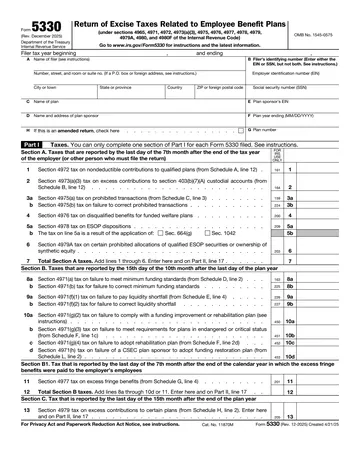
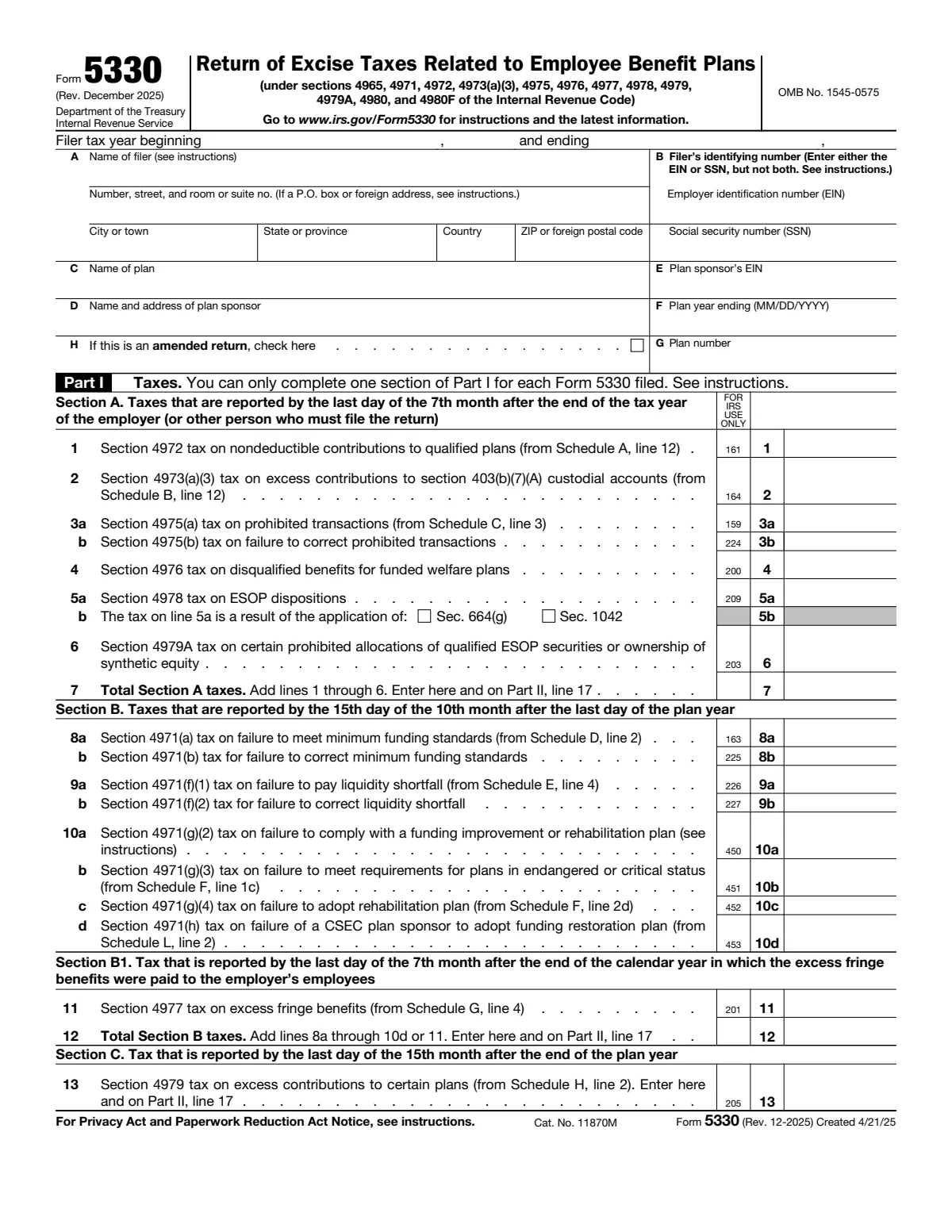
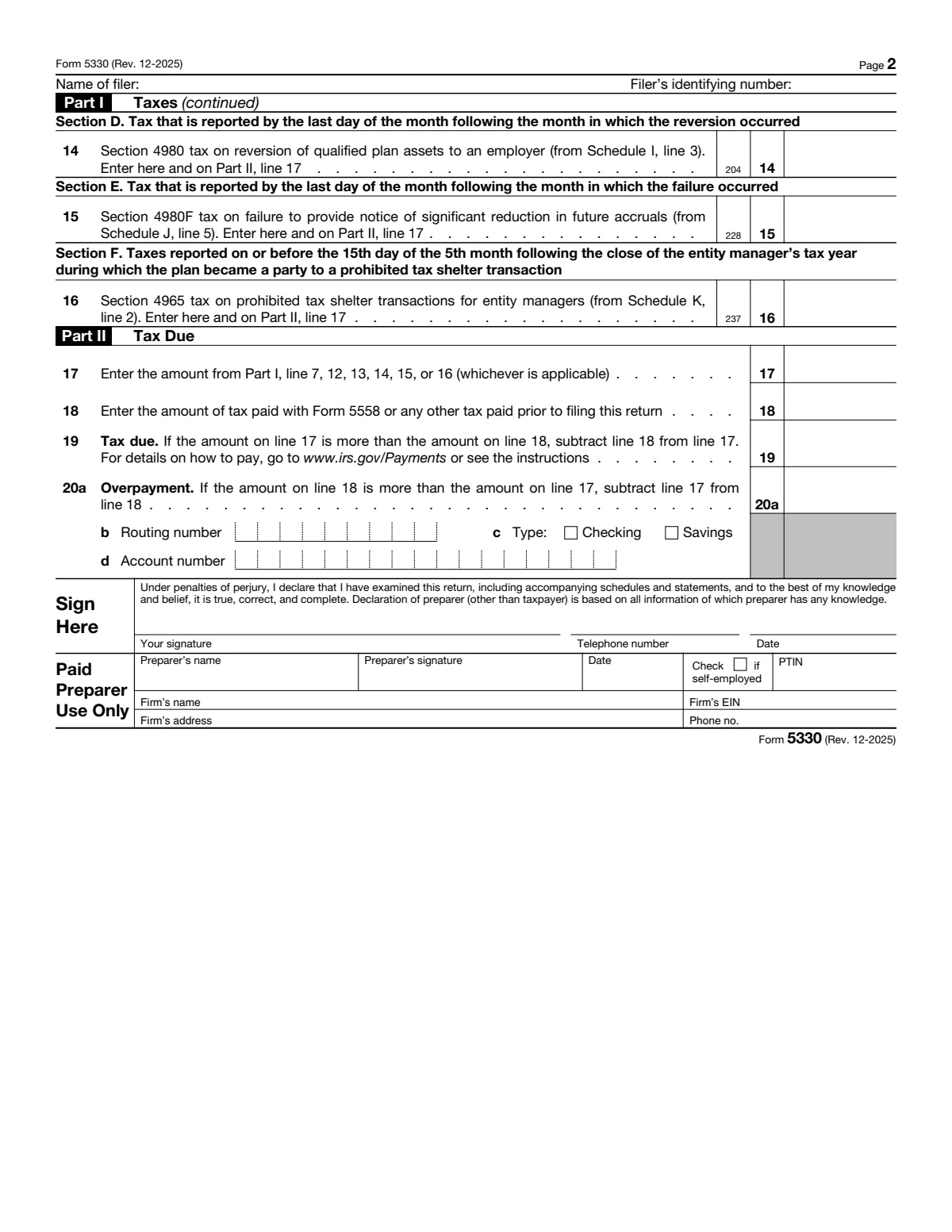
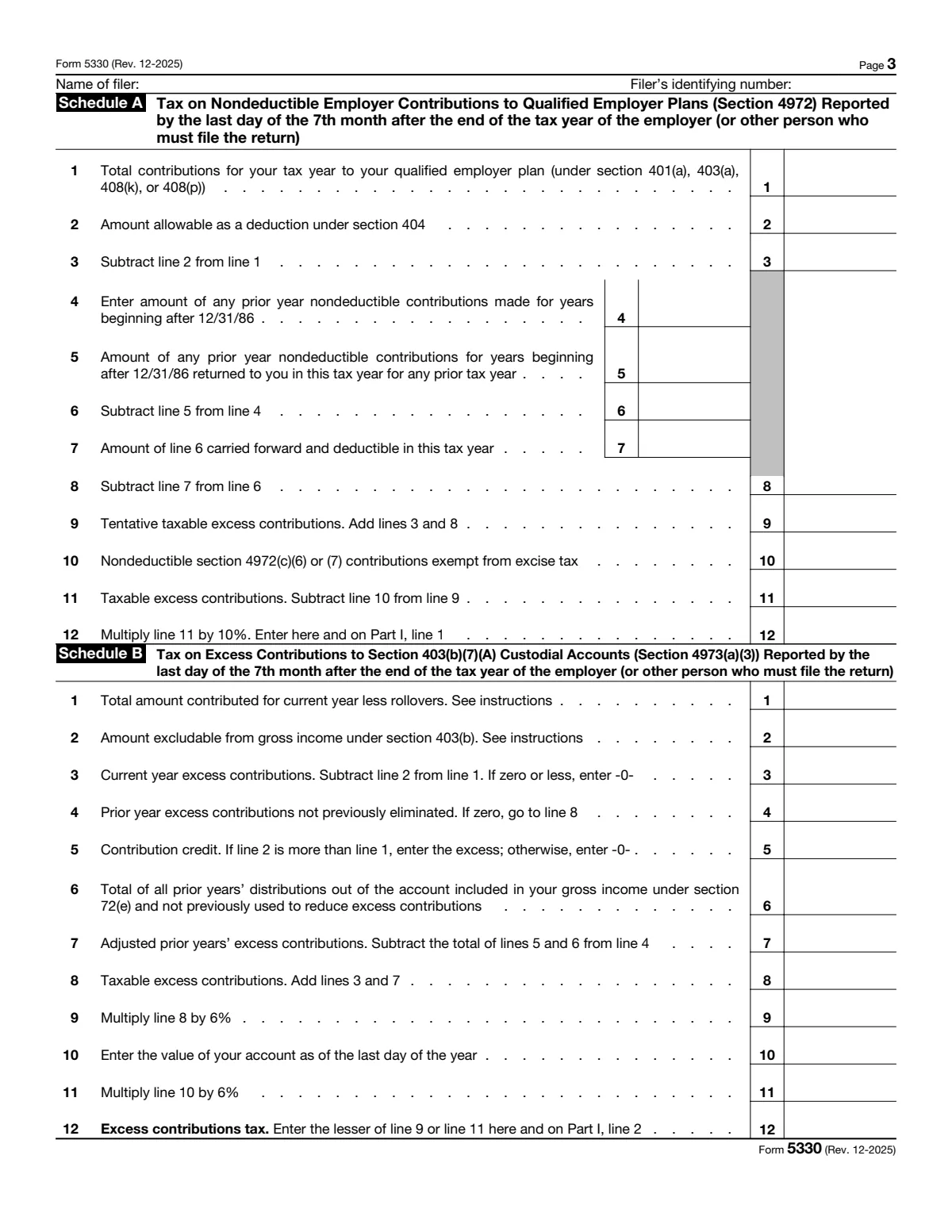
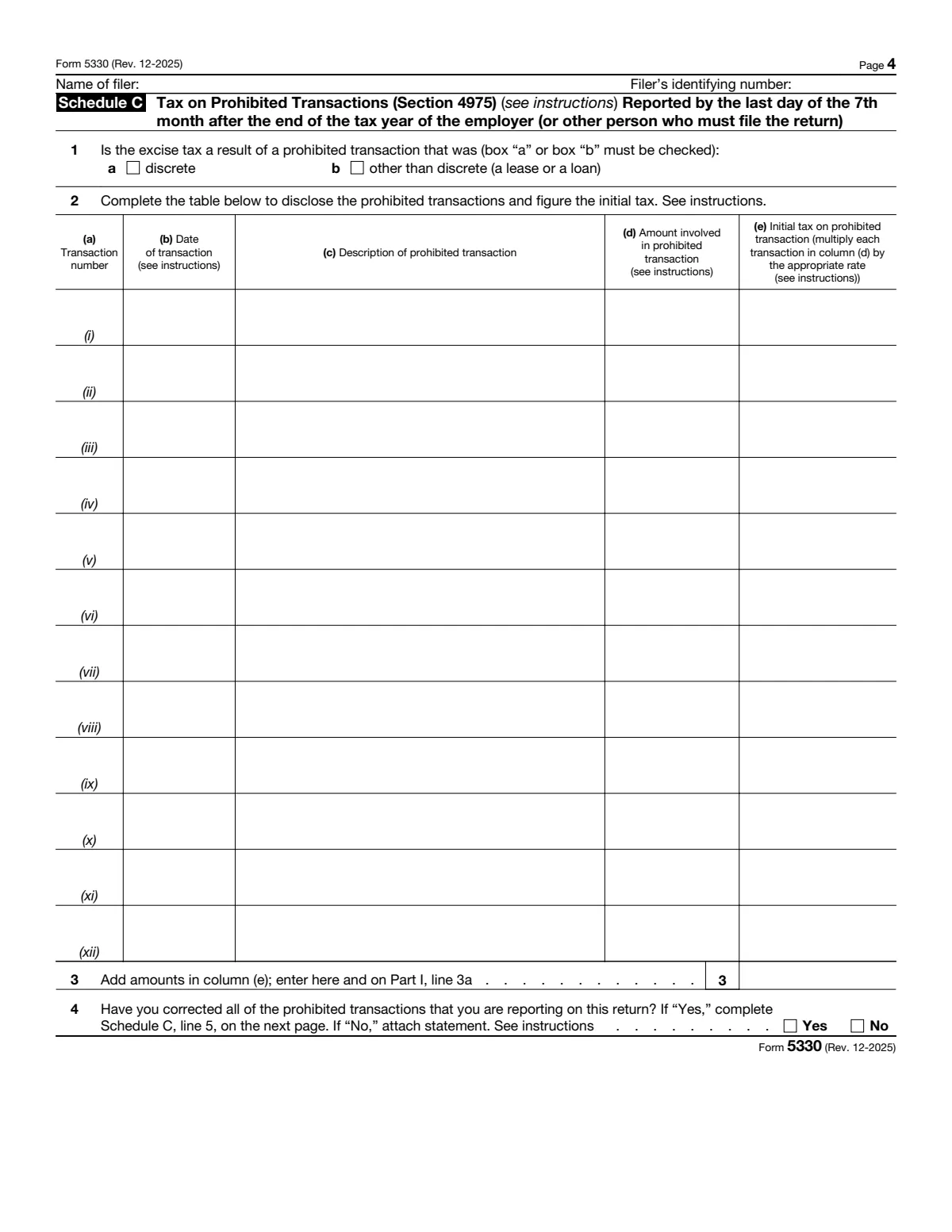
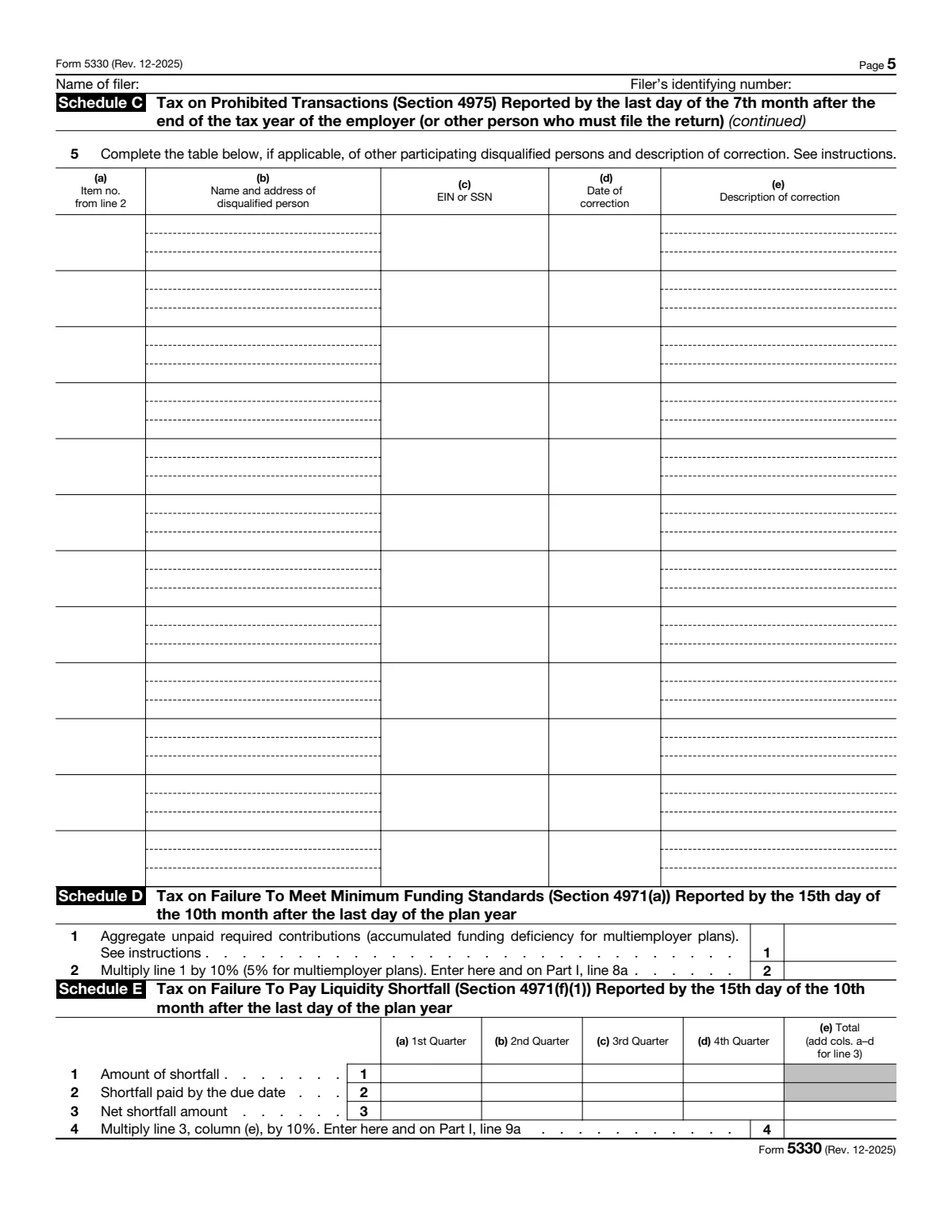
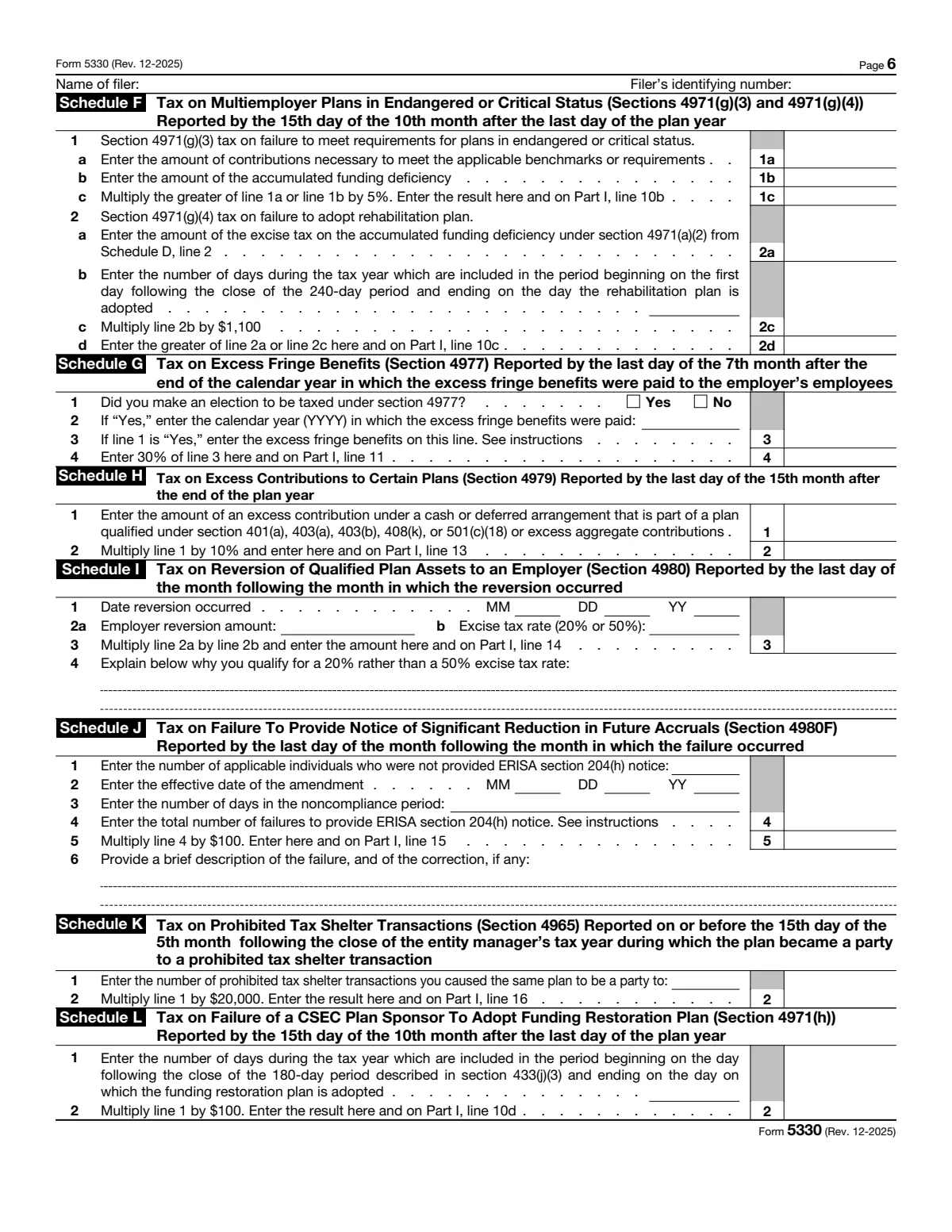
The December 2025 revision has six pages: the entity section and Part I on page 1, the rest of Part I and Part II on page 2, and Schedules A through L on pages 3 to 6. Select a box to read the rule for that line; the box jumps to its row in the tables below.
Swipe sideways to see the whole page, or pinch to zoom. Tap a box once for its note, again to jump to the line.
Entity section, Part I and Part II
The entity section identifies who owes the tax and which plan it relates to. Use the same plan name, sponsor EIN and plan number as the plan's Form 5500 so the IRS can match them.
| Line | Label | What goes there |
|---|---|---|
| Tax year | Filer tax year | Enter the tax year of the employer, entity or individual on whom the tax is imposed, using the plan year dates from Part I of the Form 5500 or the tax year of the business return. |
| A | Name and address of filer | The person liable for the tax. Use a P.O. box only if mail is not delivered to the street address. |
| B | Filer's identifying number | “The filer’s identifying number is either the filer’s employer identification number (EIN) or the filer’s social security number (SSN), but not both.” |
| C | Name of plan | The formal name, matching the plan's Form 5500 series return/report if one is required. |
| D | Name and address of plan sponsor | The single employer, the employee organization, or the association, committee or joint board for a plan maintained jointly. |
| E | Plan sponsor's EIN | The same EIN used to file the Form 5500 series. |
| F | Plan year ending | MM/DD/YYYY. |
| G | Plan number | The three-digit PN. With the EIN it forms the 12-digit number the IRS, DOL and PBGC use to identify the plan. “If the plan number is not provided, this will cause a delay in processing your return.” |
| H | Amended return | Check for an amended return: to claim a refund or credit, or to report more tax with the same due date. |
Part I: Taxes
Complete only the section whose due date this return covers, then carry its total to line 17.
| Line | Label | What goes there |
|---|---|---|
| 1 | Section 4972: nondeductible contributions | From Schedule A, line 12: 10% of nondeductible employer contributions. |
| 2 | Section 4973(a)(3): 403(b)(7) excess contributions | From Schedule B, line 12: 6% tax paid by the individual account holder. |
| 3a | Section 4975(a): prohibited transactions | From Schedule C, line 3: the 15% first-tier tax on the amount involved. |
| 3b | Section 4975(b): failure to correct | The 100% second-tier tax on a prohibited transaction not corrected within the taxable period. |
| 4 | Section 4976: funded welfare plans | 100% of a disqualified benefit provided by a funded welfare benefit plan. |
| 5a-5b | Section 4978: ESOP dispositions | 10% of the amount realized on a disposition within 3 years; check whether section 664(g) or 1042 applied. |
| 6 | Section 4979A: prohibited ESOP allocations | 50% of the amount involved in a prohibited allocation or synthetic equity owned by a disqualified person. |
| 7 | Total Section A taxes | Lines 1 to 6, carried to Part II, line 17. |
| 8a | Section 4971(a): minimum funding | From Schedule D, line 2: 10% of unpaid minimum required contributions (5% for multiemployer plans). |
| 8b | Section 4971(b): failure to correct funding | 100% of the amount still unpaid at the end of the taxable period. |
| 9a | Section 4971(f)(1): liquidity shortfall | From Schedule E, line 4. |
| 9b | Section 4971(f)(2): uncorrected shortfall | Applies when a shortfall remains at the close of a quarter and the following 4 quarters. |
| 10a | Section 4971(g)(2): funding improvement or rehabilitation plan | Enter the amount of each contribution the employer failed to make on time under the plan. |
| 10b | Section 4971(g)(3): endangered or critical status | From Schedule F, line 1c. |
| 10c | Section 4971(g)(4): no rehabilitation plan | From Schedule F, line 2d. This tax cannot be waived. |
| 10d | Section 4971(h): CSEC funding restoration plan | From Schedule L, line 2. |
| 11 | Section 4977: excess fringe benefits | From Schedule G, line 4. Section B1 has its own due date; line 12 totals either lines 8a to 10d or line 11. |
| 12 | Total Section B taxes | Lines 8a through 10d, or line 11, carried to Part II, line 17. |
| 13 | Section 4979: excess contributions | From Schedule H, line 2: 10% of excess contributions or excess aggregate contributions. |
| 14 | Section 4980: reversion | From Schedule I, line 3. Due the last day of the month after the reversion month. |
| 15 | Section 4980F: 204(h) notice failure | From Schedule J, line 5. Due the last day of the month after the failure month. |
| 16 | Section 4965: prohibited tax shelter transactions | From Schedule K, line 2. Paid by the entity manager. |
Part II: Tax due
| Line | Label | What goes there |
|---|---|---|
| 17 | Tax | Enter the total from Part I, line 7, 12, 13, 14, 15 or 16, whichever applies. Part I allows only one section per return. |
| 18 | Tax paid before filing | Tax paid before this return. On an amended return for taxes with the same due date, enter the tax reported on the original return. |
| 19 | Tax due | Line 17 minus line 18. The IRS recommends paying electronically; a paper check goes to the United States Treasury, marked with your name, identifying number, plan number and the Form 5330 section. |
| 20a | Overpayment | Line 18 minus line 17. On an amended return claiming a refund or credit, show the overreported tax here. |
| 20b-20d | Direct deposit | A nine-digit routing number, one account type box, and an account number of up to 17 characters. |
| Sign | Signature | Sign and date, with a daytime phone number. |
| Preparer | Paid Preparer Use Only | Anyone paid to prepare the return signs here and gives the taxpayer a copy. |
Schedules A to L
Complete only the schedules for the taxes you report. The full definitions are in the instructions.
| Line | Label | What goes there |
|---|---|---|
| A:1-3 | Schedule A: current-year excess | Total contributions for the tax year less the amount deductible under section 404. |
| A:4-8 | Schedule A: prior-year carryover | Prior nondeductible contributions (years after 1986), less amounts returned and amounts deductible this year. |
| A:9-11 | Schedule A: taxable excess | Lines 3 plus 8, less section 4972(c)(6) or (7) contributions that are exempt. |
| A:12 | Schedule A: tax | 10% of line 11, carried to Part I, line 1. |
| B:1-3 | Schedule B: current-year excess | Contributions for the year less rollovers, minus the amount excludable under section 415(c). |
| B:4-8 | Schedule B: prior excess and taxable amount | Prior excess not eliminated, adjusted by the contribution credit and distributions included in income. |
| B:9-12 | Schedule B: tax | The lesser of 6% of the excess or 6% of the account value at year end, to Part I, line 2. |
| C:1 | Schedule C: discrete or not | Check discrete, or other than discrete for a lease or a loan. Use of money or property is ongoing. |
| C:2 | Schedule C: the transactions | One row per prohibited transaction: date, description, amount involved and the 15% initial tax. |
| C:3 | Schedule C: total initial tax | Sum of column (e), carried to Part I, line 3a. |
| C:4 | Schedule C: all corrected? | If No, attach a statement with each item and when it will be corrected. If Yes, complete line 5. |
| C:5 | Schedule C: other disqualified persons and correction | Name, address and EIN or SSN of every other participating disqualified person, with the correction date and description. |
| D:1-2 | Schedule D: minimum funding | Aggregate unpaid required contributions (accumulated funding deficiency for multiemployer plans) times 10% or 5%. |
| E:1-4 | Schedule E: liquidity shortfall | Shortfall by quarter, less amounts paid by the installment due date, then 10% of the net total. |
| F:1a-1c | Schedule F: endangered or critical status | 5% of the greater of the contributions needed to meet the benchmarks or the accumulated funding deficiency. |
| F:2a-2d | Schedule F: failure to adopt rehabilitation plan | The greater of the 4971(a)(2) tax or $1,100 times the days after the 240-day period until adoption. |
| G:1-2 | Schedule G: election and year | Yes only if you elected to be taxed under section 4977; then the calendar year the benefits were paid. |
| G:3-4 | Schedule G: excess fringe benefits and tax | Excess fringe benefits, then 30% of that amount. |
| H:1-2 | Schedule H: excess contributions | Excess contributions or excess aggregate contributions, times 10%. |
| I:1-3 | Schedule I: reversion | Date of reversion, the reversion amount, the 20% or 50% rate, and the tax. |
| I:4 | Schedule I: why 20% | Explain why you qualify for a rate other than 50%. |
| J:1-3 | Schedule J: 204(h) failure facts | Applicable individuals not notified, the amendment's effective date, and days in the noncompliance period. |
| J:4-6 | Schedule J: failures and tax | Total failures (individuals times days) times $100, and a short description of the failure and any correction. |
| K:1-2 | Schedule K: prohibited tax shelter transactions | Number of transactions times $20,000. |
| L:1-2 | Schedule L: CSEC funding restoration plan | Days after the 180-day period until adoption, times $100. |
How the 15% tax works: the IRS loan example
In the instructions, a disqualified person borrows from a plan on July 1, 2024 and repays on December 31, 2025; the use of the money is worth $1,000 a month. A loan is a new prohibited transaction on the first day of each later tax year in the taxable period, so there are two.
| Form 5330 for | Transactions on Schedule C, line 2 | Amount involved | Tax at 15% |
|---|---|---|---|
| 2024 (filed late) | July 1, 2024 loan (6 months) | $6,000 | $900 |
| 2025 | July 1, 2024 loan, again | $6,000 | $900 |
| 2025 | January 1, 2025 deemed transaction (12 months) | $12,000 | $1,800 |
| 2025 total (line 3) | $2,700 |
The first transaction appears on both returns because its taxable period runs until correction. Without correction in the taxable period, the 100% tax under section 4975(b) applies on line 3b.
Late deferrals as prohibited transactions
Late participant contributions can lead to the section 4975 tax. The Form 5500 instructions for Schedule H say an employer holding participant contributions commingled with its general assets after the earliest date they can reasonably be segregated “will have engaged in a prohibited use of plan assets (see ERISA section 406)”, and if a nonexempt prohibited transaction occurred with a disqualified person, file Form 5330 to pay the excise tax. The late amounts are reported on Schedule H line 4a or Schedule I line 4a.
For the tax, the amount involved is not the deferral itself. Under the Form 5330 instructions, for a failure to transmit participant contributions “the amount involved is based on interest on those elective deferrals” (Rev. Rul. 2006-38). It goes on Schedule C, line 2, column (d).
Relief exists. Applicants that satisfy the DOL Voluntary Fiduciary Correction Program and the conditions of PTE 2002-51 are eligible for immediate relief from certain prohibited transaction excise taxes for certain corrected transactions, and, in the words of the Form 5500 instructions, are also relieved from the obligation to file the Form 5330 with the IRS (see 90 Fed. Reg. 4192 and 90 Fed. Reg. 3667, Jan. 15, 2025).
Filing Form 5330 starts the statute of limitations only for the taxes reported on it, with one exception that matters here: “statutes of limitations with respect to the prohibited transaction excise tax(es) are based on the filing of the applicable Form 5500”. See the 401(k) plan guide for how late deferrals show up on the annual report.
Interest, penalties and amended returns
| Item | Rule in the instructions |
|---|---|
| Interest | Charged on unpaid tax from the due date of the return, regardless of extensions, until paid in full (section 6601) |
| Late filing penalty | 5% of the unpaid tax for each month or part of a month the return is late, up to 25%, unless due to reasonable cause (attach a statement) |
| Late payment penalty | ½ of 1% of the unpaid tax for each month or part of a month, up to 25%, unless due to reasonable cause |
| Amended return | Check item H. Use it to claim a refund or credit, or to report more tax with the same due date; show the original tax on line 18 |
For the separate DOL and IRS penalties on a late annual report, see Form 5500 penalties.
Questions filers ask
Can I still extend Form 5330 with Form 5558?
No. The IRS says Form 5558 has not been used for Form 5330 since 2024. File Form 8868 by the normal due date; it can extend the filing date up to 6 months but does not extend the time to pay.
Do late 401(k) deferrals always require a Form 5330?
When they are a nonexempt prohibited transaction with a disqualified person, the Form 5500 instructions say to file Form 5330 to pay the tax. Applicants that satisfy the VFCP and PTE 2002-51 conditions are relieved from filing Form 5330 for the corrected transactions.
I owe a 4975 tax and a 4971 tax. One return or two?
Two. They fall in different Part I sections with different due dates, and only one section can be completed on each Form 5330.
Is Form 5330 filed in EFAST2?
No. It is an IRS return, filed through MeF with an authorized e-file provider, or on paper with the IRS in Ogden if you are not required to e-file.