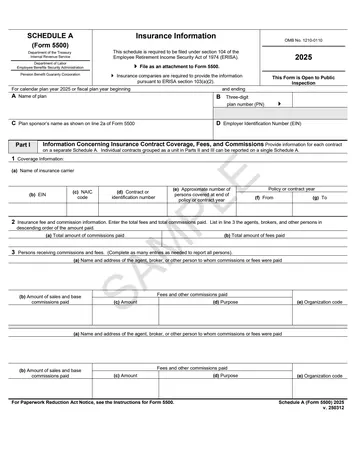
- At a glance
- The form, page by page
- Part I: coverage, fees and commissions
- Part II: investment and annuity contracts
- Part III: welfare benefit contracts
- Part IV: provision of information
- What counts as a commission or fee
- Organization codes for line 3(e)
- Schedule A and Schedule C
- Common mistakes and EFAST2 checks
At a glance
Schedule A is attached to the Form 5500 filed for every pension or welfare plan required to file “if any benefits under the plan are provided by an insurance company, insurance service, or other similar organization”, such as Blue Cross Blue Shield or an HMO. That includes investment contracts with insurers, such as guaranteed investment contracts. It is also required for each insurance or annuity contract held by an MTIA, 103-12 IE, DCG or GIA. Plan size does not matter: the instructions list Schedule A for large and small plans alike. For the welfare plan side of this, see Form 5500 for health and welfare plans.
If line 9a(1), 9a(2), 9b(1) or 9b(2) of the Form 5500 is checked, at least one Schedule A is required. Check box 10b(3) and enter the number of Schedules A attached. “Do not file Schedule A for a contract that is an Administrative Services Only (ASO) contract, a fidelity bond or policy, or a fiduciary liability insurance policy.” If a Schedule A for a contract is filed with an MTIA's or 103-12 IE's Form 5500, the participating plans do not file it again.
One Schedule A covers one contract, for the insurance contract or policy year that ends with or within the plan year (“for reporting purposes, a year cannot exceed 12 months”). For example, a contract year of July 1 to June 30 and a calendar plan year means the 2025 Schedule A reports the contract year ending June 30, 2025. If the insurer keeps records on a plan year basis, the schedule may use the plan year. Schedule A is due with the Form 5500, which “must be filed by the last day of the 7th calendar month after the end of the plan, DCG or GIA year”. “Your 2025 Form 5500 must be electronically filed in the ERISA Filing Acceptance System (EFAST2).”
Plans may treat multiple individual annuity contracts, including 403(b)(1) annuity contracts, from the same insurer as a single group contract on Schedule A. Individual contracts grouped as a unit in Parts II and III can be reported on a single Schedule A.
The form, page by page
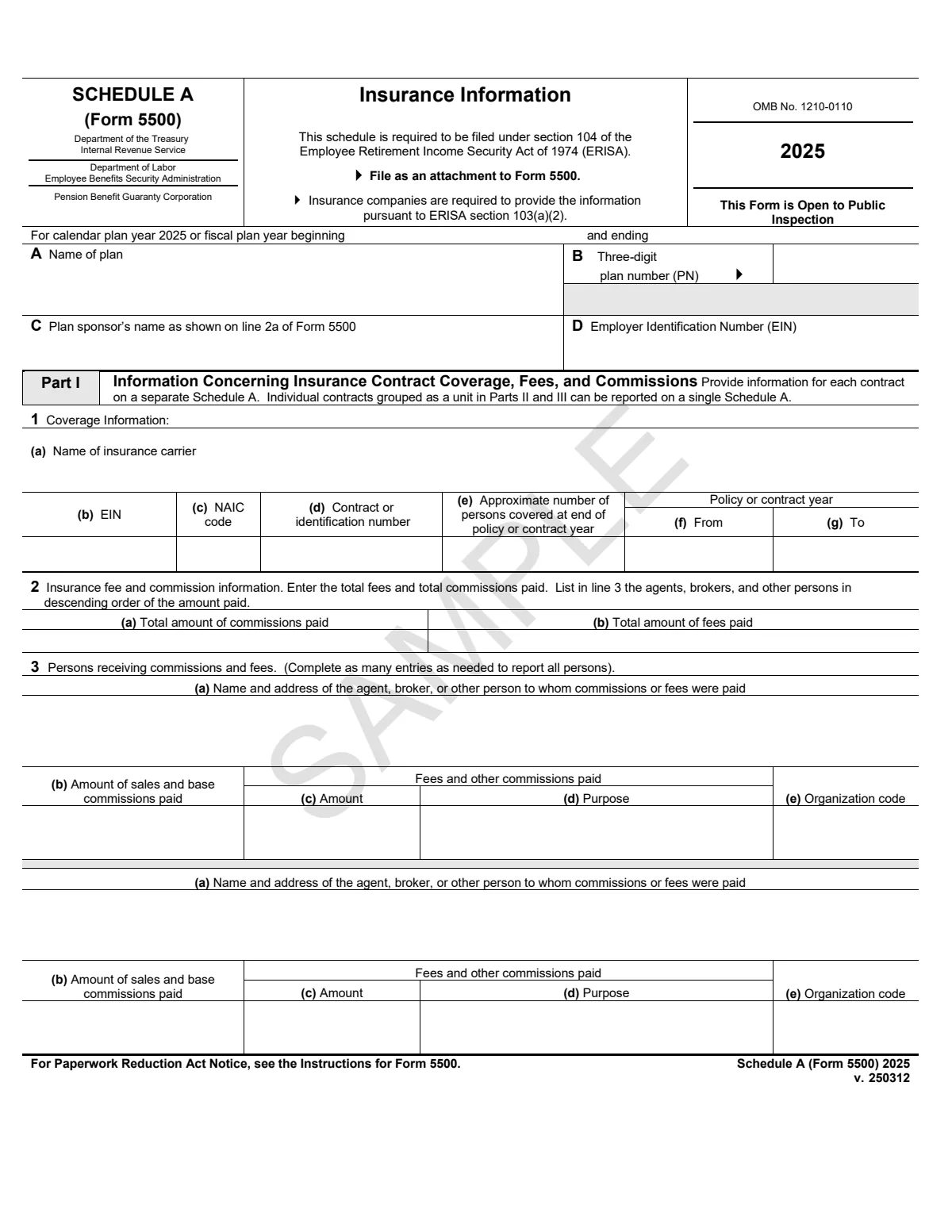
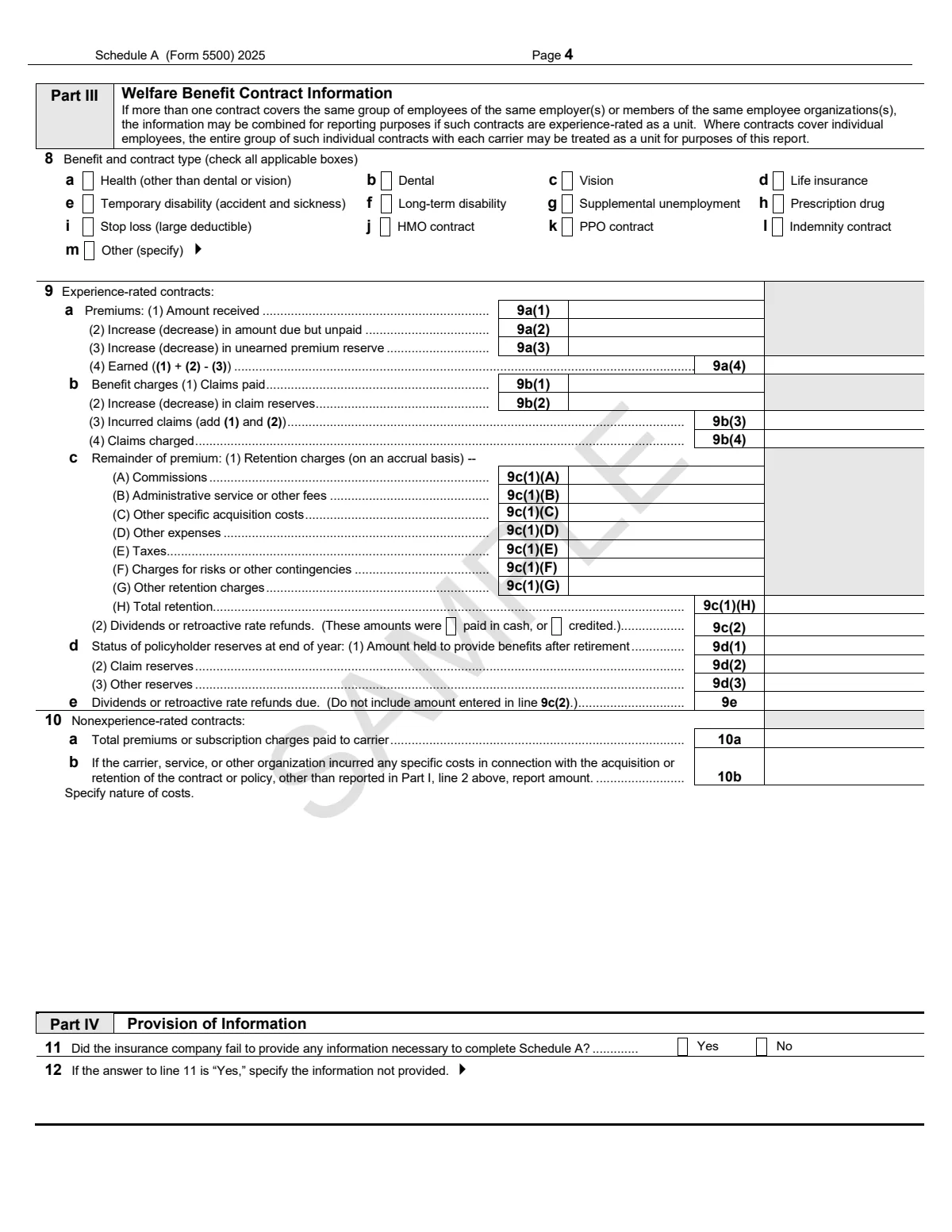
The 2025 Schedule A has four pages: Part I (coverage, fees and commissions) on pages 1 and 2, Part II (investment and annuity contracts) on page 3, and Parts III (welfare contracts) and IV (provision of information) on page 4. Part II is for investment and annuity contracts and Part III for welfare benefit contracts; line 11 in Part IV is answered Yes or No on every Schedule A.
Swipe sideways to see the whole page, or pinch to zoom. Tap a box once for its note, again to jump to the line.
Part I: coverage, fees and commissions
| Line | Label | What goes there |
|---|---|---|
| A-D | Plan name, plan number, sponsor, EIN | Must match Part II of the Form 5500. The schedule is public; an SSN on it or an attachment may cause rejection. |
| 1(a) | Name of insurance carrier | The insurance company, insurance service or similar organization (such as Blue Cross Blue Shield or an HMO) that issued the contract. |
| 1(b)-(c) | EIN and NAIC code | The carrier's EIN and the code the National Association of Insurance Commissioners assigned to it. “If none has been assigned, enter zeros “0” in the spaces provided.” |
| 1(d) | Contract or identification number | If individual policies with the same carrier are grouped as a unit and have no group number, you may use one policy's number, used consistently, if the administrator keeps the records to list every policy on request. Contracts that cannot be grouped need separate Schedules A. |
| 1(e) | Approximate number of persons covered | An estimate of persons covered at the end of the policy or contract year. For grouped contracts covering individual employees, figure it as of the end of the plan year. |
| 1(f)-(g) | Policy or contract year: from, to | The beginning and ending dates of the policy year for the contract on 1(d). Leave 1(f) blank if separate contracts covering individual employees are grouped. |
| 2 | Total commissions and total fees paid | The total of all insurance fees and commissions directly or indirectly attributable to the contract, paid to the persons listed on line 3. “Insurers must provide plan administrators with a proportionate allocation of commissions and fees attributable to each contract.” Any reasonable allocation method is acceptable if it is disclosed to the administrator. |
| 3(a) | Name and address of the agent, broker or other person | “Identify agents, brokers, and other persons individually in descending order of the amount paid.” Complete elements (a) to (e) for each person. |
| 3(b) | Amount of sales and base commissions | Monetary amounts paid by the insurer, charged directly to the contract, to a licensed agent or broker for selling or placing it. All other payments are fees on 3(c). |
| 3(c)-(d) | Fees and other commissions: amount and purpose | Payments other than sales and base commissions, such as service fees, consulting fees, finder's fees, profitability and persistency bonuses, awards, prizes and non-monetary compensation, with the purpose of each. Fees to persons other than agents and brokers are reported here, not in Parts II and III. |
| 3(e) | Organization code | The most appropriate code from the table below for the person in 3(a). |
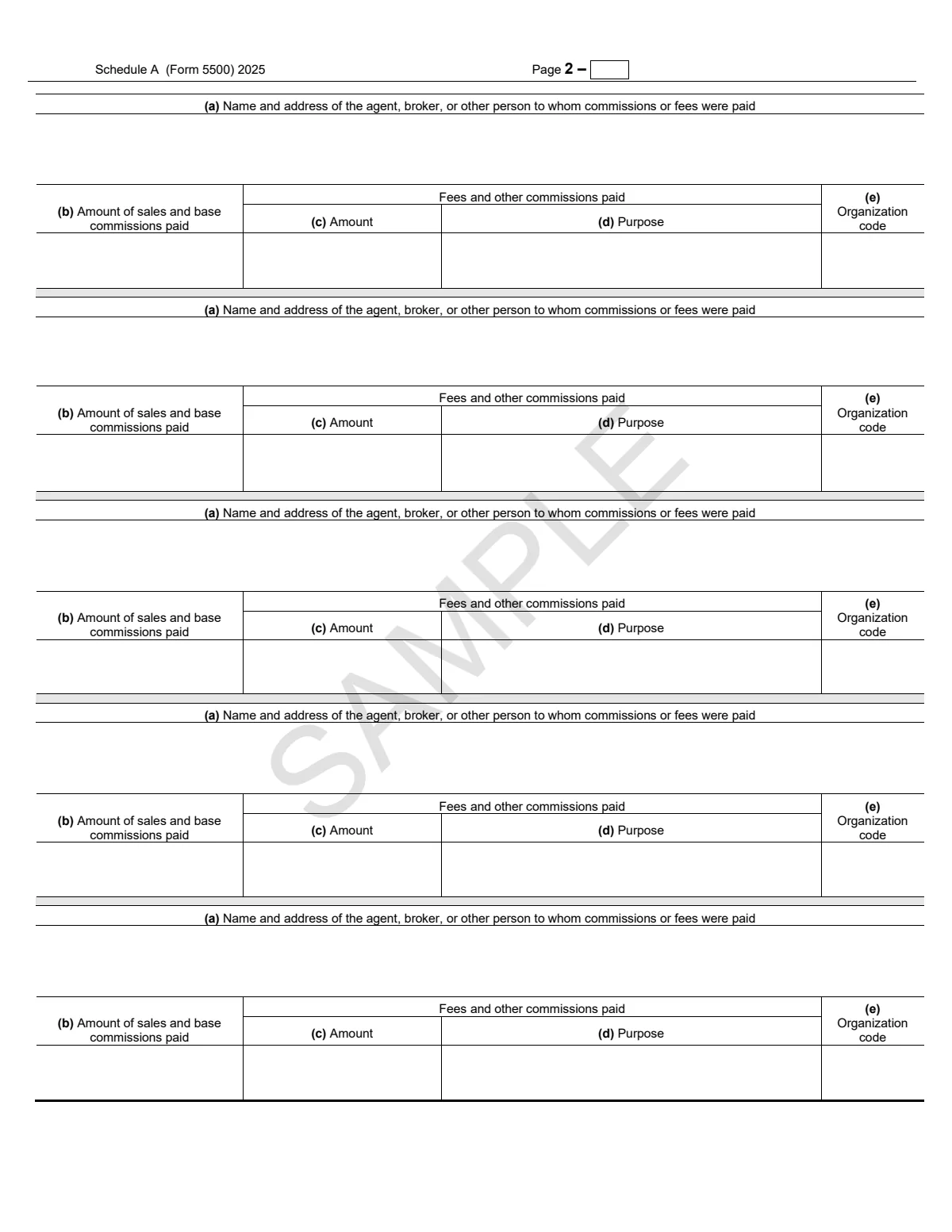
| 3-more | Additional line 3 entries (page 2) | Page 2 repeats line 3 for more persons. Complete as many entries as needed to report everyone paid. |
Part II: investment and annuity contracts
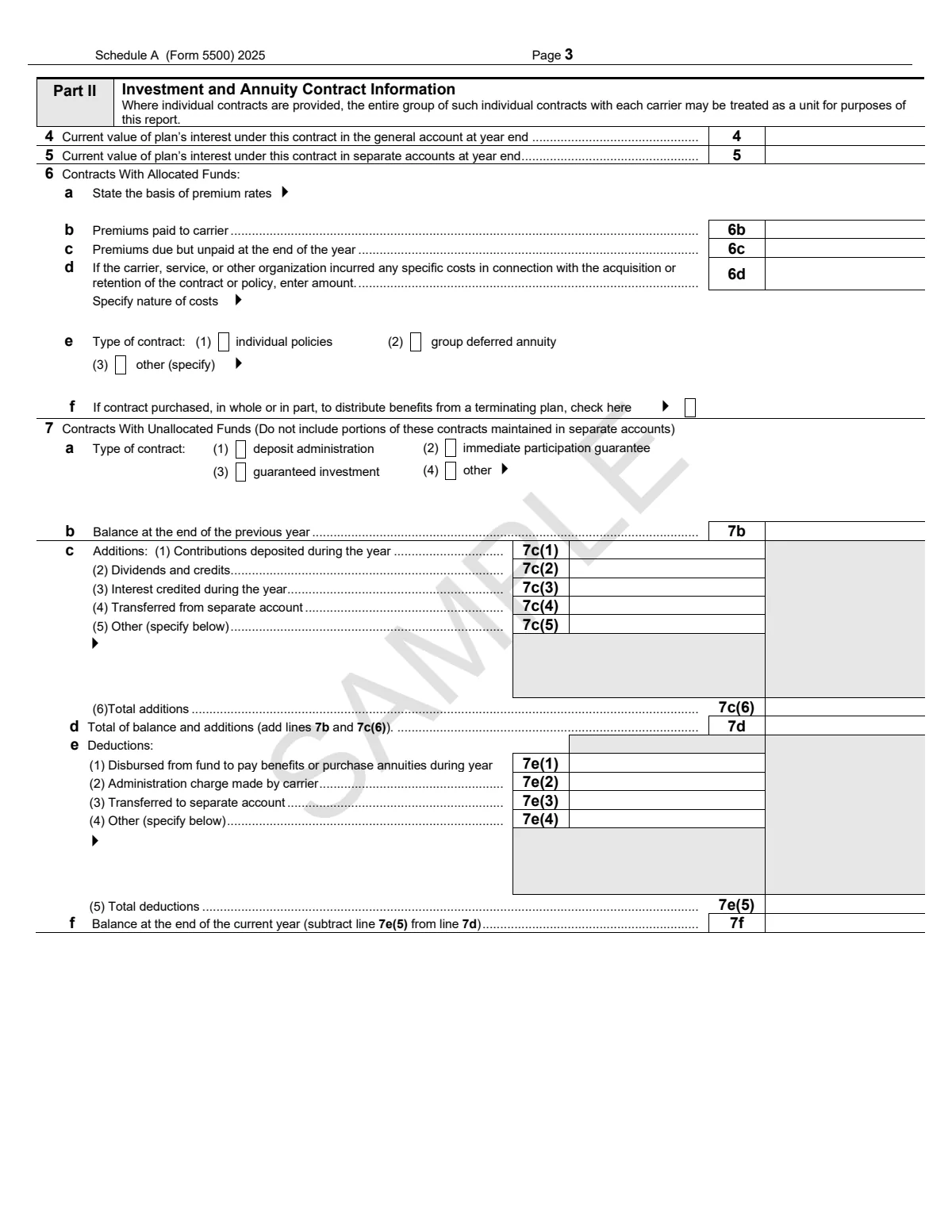
Part II is for pension contracts: the value of the plan's interest in the general account and separate accounts, contracts with allocated funds (line 6) and contracts with unallocated funds (line 7).
| Line | Label | What goes there |
|---|---|---|
| 4 | Current value of the plan's interest in the general account at year end | For the contract reported on line 7, such as deposit administration (DA), immediate participation guarantee (IPG) or guaranteed investment contract (GIC). Line 4 may be skipped for a defined benefit plan contract where “the contract was entered into before March 20, 1992”, or for a fully benefit-responsive contract in a defined contribution plan. Schedule H line 1c(14) and Schedule I line 1a use the same valuation method. |
| 5 | Current value of the plan's interest in separate accounts at year end | The plan's interest under this contract held in the carrier's separate accounts. |
| 6a | Basis of premium rates | Attach the schedules of current rates filed with the state insurance department, or a statement of the basis of the rates, and enter see attached if appropriate. |
| 6b | Premiums paid to carrier | Premiums paid on contracts with allocated funds. |
| 6c | Premiums due but unpaid at year end | Premiums owed but not paid at the end of the year. |
| 6d | Specific acquisition or retention costs | Costs the carrier incurred to acquire or retain the contract, with the nature of the costs. |
| 6e | Type of contract | Individual policies, group deferred annuity, or other (specify). |
| 6f | Purchased to distribute benefits from a terminating plan | Check if the contract was bought, in whole or in part, to pay benefits from a terminating plan. |
| 7a | Type of contract with unallocated funds | Deposit administration, immediate participation guarantee, guaranteed investment, or other. Report contracts with unallocated funds and leave out portions kept in separate accounts. |
| 7b | Balance at the end of the previous year | Show deposit fund amounts rather than experience credit records when both are maintained. |
| 7c | Additions: contributions, dividends and credits, interest, transfers from separate accounts, other, total | Each addition to the fund during the year, with any other additions described, and the total on 7c(6). |
| 7d | Total of balance and additions | Line 7b plus line 7c(6). |
| 7e | Deductions: benefits or annuity purchases, administration charge, transfers to separate accounts, other, total | Each deduction from the fund, with any other deductions described, and the total on 7e(5). |
| 7f | Balance at the end of the current year | Line 7d minus line 7e(5). |
Part III: welfare benefit contracts
Contracts covering the same group that are experience-rated as a unit may be combined, and individual contracts with one carrier may be treated as a unit. Line 9 is for experience-rated contracts and line 10 for nonexperience-rated contracts.
| Line | Label | What goes there |
|---|---|---|
| 8 | Benefit and contract type | Check all that apply: health (other than dental or vision), dental, vision, life, temporary disability, long-term disability, supplemental unemployment, prescription drug, stop loss, HMO, PPO, indemnity, other. “Report a stop-loss insurance policy that is an asset of the plan.” A stop-loss policy with the employer as the insured, paid only from the employer's general assets with no employee contributions, generally is not a plan asset and is not reported. |
| 9a | Experience-rated contracts: premiums | (1) amount received, (2) increase or decrease in amount due but unpaid, (3) increase or decrease in unearned premium reserve, and (4) earned premium, which is (1) plus (2) minus (3). |
| 9b | Benefit charges | (1) claims paid, (2) increase or decrease in claim reserves, (3) incurred claims, which is (1) plus (2), and (4) claims charged. |
| 9c(1) | Retention charges (accrual basis) | (A) commissions, (B) administrative service or other fees, (C) other specific acquisition costs, (D) other expenses, (E) taxes, (F) charges for risks or other contingencies, (G) other retention charges, and (H) total retention. |
| 9c(2) | Dividends or retroactive rate refunds | Amounts paid in cash or credited, with the matching box checked. |
| 9d | Status of policyholder reserves at end of year | (1) amount held to provide benefits after retirement, (2) claim reserves, (3) other reserves. |
| 9e | Dividends or retroactive rate refunds due | Amounts due, not including the amount on 9c(2). |
| 10a | Nonexperience-rated: total premiums or subscription charges paid | Premiums or subscription charges paid to the carrier. |
| 10b | Specific acquisition or retention costs | Costs other than those already reported on Part I, line 2, with their nature. |
Part IV: provision of information
| Line | Label | What goes there |
|---|---|---|
| 11 | Did the insurance company fail to provide information? | If information is missing because the insurer refused to provide it, check Yes. If you received everything, check No and leave line 12 blank. The insurer “is statutorily required to provide you with all of the information necessary to complete the Schedule A but need not provide the information on a Schedule A itself.” |
| 12 | Information not provided | Describe the information the insurer did not provide. Before you get here, contact the insurer: ERISA section 103(a)(2) requires it to give the administrator what is needed. |
What counts as a commission or fee
For lines 2 and 3, commissions and fees include sales and base commissions and every other monetary or non-monetary payment where the person's eligibility or the amount depends on the value of contracts placed with or kept by an ERISA plan, such as persistency and profitability bonuses. Three kinds of payments are left out:
- Reasonable payments by the insurer, from its general assets, to affiliates or third parties for administrative work the insurer needs to provide the benefits (such as recordkeeping and claims processing), when the plan pays nothing for that work beyond the premium. This exclusion does not cover finder's fees, brokerage commissions or similar fees tied to the sale or renewal of a policy.
- Payments to a general agent or manager for managing an agency or doing administrative work for the insurer, unless the payment depends on the value of plan contracts. Brokers representing insureds are not general agents.
- Occasional non-monetary gifts or meals of insubstantial value. “the gift must be valued at less than $50, the aggregate value of gifts from one source in a calendar year must be less than $100”, and gifts under $10 do not count toward the $100.
The instructions give an example: an insurer serves $20 of refreshments to each of six broker employees at an educational conference. The total is $120, but each employee is measured separately, so nothing is reportable. Gifts from several employees of one service provider count as one source. These thresholds are only for Schedule A reporting; gifts to plan fiduciaries of any amount may still violate ERISA.
Organization codes for line 3(e)
| Code | Type of organization |
|---|---|
| 1 | Banking, savings and loan association, credit union or other similar financial institution |
| 2 | Trust company |
| 3 | Insurance agent or broker |
| 4 | Agent or broker other than insurance |
| 5 | Third party administrator |
| 6 | Investment company/mutual fund |
| 7 | Investment manager/adviser |
| 8 | Labor union |
| 9 | Foreign entity (an agent, broker, bank, insurer and so on not operating within the United States) |
| 0 | Other |
Schedule A and Schedule C
For a large plan that files Schedule C, “commissions and fees listed on the Schedule A are not required to be reported again on Schedule C”. The Schedule A amounts still count toward the $5,000 threshold that decides whether the person's other compensation must be reported on Schedule C. A person whose only compensation is insurance fees and commissions listed on Schedule A is not listed on Schedule C at all.
Common mistakes and EFAST2 checks
- Funding and benefit arrangement boxes that do not match the schedules. The EFAST2 filing tips say lines 9a and 9b are cross-referenced against Schedules H, I and A, and that marking Insurance means a Schedule A “should be filed with Form 5500 for any insurance contract with a contract or policy year that ended with or within the plan year”.
- A wrong count on box 10b(3). The tips say to “take special care to enter the total number of each schedule you are filing in the space provided on Line 10b(3)”.
- Filing Schedule A for an ASO contract, a fidelity bond or a fiduciary liability policy.
- Using the plan year instead of the contract year when the insurer keeps contract-year records.
- Reporting an employer-owned stop-loss policy that is not a plan asset.
- Checking Yes on line 11 without first asking the insurer for the missing information.
An incomplete filing is exposed to the DOL's civil penalty of up to $2,739 a day under ERISA 502(c)(2) for a plan administrator who fails or refuses to file a complete and accurate report (the 2025 amount, 90 FR 1854; the DOL made no 2026 adjustment, 91 FR 31358). See Form 5500 penalties.
Questions filers ask
Do small plans file Schedule A?
Yes, when they file the Form 5500 and have insurance contracts. The quick reference chart in the instructions lists Schedule A for large and small pension and welfare plans.
We have medical, dental and life with three insurers. How many Schedules A?
Generally one per contract, so at least three. Individual policies with the same carrier can be grouped as a unit, and contracts covering the same group that are experience-rated as a unit may be combined.
Our medical plan is self-funded with an ASO contract. Do we need Schedule A?
Not for the ASO contract. The instructions say not to file Schedule A for an Administrative Services Only contract. A stop-loss policy that is a plan asset is reported on line 8i.
Which contract year goes on the 2025 Schedule A?
The insurance contract or policy year that ends with or within the 2025 plan year, unless the insurer keeps its records on a plan year basis.
The broker's commissions are on Schedule A. Do they also go on Schedule C?
No. They are not reported again on Schedule C, but they count toward the broker's $5,000 Schedule C threshold for any other compensation.