- At a glance
- What a DCG is
- The form, line by line
- Parts I and II: DCG and plan identification
- Part III: basic plan information
- Part IV: financial information
- Parts V and VI: codes and compliance questions
- Lines 10 to 13: transfers and IRS questions
- Part VII: accountant's opinion
- Rules that matter
- Common mistakes
- Questions filers ask
At a glance
A defined contribution group reporting arrangement (DCG) lets a group of defined contribution plans report on one consolidated Form 5500. The schedule is how each plan in the group still reports its own information. “Each plan participating in a DCG must individually complete a Schedule DCG to be attached to the Form 5500.”
| Question | Answer from the 2025 instructions |
|---|---|
| Who files | The common plan administrator of a DCG, one Schedule DCG for each participating plan, attached to the DCG's Form 5500 (DFE code D in Part I, line A). |
| Attach to | Form 5500 only. Check Part II, line 10a(4) and enter the number of Schedules DCG attached. A DCG cannot use the Form 5500-SF. |
| How many | Up to 999 Schedules DCG in one filing, under the EFAST2 limit. |
| Due | The last day of the 7th calendar month after the end of the DCG year, the same rule as plans. See Form 5500 due date. |
| Audit | Each plan's IQPA report is attached to its own Schedule DCG, unless it is a small plan eligible for the audit waiver. |
| Pages | 3 |
DCGs are new as of the 2023 forms. The DOL fact sheet describes changes “effective for plan years beginning on or after January 1, 2023”, including “a new Schedule DCG (Individual Plan Information)”. The DOL regulation says the administrator of a plan in a DCG “is not required to file a separate annual report with the Secretary of Labor” when the consolidated report is filed by the common plan administrator.
What a DCG is
An arrangement is a DCG for reporting purposes only if every plan in it meets all of these conditions from the instructions (and 29 CFR 2520.104-51(c)):
- Is an individual account plan or defined contribution plan.
- Has the same trustee and the same named fiduciaries (an employer may be an extra named fiduciary for its own plan).
- Has the same designated plan administrator, the common plan administrator.
- Has plan years beginning on the same date.
- Offers the same investments or investment options; certain brokerage windows qualify.
- Holds no employer securities during the year, apart from publicly traded employer securities within a common investment option.
- Is audited by an IQPA, with the report filed with the DCG return, or is eligible for the small plan audit waiver in 29 CFR 2520.104-46.
- Is not a MEP (including a pooled employer plan) or a multiemployer plan.
The DCG's own Form 5500 follows the large pension plan rules. It files Schedule A as needed, Schedule C, Schedule D Part I, Schedule G, and Schedule H (except lines 4e, 4f, 4k, 4l and 5), all reported for the plans in the aggregate. Schedule DCG is the one schedule with plan-level detail. Schedule R is not completed for a DCG: lines 12a, 12b and 13 of each Schedule DCG ask the questions that Schedule R lines 21a, 21b and 22 ask.
The form, line by line
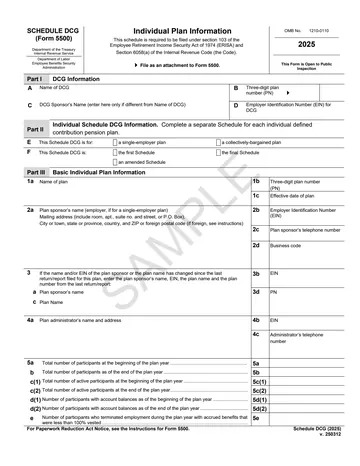
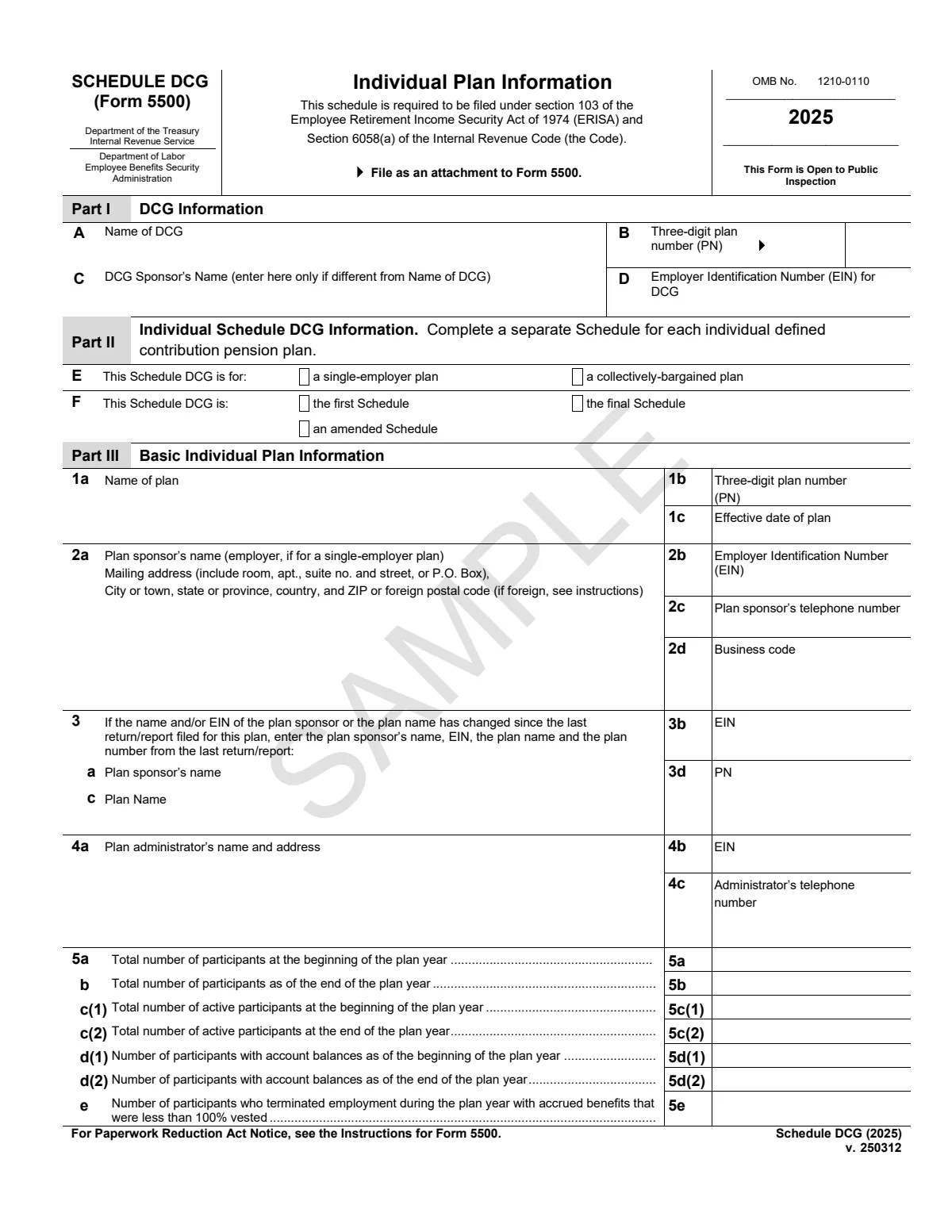
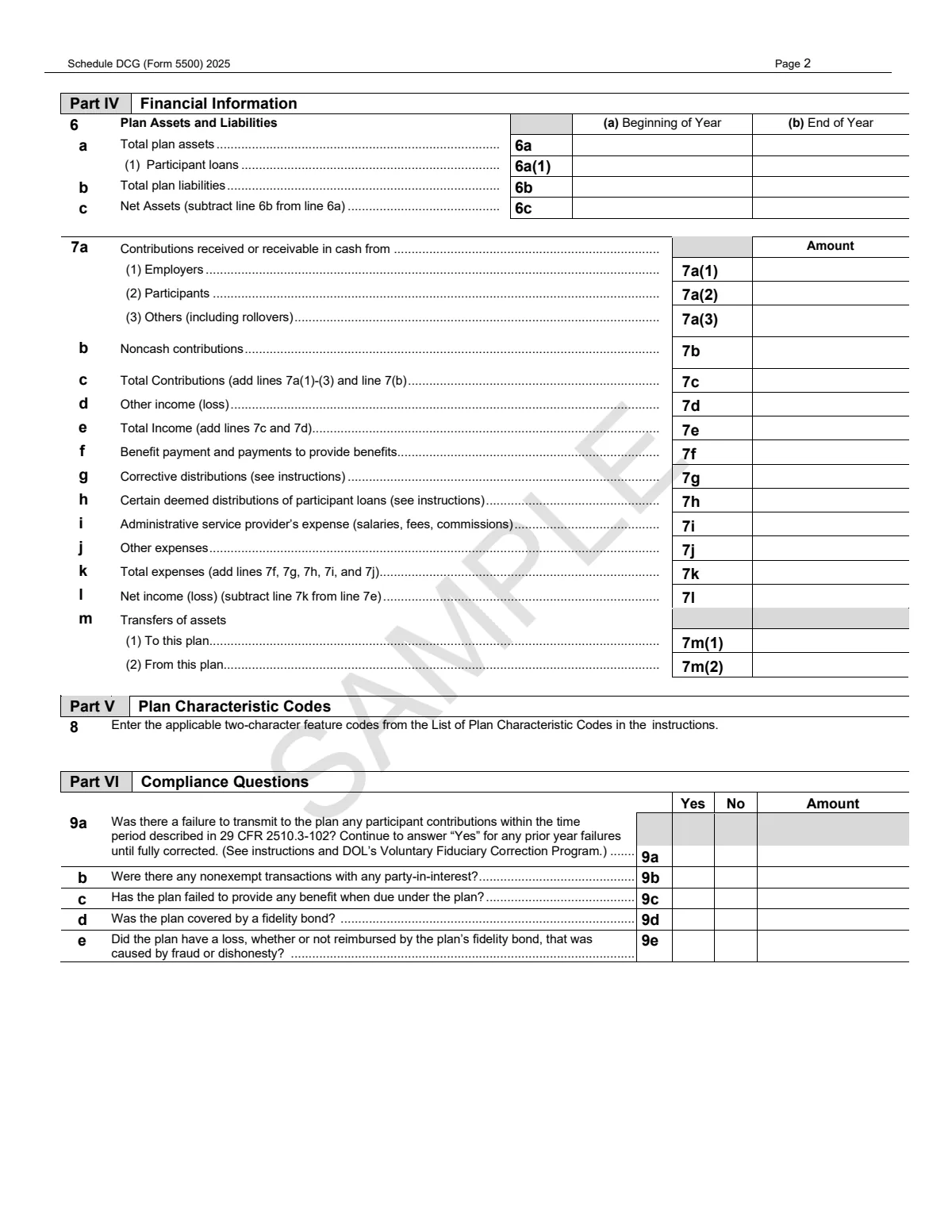
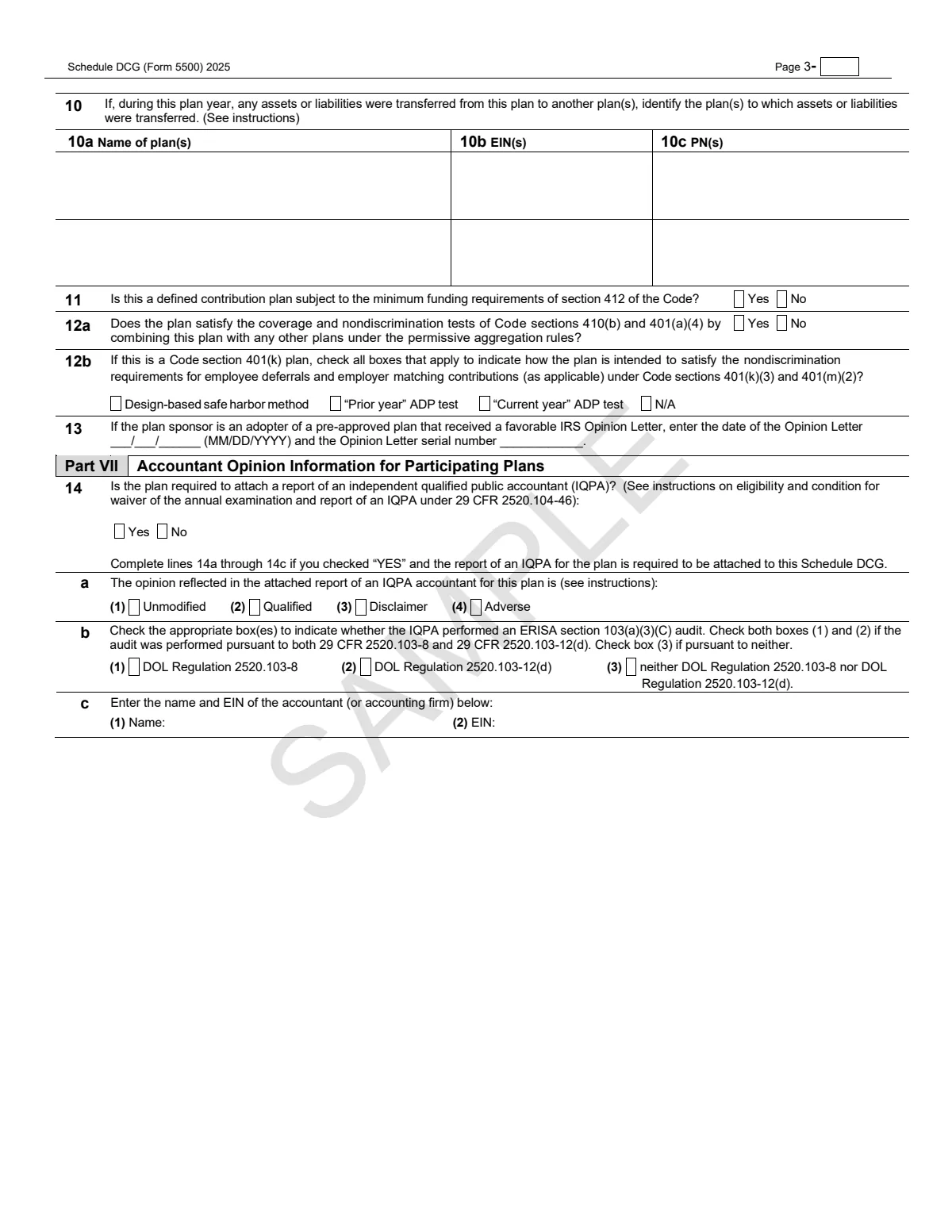
Schedule DCG is three pages: identification and participant counts on page 1, financial information and compliance questions on page 2, and transfers, IRS questions and the accountant's opinion on page 3.
Swipe sideways to see the whole page, or pinch to zoom. Tap a box once for its note, again to jump to the line.
Parts I and II: DCG and plan identification
Part I repeats the DCG's own identification from its Form 5500. Part II identifies the kind of plan and whether this is a first, final or amended schedule.
| Line | Label | What goes there |
|---|---|---|
| A-D | DCG identification | Lines A to D describe the DCG, not the participating plan. The DCG's name may differ from the DCG sponsor's name, for example when one sponsor offers more than one DCG reporting arrangement. |
| E | Single-employer or collectively bargained | A single-employer plan here is maintained by one employer or employee organization, on a controlled group basis, with each employer's funds available only for its own employees. “A plan that does not meet this definition is ineligible to participate in a DCG and should not complete this Schedule.” It files its own Form 5500 or 5500-SF instead. |
| F | First, final or amended Schedule | Do not check Final if you only withdraw from the DCG and still have a filing requirement. For an amendment, the whole DCG filing is resubmitted, and only the changed Schedules DCG are marked amended. |
Part III: basic plan information
Part III is the participating plan's own identity and participant counts, much like Form 5500 Part II for a plan filing alone.
| Line | Label | What goes there |
|---|---|---|
| 1a | Name of plan | Once you use an abbreviation, keep using it on all future filings, and never use the same name for another plan. If the name changed since the last filing, complete line 3. |
| 1b | Plan number | Start at 001 for the first pension plan and number later plans 002, 003 and so on. Never reuse a plan number, even after a plan ends. |
| 1c | Effective date of plan | Enter the original effective date of the plan. |
| 2a | Plan sponsor and address | If the plan covers only one employer's employees, enter that employer. A P.O. box is allowed only if mail is not delivered to the street address. Report an address change to the IRS on Form 8822-B. |
| 2b | Sponsor EIN | Because of privacy concerns an SSN or any part of one may result in rejection. An employer without an EIN must apply for one as soon as possible. |
| 2c | Sponsor telephone | Include the area code. |
| 2d | Business code | Do not use 525100 (insurance and employee benefit funds) or 813930 (labor unions) unless that is the predominant industry of the active participants. |
| 3 | Changes since the last filing | Failing to show a prior name, EIN or plan name could result in DOL or IRS correspondence. |
| 4a | Plan administrator | The Form 5500 instructions say the administrator on each plan's line 4 “must be the DCG common plan administrator” for the plan to report in the group. |
| 4b | Administrator EIN | Copy it from the DCG's Form 5500, Part II, line 3b. |
| 4c | Administrator telephone | Use numbers only, with no special characters. |
| 5a | Participants, beginning of year | Participants include active participants (including those eligible to defer in a 401(k)), retired or separated participants receiving or entitled to future benefits, and deceased participants with beneficiaries. Individuals for whom an insurer has made an irrevocable commitment to pay all benefits are not counted. |
| 5b | Participants, end of year | Use the same participant definition as line 5a. |
| 5c | Active participants | Active participants are those in covered employment earning or retaining credited service, including nonvested individuals still earning service. |
| 5d | Participants with account balances | For a 401(k) plan, line 5d(2) counts participants on line 5b who have made, or had made for them, a contribution for this or any earlier year. |
| 5e | Terminations, not fully vested | Include terminated employees whether or not they had a break in service, received an insurer's irrevocable commitment, or took a cash or deemed cash distribution. |
Part IV: financial information
Part IV is the plan's balance sheet and income statement. Cash, modified cash or accrual basis may be used, consistently.
| Line | Label | What goes there |
|---|---|---|
| 6a | Total plan assets and loans | Do not include contributions designated for 2025 in column (a). “amount reported on lines 6a, 6b, and 6c for the beginning of the plan year must be the same as reported for the end of the plan year on the Schedule DCG filed for the previous year” (or on last year's Form 5500 or 5500-SF). Participant loans include unpaid principal and accrued interest; a loan deemed distributed and reported on 7h comes out of column (b) only when both conditions in the instructions apply. Use whole dollars. |
| 6b | Total plan liabilities | For accrual basis filers this includes approved but unpaid benefit claims, accounts payable and other amounts owed, such as acquisition indebtedness. |
| 6c | Net assets | If line 6c does not roll forward from the beginning of the year through lines 7l and 7m, the financial section does not reconcile. |
| 7a | Cash contributions | Accrual basis plans do not include on line 7a(1) contributions designated for years before 2025. Rollovers and transfers received are valued on the date of contribution. |
| 7b | Noncash contributions | Report at current value on the date contributed. |
| 7c | Total contributions | Enter the total of cash, noncash and other contributions. |
| 7d | Other income (loss) | Unrealized appreciation is current value at year end, minus assets disposed of, less current value at the start of the year plus the cost of assets acquired. |
| 7e | Total income | Enter a minus sign to the left of a negative number. |
| 7f | Benefits paid | Include all eligible rollover distributions under Code section 401(a)(31)(D) paid at the participant's election to an eligible retirement plan, including an IRA. |
| 7g | Corrective distributions | Also include elective deferrals and employee contributions returned to employees during the year, with attributable income. |
| 7h | Deemed distributions of loans | Report here only if the loan is a directed investment of the participant's account and the participant is not repaying it at year end. Otherwise keep the loan in line 6a(1). |
| 7i | Administrative service providers | Includes fees for accounting, actuarial, legal, investment management, investment advice and brokerage, contract administrators, and individual plan trustees. |
| 7j | Other expenses | Expenses paid by or charged to the plan that are not on line 7i. |
| 7k | Total expenses | All benefits and expenses for the year. |
| 7l | Net income (loss) | This feeds the line 6c roll forward. |
| 7m | Transfers of assets | A transfer is a reduction of one plan's assets or liabilities and their receipt by another plan, not a change of investments. Transfers out at year end are reported as occurring during the year. |
Parts V and VI: codes and compliance questions
Lines 9a to 9e follow the same rules as the compliance questions on Schedule H and I for plans that file alone.
| Line | Label | What goes there |
|---|---|---|
| 8 | Plan characteristic codes | “Line 8. Do not leave blank.” Use the pension codes in the List of Plan Characteristic Codes in the instructions. |
| 9a | Late participant contributions | “The last plan year to include a delinquent participant contribution on Form 5500, Schedule DCG, Line 9a, and accompanying schedule attachment, is the plan year in which the violation has been fully corrected.” Plans with fewer than 100 participants at the start of the year have the 7-business-day safe harbor in 29 CFR 2510.3-102(a)(2). If line 14 is Yes, attach the Schedule of Delinquent Participant Contributions. |
| 9b | Nonexempt party-in-interest transactions | Do not check Yes for transactions that are statutorily or administratively exempt, exempt under Code section 4975(c) or (d), or delinquent contributions or loan repayments on line 9a. Transactions corrected under VFCP that satisfy PTE 2002-51 are treated as exempt. |
| 9c | Benefits not paid when due | Include required minimum distributions not paid on time and amounts from earlier years still unpaid. Unpaid RMDs for missing participants after reasonable search efforts need not be reported, in the absence of other guidance. |
| 9d | Fidelity bond | Check Yes only if “the plan itself (as opposed to the plan sponsor or administrator) is a named insured under a fidelity bond from an approved surety”. Fiduciary liability insurance is not a fidelity bond. |
| 9e | Loss from fraud or dishonesty | Keep records showing how an estimate was determined. Willful failure to report is a criminal offense under ERISA section 501. |
Lines 10 to 13: transfers and IRS questions
These are the plan-level IRS compliance questions that a plan filing alone would answer on Schedule R.
| Line | Label | What goes there |
|---|---|---|
| 10 | Transfers to other plans | Do not include a distribution of an account balance reportable on Form 1099-R. IRS Form 5310-A must be filed at least 30 days before a merger, consolidation or transfer of assets or liabilities. |
| 11 | Subject to minimum funding? | The Schedule R instructions list profit-sharing and stock bonus plans among the exceptions to the minimum funding rules of Code section 412; a money purchase plan is generally subject to them. |
| 12a | Permissive aggregation | Plans permissively aggregated for the Code section 410(b) coverage tests must also be treated as a single plan for the 401(a)(4) nondiscrimination test. |
| 12b | 401(k) testing method | Check N/A if the plan is not required to test under 401(k)(3), such as a plan in which no HCE is benefiting. Check all boxes that apply when groups of employees are tested separately. |
| 13 | Pre-approved plan Opinion Letter | The serial number is a capital letter and six numbers. A plan modified so that it negates the Opinion Letter is treated as individually designed. |
Part VII: accountant's opinion
Complete lines 14a to 14c only if line 14 is Yes and the IQPA report for this plan is attached to this Schedule DCG.
| Line | Label | What goes there |
|---|---|---|
| 14 | IQPA report required? | Each plan counts its own participants with account balances on lines 5d(1) and 5d(2), “including the "80 to 120" rule at 29 CFR 2520.103-1(d)”. See the 80-120 rule and the audit requirement. |
| 14a | Type of opinion | The instructions define each opinion. An unmodified opinion includes the form SAS 136 allows after an ERISA section 103(a)(3)(C) audit with no modifications. |
| 14b | ERISA 103(a)(3)(C) audit | If you check 103-8 or 103-12(d), also check the type of opinion on line 14a. These regulations do not excuse the plan from engaging an IQPA or attaching the report. |
| 14c | Accountant name and EIN | The Schedule DCG is public; never enter an SSN or part of one for the accountant. |
Rules that matter
Audits stay at the plan level. “A DCG participating plan must be audited and an IQPA report and audited financial statements for such plan must be attached to the Schedule DCG for that participating plan unless the plan is a small plan” eligible for the waiver under 29 CFR 2520.104-46. A small plan here covered fewer than 100 participants with account balances at the beginning of the year. The audit follows the same rules as for a plan filing its own Form 5500.
Attach the opinion to the right schedule. The EFAST2 processing FAQs say that when a DCG has a participating plan that requires an IQPA report, “attach that PDF to the Schedule DCG under the "Accountant's Opinion" tag”.
Amendments replace the whole filing. “You cannot submit just the Schedule DCG that is being amended.” The common plan administrator resubmits the entire DCG return with every Schedule DCG, and marks as amended only the schedules that changed.
Late contributions carry forward. Delinquent participant contributions stay on line 9a each year until fully corrected, and a plan that later leaves the DCG carries them to Schedule H or I line 4a or Form 5500-SF line 10a.
Leaving the DCG. Withdrawing from the arrangement is not a final return for the plan if it still has to file. It then files its own Form 5500 or 5500-SF; see which form to file.
Common mistakes
- Listing a plan administrator on line 4a other than the DCG's common plan administrator.
- Including a MEP, pooled employer plan, multiemployer plan or a plan holding non-public employer securities in the group.
- Leaving line 8 blank. The instructions say do not leave it blank.
- Beginning-of-year amounts on lines 6a to 6c that do not match last year's ending amounts.
- Attaching one audit report for the whole DCG instead of each plan's report to its own Schedule DCG.
- Submitting only the corrected Schedule DCG as an amendment.
Questions filers ask
Is Schedule DCG filed for every plan in the group?
Yes. Each participating plan completes its own Schedule DCG, and all of them are attached to the DCG's single Form 5500.
Do small plans in a DCG need an audit?
Not if the plan covered fewer than 100 participants with account balances at the beginning of the year and meets the waiver conditions of 29 CFR 2520.104-46. Large plans attach their IQPA report to their Schedule DCG.
Does a DCG file Schedule R?
No. The instructions say Schedule R is not completed for a DCG reporting group; each plan answers the IRS compliance questions on its Schedule DCG.
Can a pooled employer plan join a DCG?
No. A DCG cannot include a MEP, including a pooled employer plan, or a multiemployer plan.
How is a DCG plan counted for the 80-120 rule?
At the individual plan level, using participants with account balances on Schedule DCG lines 5d(1) and 5d(2).
When is the DCG's Form 5500 due?
By the last day of the 7th calendar month after the end of the DCG year, the same deadline as plans, not the 9½-month DFE deadline.