At a glance
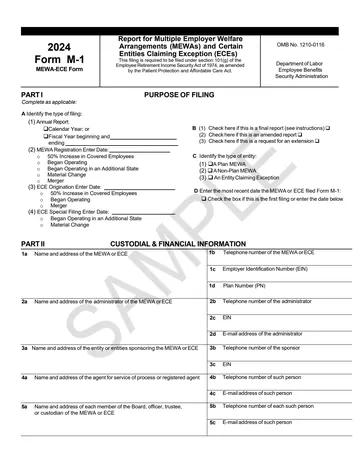
The Form M-1 reports on a MEWA that provides medical care and on any ECE. A MEWA, for this form, is a plan or other arrangement that provides medical care to the employees of two or more employers (including self-employed individuals), other than one maintained under agreements the Secretary finds to be collective bargaining agreements or by a rural electric or rural telephone cooperative. An ECE is an entity claiming it is not a MEWA because it is maintained under such collective bargaining agreements.
Who must file: “The administrator of a MEWA must file this report regardless of whether the entity is a group health plan.” “The administrator of an ECE must file this report during the first three years after the ECE is originated.”
Who does not: reporting is never required if the MEWA or ECE is licensed or authorized as a health insurance issuer in every State where it provides medical coverage; covers only excepted benefits (a mix of excepted and other medical benefits must still file); is a group health plan not subject to ERISA, such as a governmental or church plan; or covers only such non-ERISA plans or individual market coverage. Three more situations do not make an entity a MEWA or ECE for filing: employers sharing a common control interest of at least 25 percent, a temporary arrangement from a merger or acquisition, and non-employees (such as independent contractors) of no more than one percent of covered employees.
| Item | Rule |
|---|---|
| Form year | 2024 Form M-1, the most recent version saved for this site. Registration and other event filings use the most recently updated Form M-1 available. |
| How filed | “You must file the Form M-1 electronically. You cannot file a paper Form M-1 by mail or other delivery service.” “The Form M-1 must be filed online using the M-1 Online Filing System.” |
| Where | The DOL's Form M-1 filing site at askebsa.dol.gov/mewa, not EFAST2 |
| Form 5500 too? | A plan MEWA also files a Form 5500, whatever its size or funding. Filing the Form M-1 does not satisfy the Form 5500 annual report requirement under ERISA section 104. |
| Penalty | Up to $1,992 a day under ERISA 502(c)(5) (2025 amount, 90 FR 1854; no 2026 adjustment, 91 FR 31358). The 2024 instructions print the earlier $1,942. |
The Form 5500 link runs both ways. Welfare plans subject to the M-1 requirement cannot use the small insured plan exemption in 29 CFR 2520.104-20. Every welfare plan answers Form 5500 line 11a, and a plan subject to Form M-1 checks Yes and enters a Form M-1 receipt confirmation code on line 11c. See Form 5500 for health and welfare plans and Form 5500.
When to file
The annual report “must be filed no later than March 1 following any calendar year for which a filing is required”, or the next business day if March 1 is a Saturday, Sunday or federal holiday. No annual report is required if, between October 1 and December 31, the MEWA or ECE has an origination, special filing or registration event and makes a timely filing for it.
| Filing | Who | Due |
|---|---|---|
| Annual report | Every MEWA; an ECE last originated within 3 years before the due date | March 1 after the calendar year |
| Registration: begins operating | MEWA | 30 days before the event |
| Registration: new State, merger, 50% growth in covered employees, material change | MEWA | Within 30 days of the event |
| Origination: begins operating | ECE | 30 days before the event |
| Origination: merger or 50% growth | ECE | Within 30 days of the event |
| Special filing: new State or material change | ECE, within 3 years of origination | Within 30 days of the event |
For a MEWA, the registration for beginning to operate is due 30 days before the event, and the other four registration events are due within 30 days after the event. The regulation defines operating broadly, as “any activity including but not limited to marketing, soliciting, providing, or offering to provide benefits consisting of medical care”, so marketing alone starts the clock.
Extension: “A one-time extension of time of 60 days to file will automatically be granted if the administrator of the MEWA or ECE requests an extension.” To request it, check box B(3), complete the rest of Part I, complete boxes 1a to 1d, 2a to 2d and 3a to 3c, sign electronically, and file the request no later than the normal due date.
The form, line by line
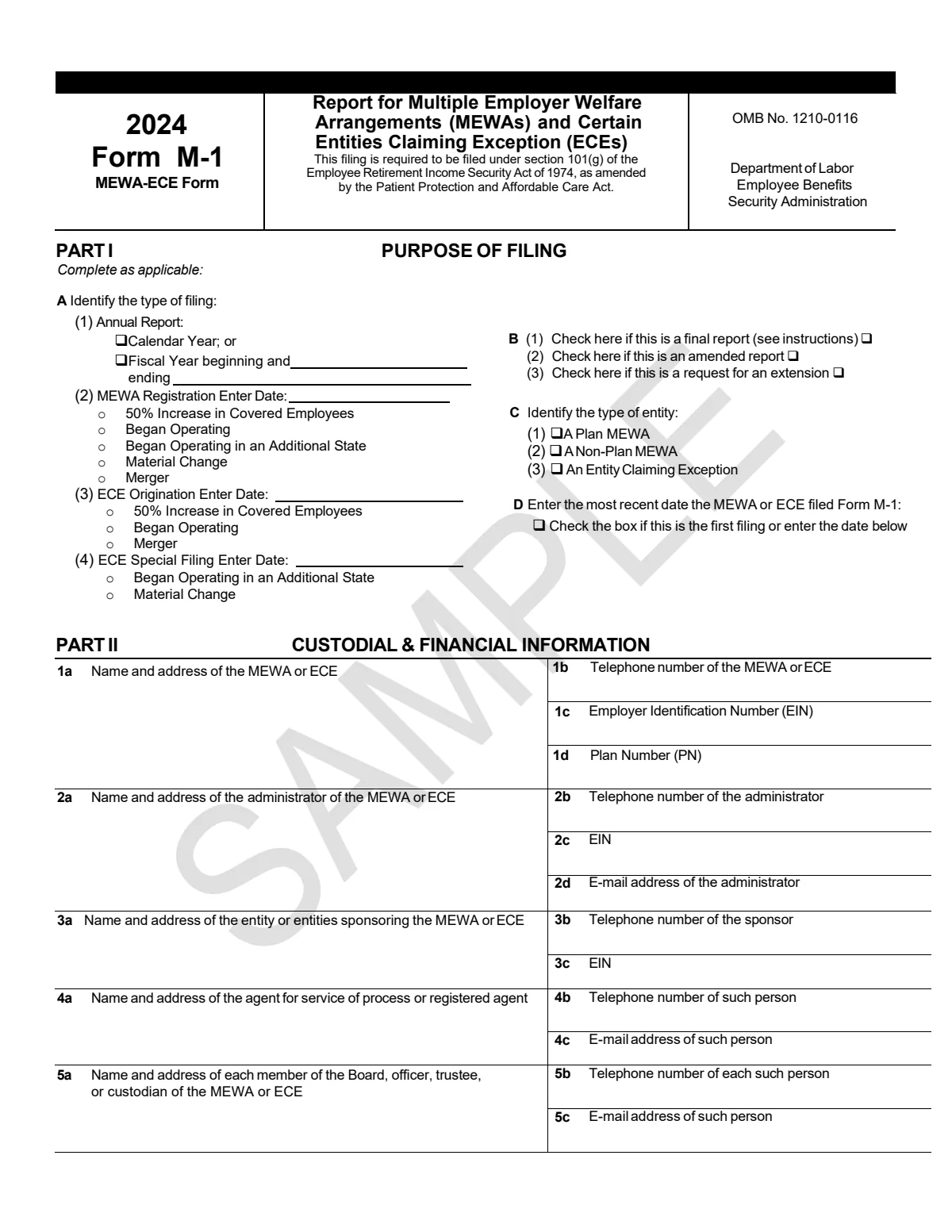
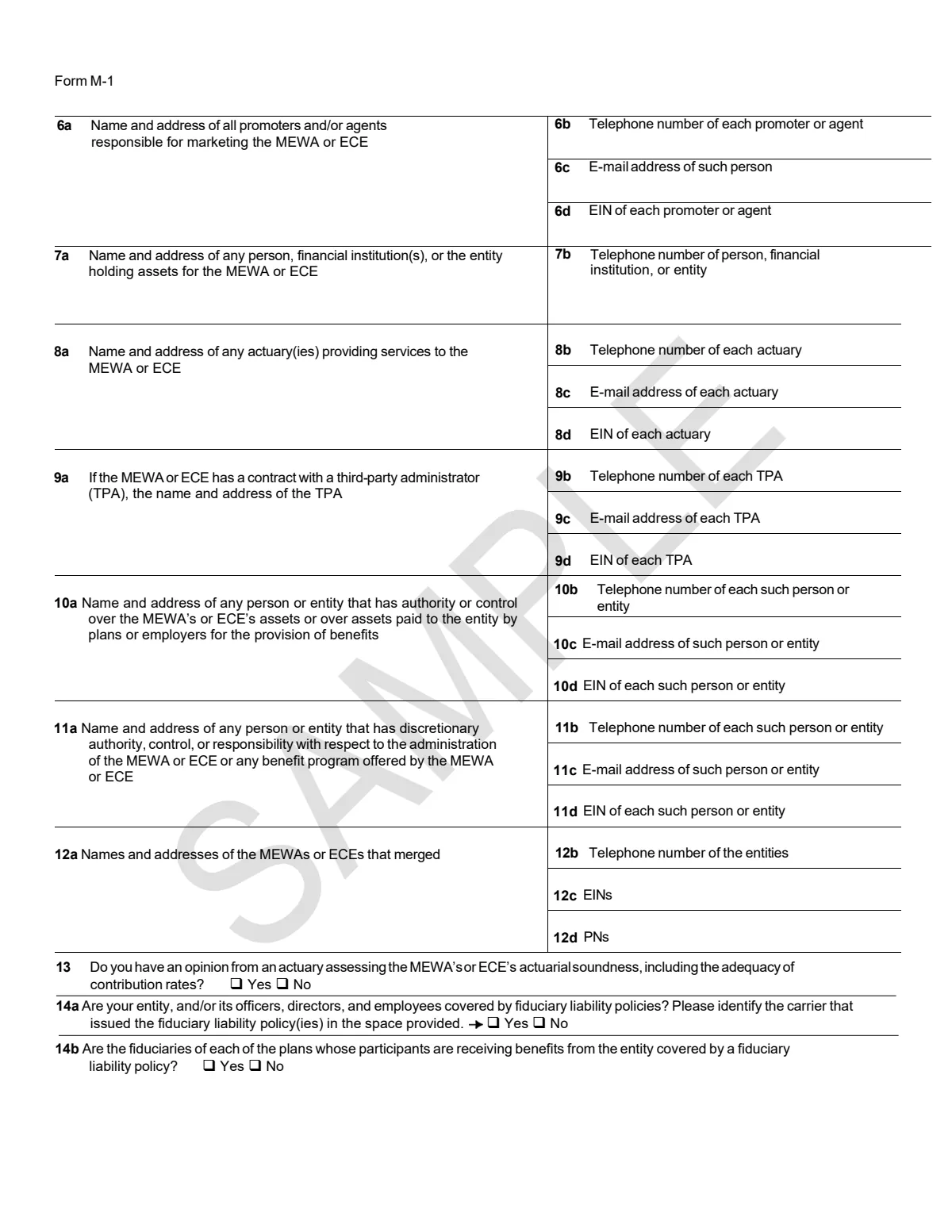
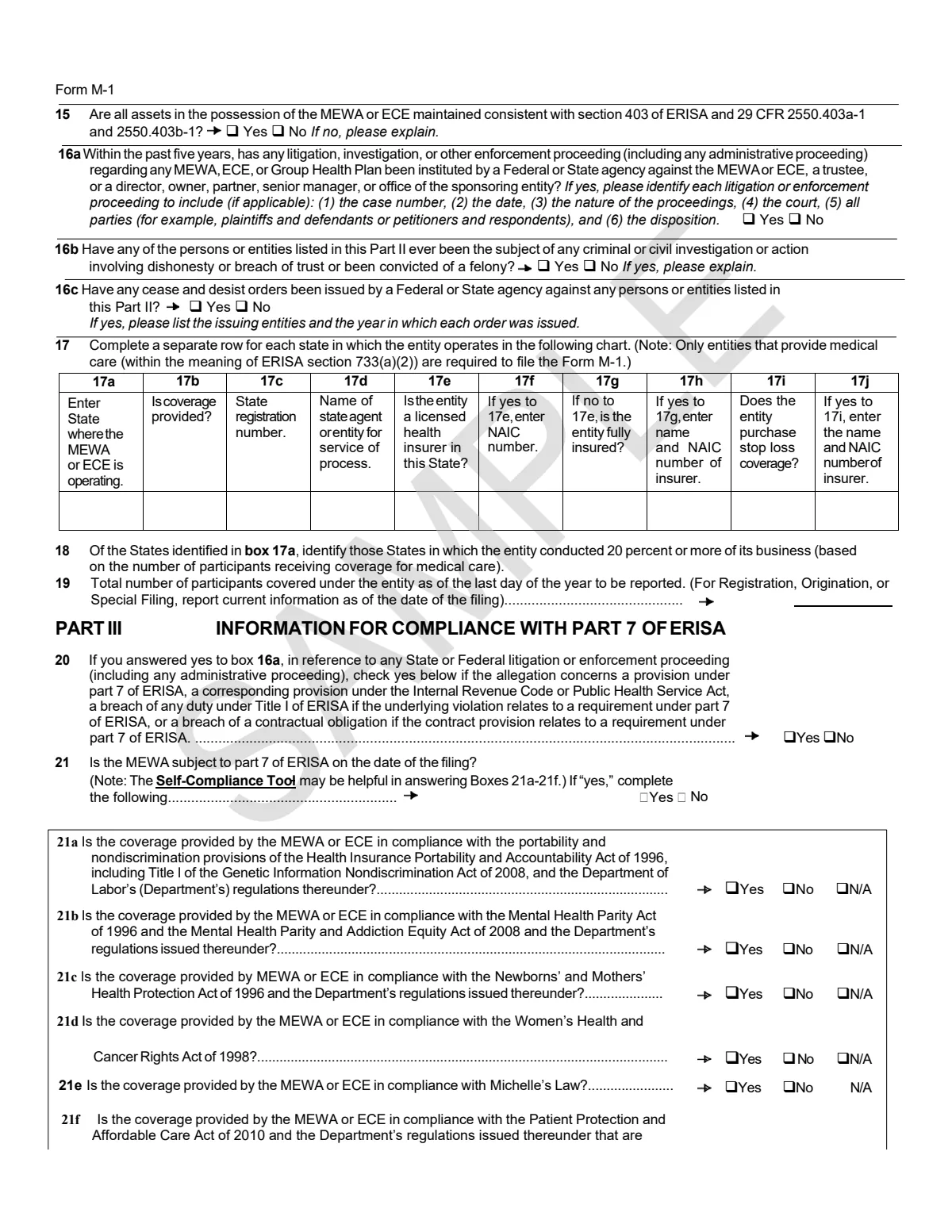
The DOL PDF is an 18-page package: a cover, a help page, the four form pages and the instructions. The figure shows only the form pages (PDF pages 3 to 6). Hover over or tap a box for the rule, and click to jump to the full note.
Swipe sideways to see the whole page, or pinch to zoom. Tap a box once for its note, again to jump to the line.
Part I: purpose of filing
| Line | Label | What goes there |
|---|---|---|
| A(1) | Annual report: calendar year or fiscal year | Check the box and say whether calendar or fiscal year information is used. A fiscal year is allowed only if it ends within the calendar year reported and six continuous months of it fall in that calendar year. “Whether you report using the calendar or fiscal year, you must use the 2024 version of Form M-1.” |
| A(2) | MEWA registration and date | Check each reason (50% increase in covered employees, began operating, began operating in an additional State, material change, merger) and enter the date of the event. For a 50% increase, the date is when growth reached that level or when the administrator learned of it. |
| A(3) | ECE origination and date | Check the event (50% increase, began operating, merger) and enter its date. |
| A(4) | ECE special filing and date | Began operating in an additional State, or a material change, within the three years after an origination. |
| B | Final report, amended report, or extension request | B(1): File a final report if the administrator does not intend to file a Form M-1 next year, for example after an ECE's third filing or when a MEWA stops operating. B(2): to correct errors or omissions in a filed Form M-1. B(3): to request the 60-day extension (see below). |
| C | Type of entity | A plan MEWA is a MEWA under ERISA section 3(40) that is also an employee welfare benefit plan under section 3(3). The instructions note that all plan MEWAs must also file the Form 5500, regardless of size or type of funding. |
| D | Most recent Form M-1 filing date | Enter the date of the most recent Form M-1 filing, or check the box for a first filing. |
Part II: custodial and financial information
For any entity or person reported in boxes 1a to 11a that also appears on the Form 5500 or its schedules, use the same name, EIN and other identifying information on both filings. In every EIN box after 1c, give the EIN of the person or entity named, never the MEWA's or ECE's own EIN.
| Line | Label | What goes there |
|---|---|---|
| 1 | 1a to 1d: name, address, phone, EIN and PN of the MEWA or ECE | Enter the EIN the MEWA or ECE uses with the DOL or IRS; leave 1c blank if it has none. For welfare plans and entities, the first PN is 501. List only numbers of the MEWA or ECE itself, not those of employers or plans buying coverage through it. Entities also on the Form 5500 use the same name, EIN and other identifying information on both filings. |
| 2 | 2a to 2d: administrator | The administrator is the person designated in the governing instrument; if none, the plan sponsor of a group health plan; if neither, the persons actually responsible for the cash or property, jointly and severally (29 CFR 2520.101-2(b)(1)). In 2c, use only an EIN of the administrator as a separate entity, not the MEWA's. |
| 3 | 3a to 3c: sponsor | The ERISA 3(16)(B) plan sponsor for a group health plan, or otherwise the entity that establishes or maintains the MEWA or ECE. Use the sponsor's own EIN. Leave blank if there is no sponsor. |
| 4 | 4a to 4c: agent for service of process or registered agent | The person appointed by the MEWA or ECE to receive legal notices for it. |
| 5 | 5a to 5c: board members, officers, trustees, custodians | Name, address, phone and email for each. Attach pages if needed; leave blank if there are none. |
| 6 | 6a to 6d: promoters and agents responsible for marketing | Include each promoter or agent's own EIN. Leave blank if none. |
| 7 | 7a and 7b: persons or institutions holding assets | Each person, financial institution or other entity holding assets for the MEWA or ECE. |
| 8 | 8a to 8d: actuaries | Each actuary providing services. The instructions say an actuary should be an associate or fellow of the Society of Actuaries and a member of the American Academy of Actuaries. Boxes 8a to 8c are mandatory if box 13 is Yes. |
| 9 | 9a to 9d: third-party administrators | Each TPA providing services, with the TPA's own EIN. Leave blank if none. |
| 10 | 10a to 10d: authority or control over assets | Each person or entity with authority or control of the MEWA's or ECE's assets, or of assets paid in by plans or employers. |
| 11 | 11a to 11d: discretionary authority over administration | Each person or entity with discretionary authority, control or responsibility over administration of the MEWA or ECE or any benefit program it offers. |
| 12 | 12a to 12d: MEWAs or ECEs that merged | The entities that merged with the filer, with EINs and PNs. Skip to box 13 if there was no merger. |
| 13 | Opinion from an actuary on actuarial soundness | For this box, “only check “yes” if the opinion is in writing and current within the last year”. The instructions remind filers that the DOL can issue an ex parte cease and desist order against a MEWA that fails to set up a way to determine it is actuarially sound. |
| 14a | Fiduciary liability policies for the entity | Yes or No. If Yes, name the issuer in the space provided. |
| 14b | Fiduciary liability policies for participating plans | Yes or No. |
| 15 | Assets held under ERISA section 403 and 29 CFR 2550.403a-1 and 2550.403b-1 | Yes or No. If No, explain in the space or attach documents. |
| 16a | Litigation, investigation or enforcement in the past five years | If Yes, identify each proceeding with the six items the form lists. “For this purpose, include only audits and investigations that result in corrective action.” |
| 16b | Criminal or civil actions involving dishonesty or breach of trust, or felony convictions | If Yes, explain. |
| 16c | Cease and desist orders | If Yes, list the issuing entities and the year of each order. |
| 17 | 17a to 17j: State chart | Complete 17a first, then 17b to 17j for each State. In 17a, “list the State(s) where the employers (of the employees receiving coverage) are domiciled”. 17e asks whether the entity is a licensed health insurer there; 17f the NAIC number if so; 17g whether it is fully insured if not; 17h the insurer and NAIC number; 17i whether it buys stop-loss coverage (including reinsurance and excess loss insurance); 17j the stop-loss insurer. An annual report uses information as of the last day of the year reported. |
| 18 | States where the entity conducted 20 percent or more of its business | Measured by participants covered for medical care. In the instructions' example, a MEWA with 70, 30 and 200 participants in States X, Y and Z lists X (23 1/3 percent) and Z (66 2/3 percent), but not Y (10 percent). |
| 19 | Total participants covered | Count participants under 29 CFR 2510.3-3(d), including former employees on COBRA continuation coverage. Dependents are not counted. A child who is an alternate recipient under a QMCSO is not counted either. |
Part III: information for compliance with part 7 of ERISA
Part 7 of ERISA holds the group health rules: HIPAA portability and nondiscrimination, mental health parity, the Newborns' and Mothers' Health Protection Act, the Women's Health and Cancer Rights Act, GINA, the dependent student rule in section 714, the Affordable Care Act provisions and the No Surprises Act. Even a MEWA or ECE that is neither a group health plan nor an insurer must complete boxes 20 to 21f if it provides medical care through one or more group health plans. The DOL's Self-Compliance Tool may help with 21a to 21f.
| Line | Label | What goes there |
|---|---|---|
| 20 | Litigation concerning part 7 of ERISA | Check Yes if you answered Yes in box 16a and the proceeding related to a provision under part 7 of ERISA. |
| 21 | Is the MEWA subject to part 7 of ERISA on the date of filing? | A MEWA providing medical care, or an ECE providing medical care through group health plans, generally answers Yes and completes 21a to 21f. A MEWA or ECE not yet providing benefits should check No and go to the signature, and report part 7 compliance on its next annual filing. |
| 21a | HIPAA portability and nondiscrimination, including GINA Title I | ERISA sections 701 to 703. N/A only for a small health plan or an entity covering only small group health plans. |
| 21b | Mental health parity (MHPA and MHPAEA) | ERISA section 712. N/A allowed in five listed cases, including no mental health benefits alongside medical/surgical benefits, the small employer exemption, and the increased cost exemption. |
| 21c | Newborns' and Mothers' Health Protection Act | ERISA section 711. N/A if there are no benefits for hospital stays in connection with childbirth, or if State law governs that coverage in every State in box 17a. |
| 21d | Women's Health and Cancer Rights Act | ERISA section 713. N/A for a small health plan, an entity covering only small group health plans, or no medical/surgical benefits for a mastectomy. |
| 21e | ERISA section 714: dependent students on medically necessary leave | The form names the 2008 law that added section 714. N/A if the entity is a small health plan, covers only small group health plans, or does not cover dependents. |
| 21f | Affordable Care Act provisions under ERISA section 715 | N/A for a small health plan or an entity covering only small group health plans. |
Attachments and signature
| Line | Label | What goes there |
|---|---|---|
| Attach | Attachments | Extra pages are uploaded with the electronic filing using the Attachments tab. An extension request must be attached to the completed Form M-1 when it is filed. |
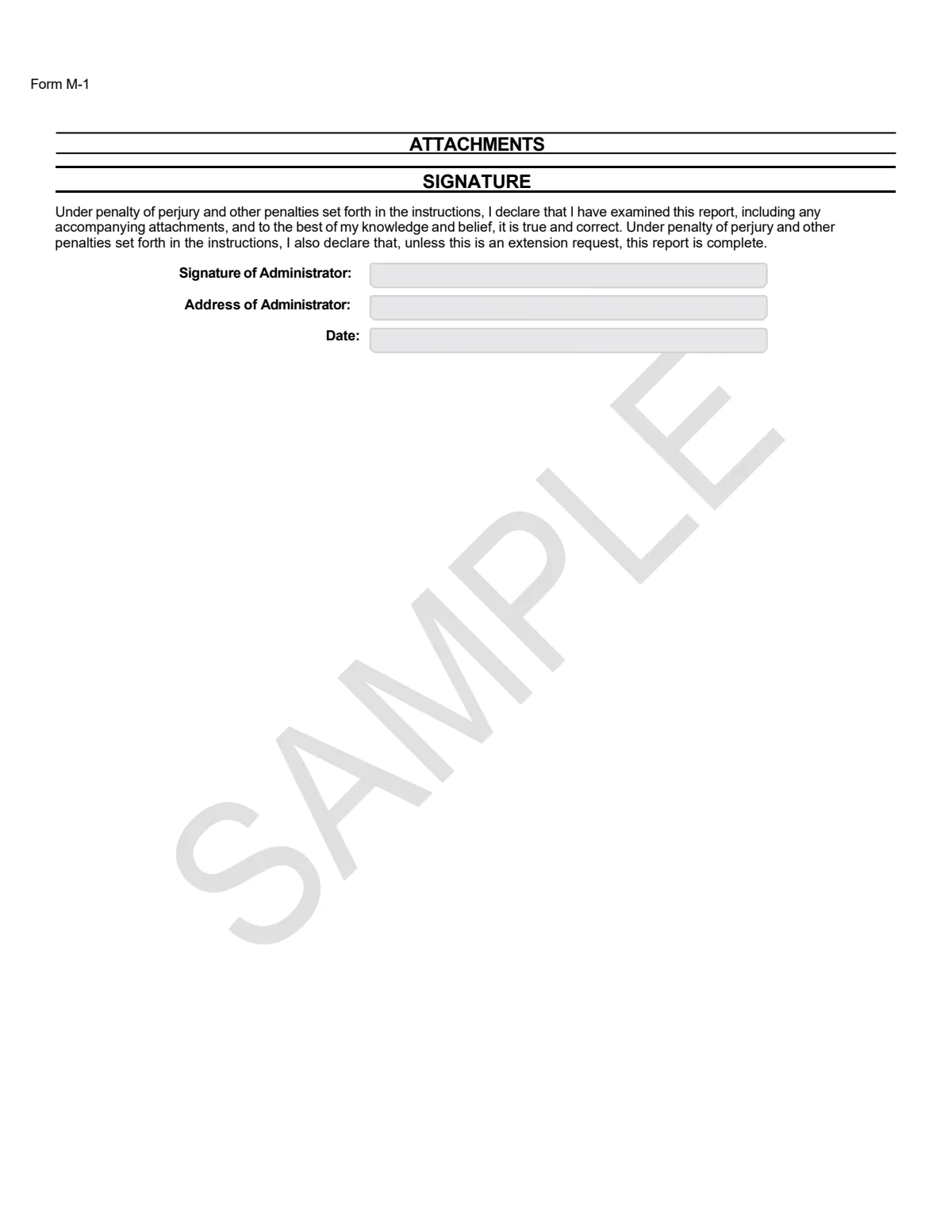
| Sign | Signature, address and date of administrator | The administrator, or for an entity administrator a person authorized to sign for it, signs electronically after registering as a signer for a User ID and password. If the administrator does not sign, the filing status shows an error. “A completed filing will generate a receipt confirmation code.” Keep the receipt and attachments with the records. |
Rules that matter
Material change
“If any of the custodial or financial information reported on Part II of this Form M-1 changes, such change is considered a material change”, and a MEWA must file within 30 days. An ECE files for a material change only during its three-year window, and the change does not restart that window.
Incomplete filings
The DOL may reject a filing it finds incomplete. Under the regulation, if a satisfactory revised filing is not submitted “within 45 days after the notice of rejection”, the DOL may bring a civil action, including penalties under ERISA 502(c)(5). Even an accepted filing may be reviewed later and found deficient.
Penalties and enforcement
The 2024 instructions print a maximum of $1,942 a day for penalties assessed after January 15, 2024, and warn that the amount is adjusted each year. The 2025 adjustment raised the ERISA 502(c)(5) maximum to $1,992 a day (90 FR 1854), and the DOL made no 2026 adjustment (91 FR 31358). ERISA section 521 also lets the Secretary issue an ex parte cease and desist order against a MEWA whose conduct is fraudulent or creates an immediate danger to the public, and a summary seizure order if a MEWA is in a financially hazardous condition. See Form 5500 penalties for the Form 5500 side.
Excepted benefits
Part 7 does not apply to excepted benefits, such as accident-only coverage, disability income, liability insurance, workers' compensation and on-site medical clinics, and, if conditions are met, limited scope dental and vision, long-term care, some specified disease or hospital indemnity coverage, and certain supplemental policies. A MEWA covering only excepted benefits does not file; one covering excepted and other medical benefits does.
Common mistakes
- Writing N/A where it is not allowed. “Do not enter “N/A” or “Not Applicable” on the Form M-1 unless specifically permitted.” Only boxes 21a to 21f permit N/A, and only in the listed cases.
- Leaving a Yes/No box blank, or checking both. Answer Yes or No, never both.
- Using the MEWA's EIN for the administrator, sponsor or vendors. Boxes 2c, 3c, 6d, 8d, 9d, 10d and 11d take that person's own EIN.
- A Social Security number in an EIN box, which can get the filing rejected.
- Checking Yes in box 13 for an oral or stale opinion, or checking Yes without completing boxes 8a to 8c.
- Listing States where employees live instead of where employers are domiciled in box 17a.
- Counting dependents in box 19.
- Assuming the Form 5500 covers it, or the reverse. A plan MEWA files both, and enters its M-1 receipt confirmation code on Form 5500 line 11c.
- Missing an event filing because the annual report is not due yet. Registration and origination deadlines run from the event.
Questions filers ask
Is Form M-1 filed through EFAST2?
No. It is filed electronically through the DOL's M-1 Online Filing System at askebsa.dol.gov/mewa. Paper filings are not accepted. The plan MEWA's Form 5500 goes through EFAST2 separately.
What year's form do I use?
The form shown here is the 2024 Form M-1, the most recent version saved for this site. The instructions say registration, origination and special filings use the most recently updated Form M-1 available, so check the filing site for the current version before you file.
Does a small insured health plan that is part of a MEWA file Form 5500?
Yes. Welfare plans required to file Form M-1 are not eligible for the 29 CFR 2520.104-20 exemption and must file the Form 5500 regardless of size or type of funding.
Can we get more time?
Yes, once: a 60-day extension is granted automatically if the administrator files the extension request (box B(3) and the listed boxes, signed) by the normal due date. Attach the request to the completed Form M-1.
An ECE was originated four years ago. Does it still file?
Not unless it was originated again. An ECE files during the three years after its last origination; a merger or a 50% increase in covered employees can be a new origination.
Who signs the Form M-1?
The administrator, or a person authorized to sign for an administrator that is an entity, electronically with a signer User ID and password.