At a glance
Schedule MEP reports information about multiple-employer pension plans (MEPs). “It consists of three parts.” All MEPs complete Parts I and II; only pooled employer plans complete Part III. Check the Schedule MEP box on Form 5500 Part II, line 10a(5).
| Question | Answer from the 2025 instructions |
|---|---|
| Who files | Any pension plan that checks the multiple-employer plan box in Part I of the Form 5500 or 5500-SF, including pooled employer plans, association retirement plans, PEO plans and defined benefit MEPs. |
| Who does not | Multiple-employer welfare plans: they attach a participating employer list instead. Plans whose employers are all in one controlled group or affiliated service group are not MEPs. |
| Attach to | Form 5500, or Form 5500-SF for a MEP that qualifies for the short form. A pooled employer plan cannot use the 5500-SF. |
| Due | With the return: the last day of the 7th month after the plan year ends, or the extended date. See Form 5500 due date. |
| How filed | Electronically through EFAST2 with the return. IRA-funded MEPs on limited reporting still file Schedule MEP. |
| Pages | 3: Parts I and II, Part II continued, Part III. |
Small MEPs can be on the short form. The 5500-SF instructions say “Multiple-employer pension plans using the Form 5500-SF must also file the Schedule MEP”, and the IFILE guide lists Schedule MEP among the schedules available for a 5500-SF. Pooled employer plans are the exception: “Multiemployer plans, pooled employer plans and DCG reporting arrangements cannot use the Form 5500-SF to satisfy their annual reporting obligations.”
Is it a MEP?
The Form 5500 instructions define a multiple-employer plan as one maintained by more than one employer that is not a multiemployer plan. “A single Form 5500 Annual Return/Report is filed for the multiple-employer plan; participating employers do not file individually for this type of plan.” Two definitions settle most cases:
- Pooled employer plans count: “A pooled employer plan as defined in ERISA section 3(43) operated by a "pooled plan provider" that meets the definition under ERISA section 3(44) is a multiple-employer plan.”
- Controlled groups do not: “Do not check this box if all of the employers maintaining the plan are members of the same controlled group or affiliated service group under Code sections 414(b), (c), or (m).” A DCG does not check the box either.
- Welfare MEPs are out of scope: multiple-employer welfare plans do not file Schedule MEP, but they attach a participating employer information list to the Form 5500.
The multiple-employer plan box covers more than 401(k) plans: the instructions say to check it for a multiple-employer plan “including a multiple-employer 403(b) plan”. For welfare plans, the participating employer list is an attachment labeled as Multiple-Employer Welfare Plan Participating Employer Information, with the plan name, EIN and plan number at the top. Element 3 of that attachment is a good faith estimate of each employer's percentage of total contributions, including employer and participant contributions, much like Schedule MEP line 2c.
The form, line by line
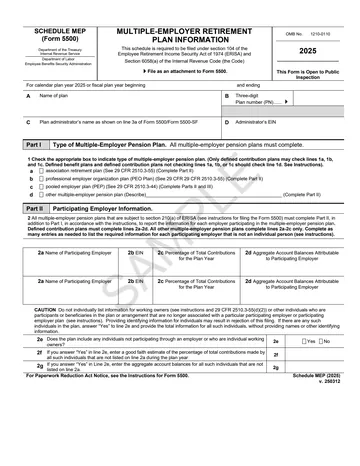
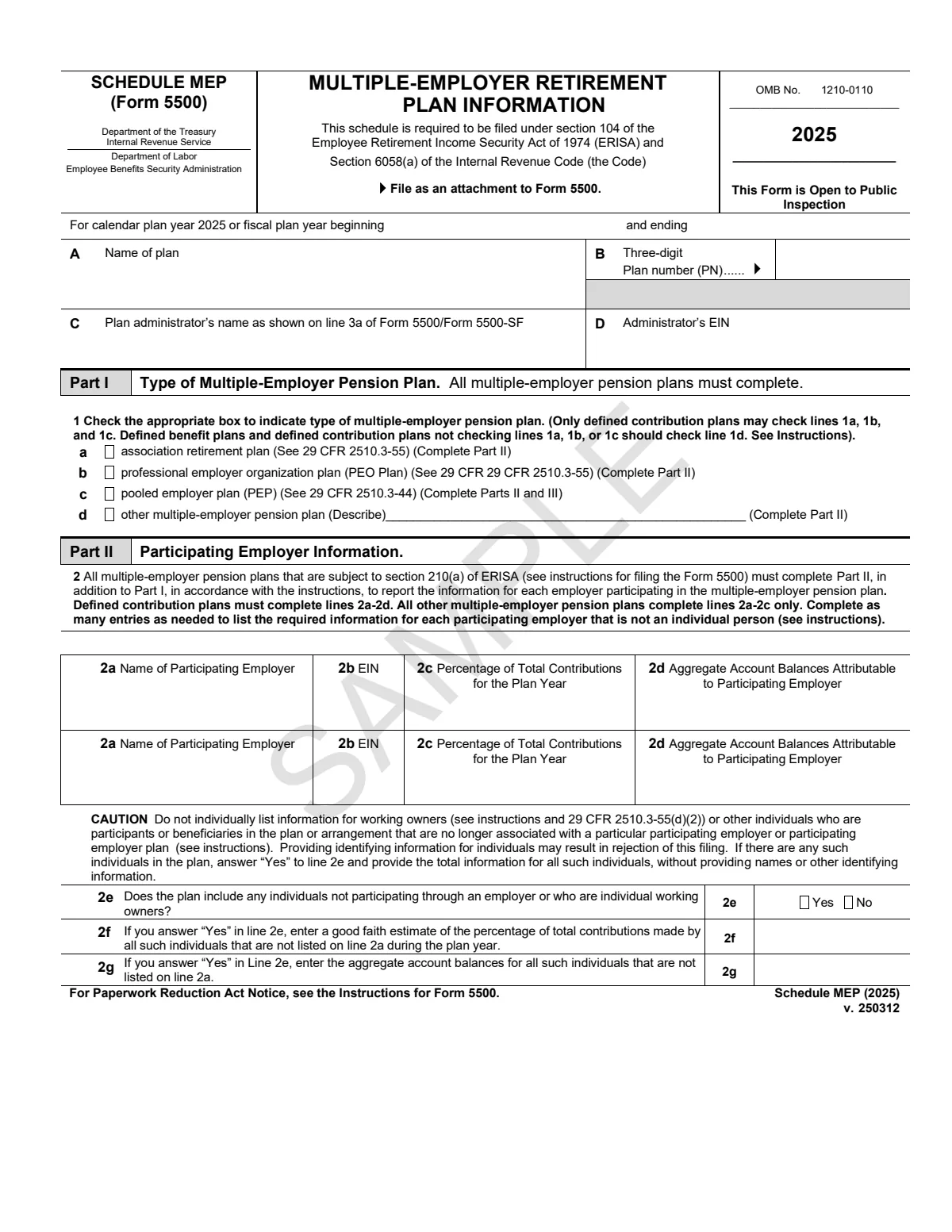
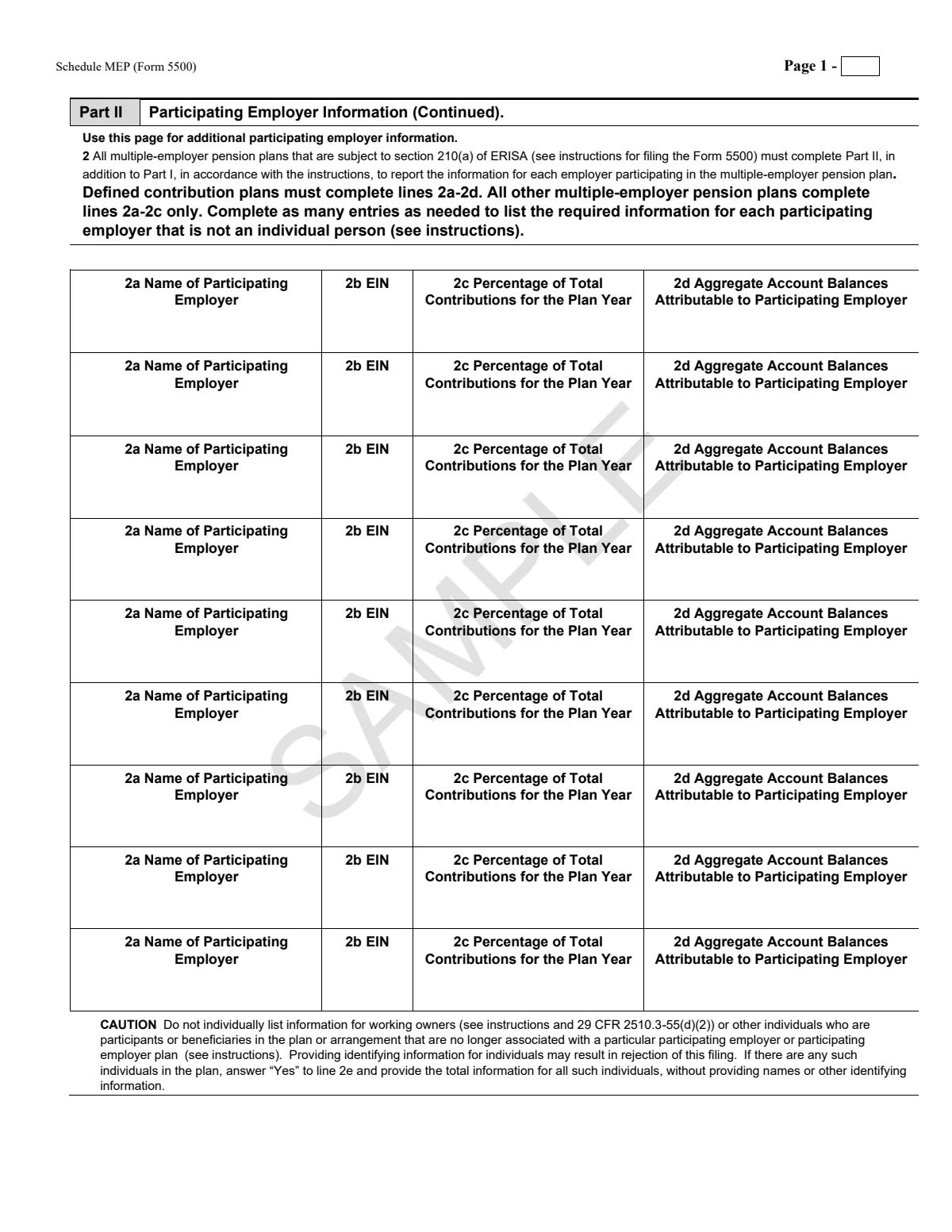
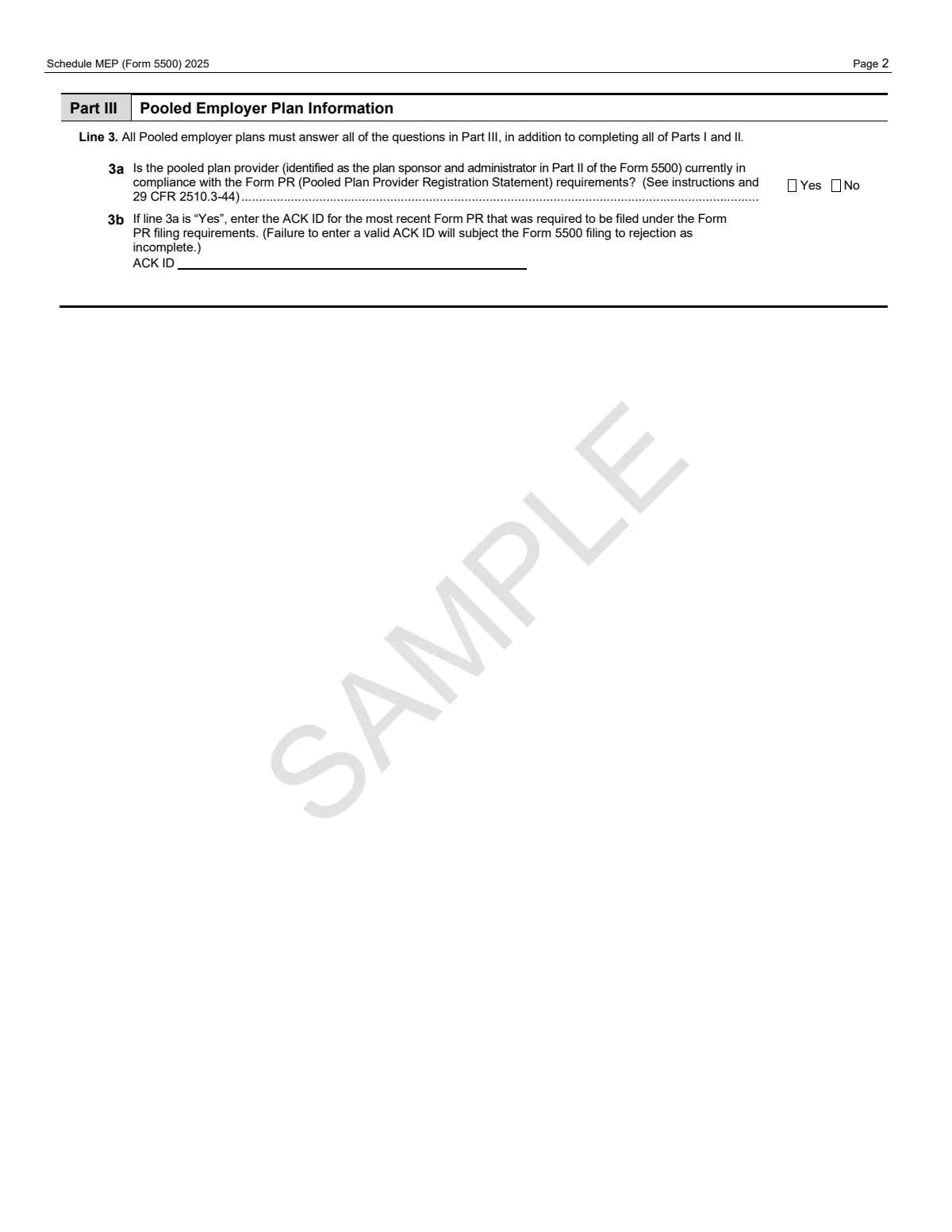
Page 1 holds Part I and the first two participating employer entries with lines 2e to 2g. Page 2 continues the employer list. Page 3 is Part III for pooled employer plans.
Swipe sideways to see the whole page, or pinch to zoom. Tap a box once for its note, again to jump to the line.
Part I: type of multiple-employer plan
Only defined contribution plans may check lines 1a, 1b and 1c. Defined benefit plans, and defined contribution plans that do not fit 1a to 1c, check line 1d.
| Line | Label | What goes there |
|---|---|---|
| A-D | Plan and administrator identification | Unlike most schedules, line C is the plan administrator, not the sponsor. For a pooled employer plan, “The pooled plan provider must be the same as the person identified as the plan sponsor and administrator in Part II of the Form 5500 and plan administrator on line C of Schedule MEP.” |
| 1a | Association retirement plan | Check exactly one of the four boxes. An association retirement plan's group or association has a substantial business purpose besides benefits, a formal structure, control by its employer members, a commonality of interest, and is not a financial services firm, among the conditions in the instructions. A defined benefit plan sponsored by a group or association of employers checks 1d instead. |
| 1b | PEO plan | The PEO performs substantial employment functions for client employers, has substantial control over the MEP as sponsor, administrator and named fiduciary, keeps plan obligations after a client leaves, and limits participation as the instructions describe. A defined benefit plan sponsored by a PEO checks 1d instead. |
| 1c | Pooled employer plan | A pooled plan provider is the plan's named fiduciary and administrator, acknowledges that status in writing, ensures bonding, and “registers as a pooled plan provider by filing a Form PR in accordance with 29 CFR 2510.3-44”. See Form PR. A plan established before January 1, 2021 is not a pooled employer plan unless the administrator elected that treatment. |
| 1d | Other multiple-employer pension plan | Examples in the instructions: a defined benefit MEP, or a collectively bargained multiple-employer pension plan that did not elect to be treated as a multiemployer plan. A MEP covered by PBGC must have made that election before September 27, 1981. |
Part II: participating employers
All MEPs report each participating employer that is not an individual person. Lines 2e to 2g report individuals and working owners as a group, never by name.
| Line | Label | What goes there |
|---|---|---|
| 2 | Participating employer information | All MEPs complete lines 2a to 2c; defined contribution MEPs also complete line 2d. Page 2 of the schedule continues the list. |
| 2a | Name of participating employer | Enter the name of each participating employer. Individuals participating on their own are covered by lines 2e to 2g instead. |
| 2b | EIN | The Schedule MEP is open to public inspection and may be published on the Internet, so an SSN or any part of one on the schedule may result in rejection of the filing. |
| 2c | Percentage of total contributions | An employer that was obligated to contribute, did contribute, or had employees covered for the year is a participating employer. “If a participating employer made no contributions for the plan year (including participant contributions), enter” -0-. |
| 2d | Aggregate account balances | Use the same end-of-year valuation as the plan's schedule of assets. Round to the nearest dollar, consistent with other asset reporting. |
| Caution | Do not list individuals | The form warns: “Providing identifying information for individuals may result in rejection of this filing.” |
| 2e | Individuals or working owners? | A working owner has the meaning in 29 CFR 2510.3-55(d)(2). Do not identify these individuals on line 2a. |
| 2f | Their share of contributions | “The amounts listed in line 2c and line 2f must equal 100 percent (with a permitted variance of less than 1 percent due to rounding).” |
| 2g | Their account balances | Enter one total for all individuals not listed on line 2a. |
| II-cont | Part II continued | The EFAST2 guide says repeating blocks have no limit other than the filing size limit. The paper page shows nine more entries. |
Part III: pooled employer plans
All pooled employer plans answer every question in Part III, in addition to Parts I and II.
| Line | Label | What goes there |
|---|---|---|
| 3a | Form PR compliance | Pooled plan providers must comply with the Form PR registration requirements in 29 CFR 2510.3-44 to operate a pooled employer plan. |
| 3b | Form PR ACK ID | The ACK ID is the acknowledgment code EFAST2 generated when the Form PR was submitted. “Failure to enter a valid Receipt Confirmation Code (ACK ID) for the pooled plan provider's most recent Form PR will subject the Form 5500 filing to rejection as incomplete.” The provider keeps the electronic Form PR receipt with the plan records. |
Rules that matter
Match the Form PR. “All information for the pooled employer plan and the pooled plan provider operating the plan reported on the Form 5500, including Schedule MEP, must match the information reported on the Form PR.” The instructions warn that inconsistent identifying information could result in DOL or IRS correspondence.
Percentages add to 100. Lines 2c and 2f together equal 100 percent, with a variance of less than 1 percent for rounding. Line 2c is a good faith estimate that includes both employer and participant contributions.
Other schedules still apply. A defined benefit MEP also files Schedule SB, where line E shows whether it is funded as one plan (Multiple-B) or as separate plans for each employer (Multiple-A). A multiple-employer plan or pooled employer plan skips the permissive aggregation and 401(k) testing questions on Schedule R lines 21a and 21b.
IRA-based plans. An IRA-funded plan on limited reporting completes only Form 5500 Part I and Part II lines 1 to 4 and 8 (feature code 2N), and still files Schedule MEP if it is a multiple-employer plan, including a pooled employer plan.
Where it came from. The DOL fact sheet on the Form 5500 changes for plan years beginning on or after January 1, 2023 lists “Improved reporting by multiple-employer plans (MEPs), including pooled employer plans (PEPs).”
Common mistakes
- Leaving the line 3b ACK ID blank or entering one from an old Form PR. The filing is subject to rejection as incomplete.
- Listing working owners by name on line 2a. Report them only as totals on lines 2e to 2g.
- Entering an SSN for a sole proprietor employer on line 2b.
- Percentages on lines 2c and 2f that do not add to 100.
- Checking 1a or 1b for a defined benefit plan. Defined benefit MEPs check 1d.
- Naming a different person on line C than the pooled plan provider shown on the Form 5500 and Form PR.
Questions filers ask
Does a pooled employer plan file Schedule MEP?
Yes. It checks line 1c and completes Parts I, II and III, including the ACK ID of its pooled plan provider's most recent Form PR.
Can a MEP file Form 5500-SF?
A MEP that meets the 5500-SF conditions may, and it attaches Schedule MEP. Pooled employer plans cannot use the Form 5500-SF.
Do we list every participating employer?
Yes, every participating employer that is not an individual person, with its EIN and share of contributions, plus account balances for a defined contribution MEP.
What about a self-employed owner with no employees?
Do not list the person by name. Answer Yes on line 2e and include that owner in the totals on lines 2f and 2g.
Do participating employers file their own Form 5500?
No. A single Form 5500 is filed for the multiple-employer plan.